
📅 Last updated: 19.09.2026
The Roanoke Colony disappearance remains one of American history’s most enduring mysteries — and also one of its most misunderstood. In 1587, more than 100 English men, women, and children settled on Roanoke Island, off the coast of present-day North Carolina, hoping to establish England’s first permanent foothold in the New World. Three years later, when a supply ship finally returned, the colonists were gone. The only traces left behind were the letters “CRO” carved into a post and the word “CROATOAN” cut into a wooden palisade. For four centuries, that single word has fueled speculation about massacre, starvation, kidnapping, and assimilation. Today, however, a combination of archaeology, forensic science, and careful re-reading of 16th-century documents is producing new clues that point toward a far less dramatic — but historically richer — explanation.
- England's Ambitious Gamble in the New World
- Three Years of Silence: The Roanoke Colony Disappearance Begins
- What the Documents Actually Say: Rereading the Evidence
- Archaeology and Science: New Clues Emerge
- Why the Roanoke Colony Disappearance Still Matters
- The Legacy of the "Lost Colony"
- Conclusion: What the New Clues Tell Us
England’s Ambitious Gamble in the New World
To understand the Roanoke Colony disappearance, you have to understand why the English were there in the first place. By the 1580s, Spain had already built a vast empire in the Americas, extracting silver from Potosí and shipping treasure fleets across the Atlantic. England, under Queen Elizabeth I, was a rising but comparatively poor rival. Sir Walter Raleigh — a favorite of the queen and a veteran of Elizabethan court politics — saw an opportunity. In 1584, he obtained a royal charter to establish a colony in North America, hoping to create a base for privateering against Spanish shipping, a source of valuable commodities, and a strategic counterweight to Spain’s dominance.
Raleigh’s first attempt, in 1585, was a military-style expedition led by Sir Richard Grenville. About 100 men — soldiers, scientists, and artisans — landed on Roanoke Island, which had been scouted the previous year by Arthur Barlowe. The colony was plagued by poor planning. A drought that modern climate scientists have reconstructed from tree-ring data struck the region in 1587–1589, and relations with local Algonquian peoples, particularly the Secotan, deteriorated after the English burned a village in retaliation for a stolen silver cup. When Sir Francis Drake stopped at Roanoke in June 1586 on his way back from raiding the Caribbean, the demoralized survivors abandoned the settlement and sailed home with him. A small garrison left behind by Grenville vanished as well.
The 1587 Voyage and the “Lost” Colonists
The second attempt, in 1587, was different. This time Raleigh intended a genuine civilian settlement — families, not soldiers. John White, an artist who had served on the 1585 expedition and had produced invaluable watercolors of Algonquian life, was appointed governor. The group of about 115 colonists included White’s daughter Eleanor and her husband Ananias Dare. On August 18, 1587, Eleanor gave birth to a daughter, Virginia Dare — the first English child born in the Americas.
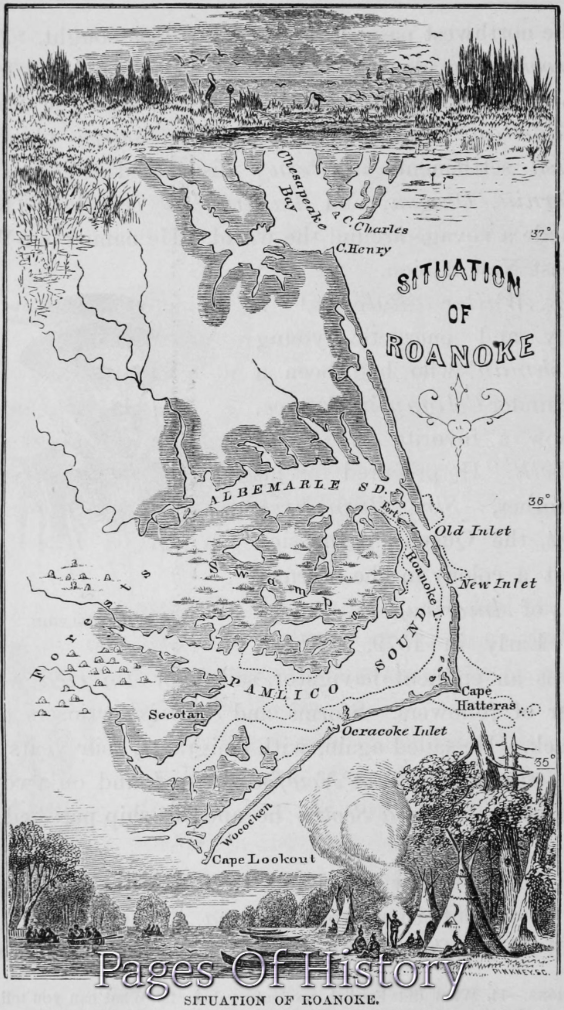
The colonists were supposed to settle in the Chesapeake Bay area, farther north, where the land was considered better and a deep-water harbor was available. But the ship’s captain, Simon Fernandes, refused to carry them further. He was eager to get to the Caribbean for privateering, and he dumped the colonists at Roanoke, where the abandoned buildings of the 1585 settlement still stood. This decision — driven by profit, not strategy — set the stage for everything that followed.
Relations with the local peoples were tense. The colonists had hoped to befriend the Croatoan, a smaller Algonquian group living on present-day Hatteras Island, whose leader Manteo had traveled to England in 1584 and returned as an ally. But the Secotan, led by Wingina’s successors, were hostile after the earlier violence. In late August 1587, the colonists persuaded John White to sail back to England for supplies. It was a fateful choice: White would not return for three years.
Three Years of Silence: The Roanoke Colony Disappearance Begins
White’s return voyage was a disaster. He reached England in November 1587, only to find the country mobilizing against the Spanish Armada. Every available ship was requisitioned for the defense of the realm. White managed to secure two small vessels in 1588, but their captains, more interested in plunder than in rescue, were captured by the Spanish and White was forced back to England. It was not until August 1590 — three years after he had left — that White finally returned to Roanoke Island, aboard a privateering ship commanded by Abraham Cocke.
What he found has haunted historians ever since. The settlement was dismantled, not destroyed. The houses had been taken down, suggesting deliberate departure rather than sudden attack. White found the letters “CRO” carved into a post at the entrance to the abandoned fort, and the full word “CROATOAN” carved into a palisade. He also found a number of iron objects and heavy items buried in pits — things too heavy to carry, hidden for later retrieval. White had instructed the colonists before he left that if they moved, they should carve their destination in a tree, and if they were in distress, they should carve a cross above the name. There was no cross.
White interpreted the message as a sign that the colonists had moved to Croatoan Island, about 50 miles south, to live with Manteo’s people. He was eager to sail there, but a storm blew his ship off course and he was forced to return to England. He never saw his daughter or granddaughter again. The Roanoke Colony disappearance became a permanent mystery.
What the Documents Actually Say: Rereading the Evidence
For centuries, popular accounts treated the colonists as victims of a single catastrophic event — a massacre by the Powhatan, a Spanish raid, or a starvation winter. But the documentary record tells a more complicated story. Several 17th-century sources, some of them written decades after the fact, describe English survivors living among Native peoples in the region.
The most important is a 1607 account by Captain John Smith, leader of the Jamestown colony. Smith wrote that when he questioned local Algonquians about the Roanoke colonists, he was told that some were alive and living with the Chesapeake, a group near the southern shore of the Chesapeake Bay. Smith even claimed that Powhatan showed him “a musket barrel and a brass mortar” that had belonged to the English. In 1608, Smith sent a party to search for survivors but found nothing conclusive.
Another key source is a 1612 treatise by William Strachey, secretary of the Jamestown colony. Strachey reported that the colonists had been “slain” by the Powhatan, but he also noted that some had intermarried with local peoples. A 1622 account by John Smith repeated the claim that the colonists had been killed, but by then the story had been simplified for political purposes — Jamestown needed to justify its own claims to the region.
“The people were determined to go to Croatoan, and there to remain with Manteo, who was their friend.” — John White, 1590
The word “CROATOAN” itself is crucial. It was not a distress signal. It was a destination. White had explicitly instructed the colonists to carve their intended location, and that is exactly what they did. The absence of a cross — the agreed-upon distress marker — strongly suggests the colonists left voluntarily and in reasonable order, not under immediate attack.
Archaeology and Science: New Clues Emerge
The most exciting recent developments have come from archaeology. Since 1998, the First Colony Foundation — a nonprofit research group — has been excavating sites on Roanoke Island and along the Albemarle Sound. In 2012, researchers working at a site on Hatteras Island (historically Croatoan) uncovered a small, 16th-century copper ring and other artifacts that may be associated with the colonists. In 2015, the foundation announced the discovery of a site at Bertie County, North Carolina — about 50 miles inland from Roanoke — where a patch of European-style pottery and a fragment of a slate board were found. The site, known as Site X, was identified after the foundation re-examined a “hidden” map drawn by John White himself.
The map — a watercolor of the Albemarle Sound region — contains a faint, almost invisible patch over what is now the Bertie County area. When examined under ultraviolet light, the patch revealed a symbol that may represent a fort. The foundation believes this could be the location of the “Chesapeake” settlement mentioned by John Smith — a group of Roanoke colonists who moved inland rather than south.
DNA analysis has also entered the picture. In 2019, researchers began collecting DNA from descendants of the Croatoan people and from English families with possible links to the colonists, hoping to find genetic matches. The work is slow and complicated by centuries of intermarriage, but it offers the possibility of confirming what oral histories have long claimed: that some Roanoke colonists survived and were absorbed into Native communities.
| Date | Event | Key Figure |
|---|---|---|
| 1584 | Raleigh’s first scouting expedition reaches Roanoke Island | Arthur Barlowe |
| 1585 | First colony established; abandoned in 1586 | Sir Richard Grenville |
| 1587 | Second colony arrives; Virginia Dare born August 18 | John White |
| 1590 | White returns; finds “CROATOAN” carved; colony gone | John White |
| 1607 | Jamestown founded; Smith hears reports of survivors | Captain John Smith |
| 2015 | Site X discovered in Bertie County, North Carolina | First Colony Foundation |
Why the Roanoke Colony Disappearance Still Matters
The fate of the Roanoke colonists is not just a historical curiosity. It matters for several reasons. First, it shaped the way England approached colonization. The failure at Roanoke made the English wary of isolated settlements and contributed to the more militarized, aggressive model used at Jamestown in 1607 and Plymouth in 1620. Second, it complicates the traditional narrative of European colonization as a simple story of conquest. The evidence suggests that the Roanoke colonists did not simply vanish or die — they adapted, moved, and in some cases integrated into Indigenous societies. That is a far more human story than the legend of a doomed outpost.
Third, the mystery has become a cultural touchstone. The word “Croatoan” has appeared in everything from Stephen King’s novels to the television series American Horror Story. It has become a symbol of the unknown, a reminder that history is not always neatly resolved. But the new clues — the carved word, the buried objects, the archaeological sites, the DNA research — are gradually replacing speculation with evidence.
Competing Theories and Their Problems
Several theories have been proposed to explain the Roanoke Colony disappearance. Each has strengths and weaknesses.
- Massacre by the Powhatan or Secotan: This was the most popular theory for centuries, supported by John Smith’s 1607 report. But it conflicts with the absence of a distress cross, the dismantled houses, and the buried objects. A massacre would likely have left bodies and destruction; none were found.
- Assimilation into Native communities: This is now the leading theory. The word “CROATOAN” points to a specific destination, and 17th-century reports describe English survivors living among local peoples. The Croatoan were allies, not enemies, and Manteo had lived in England.
- Starvation or disease: The 1587–1589 drought would have made farming difficult, and the colonists arrived too late to plant. But the dismantled settlement suggests they left deliberately, not that they died in place.
- Spanish raid: Spain had reasons to destroy an English colony, but Spanish records contain no mention of such an attack, and the colonists were not a significant military threat.
- Migration to the Chesapeake: John Smith’s report of survivors near the Chesapeake Bay, combined with the Site X discovery, suggests a group may have moved north. This could explain why some colonists were never found at Croatoan.
The most likely scenario is a combination: the main body of colonists moved south to Croatoan, where they were absorbed into the Croatoan and later Secotan communities, while a smaller group moved north toward the Chesapeake. Over time, their descendants intermarried, and their English identity faded. The “lost colony” was not lost — it was transformed.
The Legacy of the “Lost Colony”
The Roanoke Colony disappearance has had a lasting impact on American culture and history. It was the first major English attempt to settle North America, and its failure delayed English colonization by nearly two decades. It also created a template for later colonies: the importance of supply lines, the dangers of poor planning, and the necessity of good relations with Indigenous peoples. Jamestown and Plymouth both learned from Roanoke’s mistakes — sometimes successfully, sometimes not.
The mystery has also shaped how Americans think about their origins. The story of Virginia Dare, the first English child born in the New World, has become a symbol of innocence and loss. The word “Croatoan” has become a kind of American hieroglyph, a single word that carries centuries of speculation. And the ongoing archaeological work — the First Colony Foundation’s excavations, the DNA studies, the re-examination of John White’s maps — keeps the story alive, reminding us that history is not static.
What is most striking about the new clues is how they shift the narrative. The Roanoke colonists were not passive victims. They were active agents who made choices: to move, to adapt, to survive. They carved a word into a post because they wanted to be found. They buried their belongings because they intended to return. They may have failed as a colony, but they did not simply disappear.
Conclusion: What the New Clues Tell Us
The Roanoke Colony disappearance is no longer quite the impenetrable mystery it once seemed. The evidence — the carved word “CROATOAN,” the absence of a distress cross, the dismantled settlement, the buried objects, the 17th-century reports of survivors, and the recent archaeological discoveries at Hatteras and Bertie County — points toward a gradual dispersal rather than a sudden catastrophe. The colonists likely split into groups, moved to Croatoan and possibly the Chesapeake, and were absorbed into Indigenous communities. Their story is not one of vanishing but of transformation.
That does not mean the mystery is solved. Questions remain: How many colonists survived? Where exactly did they go? What happened to Virginia Dare? The DNA research may eventually provide answers, but it may also raise new questions. What is clear is that the Roanoke Colony disappearance was not a single event but a process — one that unfolded over years, shaped by drought, poor planning, political conflict, and the resilience of ordinary people caught in extraordinary circumstances.
For historians, the lesson is that mysteries are rarely as simple as they appear. The “Lost Colony” was never truly lost. It was scattered, absorbed, and remembered — and now, four centuries later, it is finally being understood.