
📅 Last updated: 16.09.2026
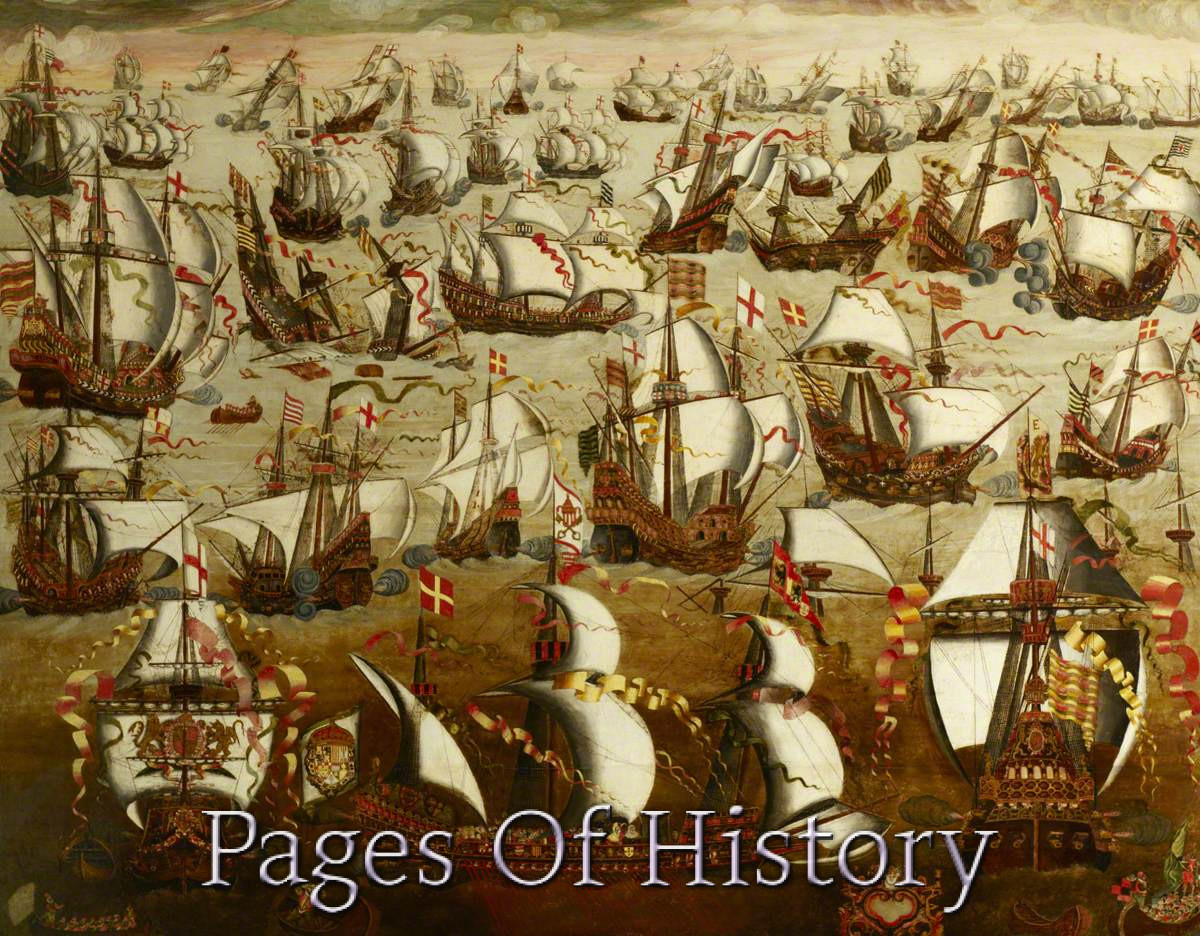
The Spanish Armada defeat of 1588 is one of history’s great turning points — and one of its most stubbornly misunderstood. For centuries it was told as a simple morality tale: plucky Protestant England, guided by God and Drake, humbled the mighty Catholic superpower of Spain. But the deeper historians dig into the archives, the more that story frays at the edges. The Armada was not destroyed in a single glorious sea battle; it was worn down by weather, logistics, disease, and a chain of command riddled with fatal ambiguities. This article re-examines what really happened in that extraordinary summer, and why the “defeat” was far more complex — and more consequential — than the legend allows.
- The Strategic Background: Two Rivals, One Crown, and a Slow-Burning War
- Building the Armada: A Floating City of 130 Ships
- Key Figures and Forces at a Glance
- The Spanish Armada Defeat Begins: The Channel Battles, July–August 1588
- The Battle of Gravelines: Gunpowder, Not Glory
- Why the Spanish Armada Defeat Was Really a Story of Weather and Logistics
- Command, Communication, and the Fatal Rendezvous Problem
- What the English Actually Won — and What They Didn't
- New Clues from the Wreck Sites and Archives
- Why the Legend Endures — and Why It Misleads
- The Lasting Takeaway
The Strategic Background: Two Rivals, One Crown, and a Slow-Burning War
To understand why Philip II of Spain launched the Armada at all, you have to look past religion to the cold arithmetic of power. By the 1580s, Spain governed the largest empire on Earth, stretching from the silver mines of Potosí to the Philippines — a domain so vast that contemporaries joked the sun never set on it. Philip ruled Spain, Portugal, much of Italy, the Low Countries, and the Americas. England, by contrast, was a small, cash-strapped island kingdom of perhaps four million people.
Yet England had become a persistent thorn. Since the 1560s, English privateers — most famously Francis Drake — had preyed on Spanish treasure fleets and colonial ports. Drake’s circumnavigation of 1577–1580 and his daring raid on Cádiz in 1587 (the “singeing of the King of Spain’s beard”) humiliated Philip and drained his treasury. Meanwhile, Elizabeth I’s England quietly funded Dutch rebels fighting Spanish rule in the Netherlands, and in 1585 she signed the Treaty of Nonsuch, formally committing troops to the Dutch cause. When Elizabeth’s parliament executed the Catholic Mary, Queen of Scots in February 1587, Philip lost any hope of a peaceful Catholic succession in England. The invasion was no sudden whim; it was the culmination of two decades of undeclared war.
Philip’s plan was audacious and, in theory, sound. A great fleet would sail from Lisbon up the English Channel, rendezvous with the Duke of Parma’s battle-hardened army in Flanders, and escort it across the narrow strait to Kent. From there, Parma’s veterans — the finest infantry in Europe — would march on London and depose Elizabeth. The critical word was rendezvous. Everything depended on the two forces meeting at exactly the right place and time, in a stretch of water the English could easily contest.
Building the Armada: A Floating City of 130 Ships
The fleet that assembled at Lisbon in the spring of 1588 was a logistical marvel. Commanded by Alonso Pérez de Guzmán, 7th Duke of Medina Sidonia — a conscientious administrator with little sea experience, appointed after the death of the more capable Álvaro de Bazán, Marquis of Santa Cruz — it numbered roughly 130 ships carrying some 19,000 soldiers and around 8,000 sailors. Alongside them sailed thousands of rowers, priests, and servants, plus siege artillery intended for the invasion of England.
Contrary to the old caricature of lumbering, obsolete galleons, the Armada was a modern and versatile force. It included purpose-built galleons, heavily armed Portuguese and Castilian warships, and fast pataches and zabras used for scouting. Its fighting doctrine, however, reflected Spanish preference for boarding actions: grapple an enemy ship, pour soldiers onto its deck, and win by sheer numbers. The English would exploit this difference ruthlessly.
Elizabeth’s navy was smaller — about 100 to 200 vessels of varying size, with perhaps 34 of the queen’s own ships — but tactically innovative. English galleons such as the Ark Royal and Revenge were longer, lower, and faster, built to sail close to the wind. Their crews were drilled to stand off and pound enemy hulls with long-range culverins rather than close and board. Commanded by Charles Howard, Lord Howard of Effingham, as Lord High Admiral, with Drake, John Hawkins, and Martin Frobisher as his principal captains, the English fleet was a leaner, more maneuverable instrument.
Key Figures and Forces at a Glance
The table below summarizes the opposing sides as they stood in July 1588 — a useful corrective to the idea that this was a mismatch of David against Goliath.
| Factor | Spanish Armada | English Fleet |
|---|---|---|
| Overall commander | Duke of Medina Sidonia | Lord Howard of Effingham |
| Ships (approx.) | 130 | 100–200 (34 royal) |
| Personnel | ~19,000 soldiers, ~8,000 sailors | ~16,000 sailors and soldiers |
| Preferred tactic | Boarding and close combat | Long-range gunnery |
| Primary objective | Escort Parma’s army to England | Prevent rendezvous and invasion |
The Spanish Armada Defeat Begins: The Channel Battles, July–August 1588
The Armada was first sighted off the Lizard in Cornwall on 19 July 1588. The English, using a chain of beacons and fast pinnaces, tracked its progress up the Channel. What followed was not one battle but a running series of engagements.
Plymouth and the Pursuit
On 21 July, the English caught the Armada near Plymouth and, aided by the wind, worked to windward — the “weather gauge,” the tactical high ground at sea. Over the following days, at Start Point (22 July), Portland Bill (23 July), and the Isle of Wight (24 July), English squadrons harried the Spanish rear and flanks. The Spanish formation, a tight crescent with the fighting galleons on the horns and the vulnerable transports in the center, proved hard to break. But the English guns outranged and outshot their opponents, doing damage without being boarded.
By late July, Medina Sidonia had anchored off Calais to await word from Parma. This was the decisive pause. Parma’s army, short of barges and blockaded by Dutch flyboats under Justin of Nassau, was not ready to embark — and never would be. The two halves of Philip’s plan were now dangerously out of sync, and the English could see it.
The Fire Ships at Calais
On the night of 28 July 1588, the English launched eight fire ships — stripped, tarred, and loaded with combustibles — into the crowded Spanish anchorage at Calais. Panic tore the Armada’s formation apart as captains cut cables and scattered to sea. This was the turning point. When dawn broke on 29 July, the Spanish fleet was disorganized and drifting, and the English closed for the decisive action.
The Battle of Gravelines: Gunpowder, Not Glory
Off Gravelines, near Dunkirk, the English finally brought the Armada to a general engagement. For roughly eight hours they raked the Spanish ships from close range, firing an estimated thousands of rounds. Spanish galleons such as the San Martín and San Mateo were mauled; several ships were lost or driven aground. Yet here is a crucial, often-overlooked fact: the English failed to sink or capture the bulk of the Armada. Their powder ran low, their shot was inferior in some cases, and the wind shifted to blow the Spanish northward. The English had won a tactical advantage, not an annihilation.
What actually doomed the Armada was what came next. With the Channel now blocked by contrary winds and the English fleet, Medina Sidonia could not return south. He chose — correctly, given his orders — to sail north around Scotland and Ireland and return home the long way. It was a voyage into catastrophe.
Why the Spanish Armada Defeat Was Really a Story of Weather and Logistics
The most important new understanding in modern scholarship is that the Spanish Armada defeat was less a battle loss than a logistical and environmental collapse. Historians such as Geoffrey Parker, Colin Martin, and the late Felipe Fernández-Armesto have shown that the fleet’s destruction owed more to storms, hunger, and disease than to English gunnery.
The Atlantic Storms
As the Armada rounded Scotland in August, it ran into the tail end of a violent Atlantic storm system. Ships were scattered, driven onto the rocky coasts of Ireland, and wrecked in appalling numbers. Of the roughly 130 ships that left Lisbon, only about 67 returned to Spain. Some 20 to 30 vessels were lost on the Irish coast alone — at places like Streedagh Strand in County Sligo and the coast of Antrim. Thousands of men drowned or were killed ashore by local authorities and English garrisons.
Hunger, Thirst, and Disease
Even the ships that survived were floating hospitals. The Armada had been provisioned for a short campaign, not a months-long voyage around the British Isles. Rations rotted; water casks leaked; dysentery and typhus swept the crews. When survivors limped into Spanish ports in September and October 1588, they were skeletal. Contemporary estimates suggest that of the roughly 27,000 men who sailed, only about 10,000 returned — a death toll comparable to that of a major land war.
“The most fortunate ships were those that were wrecked, for they at least ended the suffering of their crews.” — a sentiment echoed in Spanish accounts of the return voyage, where starving sailors begged for food on arrival.
Command, Communication, and the Fatal Rendezvous Problem
If the weather finished the Armada, poor coordination doomed it from the start. Philip II, working from the Escorial with maps and dispatches, issued detailed written orders that assumed a level of communication that simply did not exist in the age of sail. The plan required Medina Sidonia and Parma to coordinate a rendezvous in the narrow seas — but the two commanders had no reliable way to speak to each other in real time.
- The Parma problem: Parma’s army was never embarked. Dutch rebel flyboats patrolled the shallow coastal waters, and Parma lacked enough barges to move 30,000 men in one lift.
- The wind problem: The prevailing southwesterlies made it hard for the Armada to hold station off Calais while waiting.
- The command problem: Medina Sidonia, a landsman, deferred to his sailing masters but lacked the authority and experience to improvise. Philip’s rigid instructions left little room for initiative.
- The intelligence problem: The English, thanks to spies and fast scouting craft, knew the Armada’s movements almost in real time. The Spanish did not.
This asymmetry — English flexibility against Spanish centralization — mattered more than any single cannon shot. It is one of the clearest lessons of the campaign.
What the English Actually Won — and What They Didn’t
It is worth being precise about the outcome, because the Spanish Armada defeat did not end the war. England and Spain remained in conflict until 1604, and Spain would launch further armadas in 1596 and 1597 (both scattered by storms). English counter-attacks, such as Drake and Norris’s expedition to Portugal in 1589, were themselves failures. The war drained both treasuries.
What the Armada did accomplish was psychological and strategic. It preserved Elizabeth’s regime, kept England Protestant, and gave the English navy a lasting confidence and a template for its future dominance. It also exposed the limits of Spanish power: a global empire could not simply impose its will on a small, agile rival across the water.
The economic consequences rippled outward. Spain’s costly war effort, combined with the loss of ships and men, contributed to the fiscal strains that would culminate in the great bankruptcies of the 1590s. England, meanwhile, began to see the sea as its strategic frontier — a shift that would shape its empire for three centuries.
New Clues from the Wreck Sites and Archives
Some of the most exciting evidence has come from underwater archaeology. Since the 1960s, divers have recovered material from Armada wrecks off Ireland and Scotland — at Streedagh, Lacada Point (the Girona), and Fair Isle (the El Gran Grifón). These finds have revised the picture in several ways:
- They confirm that many ships were lost to storm and navigation error, not battle damage.
- They show the Armada carried a mix of high-quality and obsolete ordnance, undercutting the “inferior technology” myth.
- They reveal the personal possessions of ordinary sailors and soldiers — a human dimension the chronicles often omit.
In the archives, scholars have also re-read Spanish and Dutch documents to show that Parma’s failure to embark was not cowardice but a genuine operational impossibility. The “rendezvous” was never realistic given the weather, the Dutch blockade, and the lack of shallow-draft transports.
Why the Legend Endures — and Why It Misleads
The story of the Spanish Armada defeat was quickly turned into propaganda. Elizabeth’s government minted medals and commissioned plays; Protestant Europe celebrated divine deliverance. The “Protestant wind” became a byword for God’s favor. Over time, the nuance vanished: the Armada became a fleet of clumsy giants defeated by clever English sea dogs.
Modern history tells a messier, more interesting story. The Armada was a formidable, well-organized force undone by a plan that asked too much of wind, weather, and coordination. The English fought bravely and skillfully, but they did not destroy the fleet — the Atlantic did. The real lesson is about the fragility of grand strategy when it depends on perfect timing across vast distances.
The Lasting Takeaway
The Spanish Armada defeat was not a single battle but a slow, brutal unravelling — a collision of ambitious strategy, rigid command, and merciless nature. It ended Spanish hopes of conquering England, but it did not end the war, and it did not prove English invincibility. What it did prove is that in the age of sail, the sea itself was the most powerful adversary of all. For anyone studying world history, the Armada remains a masterclass in how logistics, weather, and human error can decide the fate of empires — and in why the simplest stories are often the least true.