
📅 Last updated: 15.09.2026
The Aztec Empire fall is one of history’s most startling collapses: a state of several million people, ruling the Valley of Mexico from the island city of Tenochtitlan, was brought down in under two years by an invading force that never numbered more than a few thousand fighting men. Between April 1519, when Hernán Cortés landed on the Gulf coast, and August 13, 1521, when the last Aztec emperor surrendered, the most powerful polity in Mesoamerica was destroyed. How did so few do so much? The short answer is that the conquistadors were rarely alone — and that the Aztecs were fighting far more than Spaniards.
- Tenochtitlan: The Empire the Spanish Walked Into
- Why the Aztec Empire Fall Began With a Legal Loophole
- The First Conquest Was Not of the Aztecs, but of Their Enemies
- The Tlaxcalans: The Alliance That Broke the Aztecs
- The Massacre at Cholula and the Road to Tenochtitlan
- La Noche Triste: The Escape That Nearly Ended the Conquest
- Smallpox: The Invisible Conquistador
- The Siege of Tenochtitlan: The Aztec Empire Fall Completed
- Why It Happened So Fast: Five Causes
- What the Aztecs Were Not: Myths and Misreadings
- The Aftermath: A New Empire on the Ruins
- Why the Aztec Empire Fell So Fast — and Why It Still Matters
Tenochtitlan: The Empire the Spanish Walked Into
When Cortés arrived, the Aztec (more precisely, Mexica) Empire was barely a century old. It had been forged in 1428, when Tenochtitlan allied with the city-states of Texcoco and Tlacopan to overthrow the dominant power of Azcapotzalco. That Triple Alliance became the engine of expansion, and by 1519 it extracted tribute from roughly 370 to 500 subject towns and provinces, stretching from the Pacific coast to the Gulf and south into what is now Guatemala.
Tenochtitlan itself was an engineering marvel. Built on an island in Lake Texcoco, it was connected to the mainland by three broad causeways, crisscrossed by canals, and supplied with fresh water by an aqueduct. Spanish eyewitnesses estimated its population between 150,000 and 200,000 — larger than any city in Spain, and comparable to the great urban centers of Europe and Asia. Bernal Díaz del Castillo, who marched with Cortés, recalled the moment the Spaniards first saw it from the mountains:
“We saw so many cities and villages built in the water and other great towns on dry land and that straight and level causeway going towards Mexico, we were amazed… I say that it seemed like the enchantments they tell of in the legend of Amadis.”
But the empire was also young, and its grip was uneven. Most conquered provinces were left in place, ruled indirectly, and required only to pay tribute and accept Aztec overlordship. That system generated enormous wealth — and enormous resentment. When a rival appeared, many of those provinces had a choice to make.
Why the Aztec Empire Fall Began With a Legal Loophole
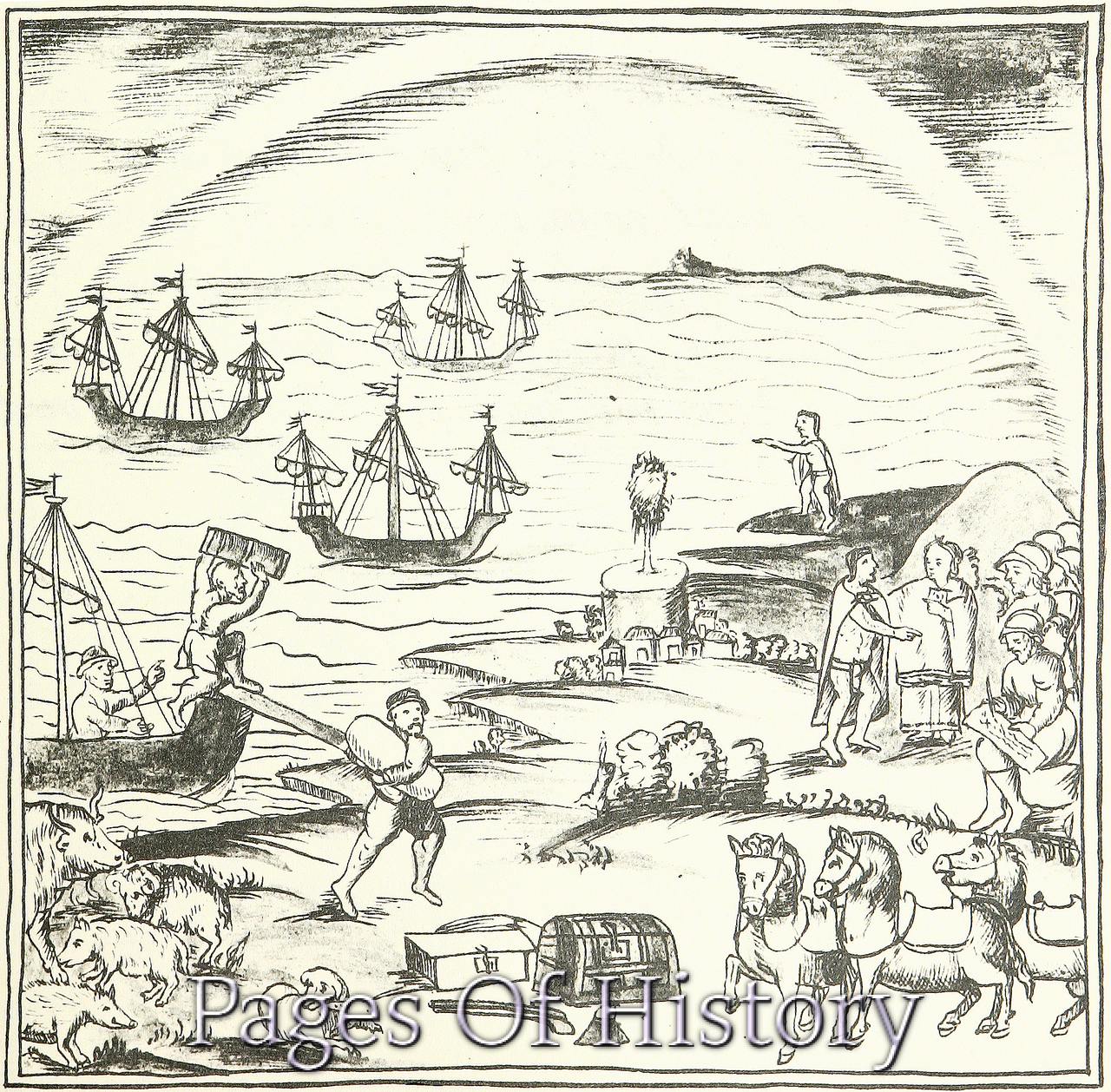
Cortés was not supposed to be there. In 1518, Diego Velázquez, governor of Cuba, appointed him to lead an expedition of exploration, then revoked the commission at the last moment. Cortés sailed anyway, on February 18, 1519, with roughly 500 men, 11 ships, and a handful of horses. He was, in effect, a mutineer — a fact that shaped everything that followed.
On the coast he founded the town of Villa Rica de la Vera Cruz, then resigned his authority and had the new town council appoint him captain-general. This legal theater made him answerable to the crown directly rather than to Velázquez. He also sent the crown a ship loaded with treasure — the famous “first letter” and its accompanying gifts — betting that gold would buy forgiveness. It worked.
That same spring, Cortés acquired two assets worth more than any cannon. The first was La Malinche (also called Doña Marina), a Nahua woman given to the Spaniards as a slave, who became Cortés’s interpreter and adviser. The second was Jerónimo de Aguilar, a Spaniard shipwrecked on the Yucatán coast in 1511 who had learned Mayan. Together they gave Cortés a chain of translation — Spanish to Mayan to Nahua — and, just as importantly, a guide to local politics.
The First Conquest Was Not of the Aztecs, but of Their Enemies
Cortés understood something the Aztecs did not: that the empire was a patchwork of conquered peoples with grievances. His strategy, from the start, was to recruit them.
In July 1519, he marched inland to Cempoala, a Totonac city on the coast that was chafing under Aztec tribute demands. Its leaders agreed to ally with him — and, crucially, to stop paying the empire. When Aztec tribute collectors arrived and demanded their due, Cortés had them arrested. That single act declared war.
He then ordered his fleet scuttled. Whether he burned the ships or sank them is debated, but the message was unambiguous: there was no going back. From that point, Cortés’s army was never purely Spanish. As he moved inland, he absorbed thousands of indigenous warriors, porters, and allies. By the final siege of Tenochtitlan, his forces included tens of thousands of Tlaxcalan, Texcocan, and other native troops — the Spanish were a small minority of the army that took the city.
The Tlaxcalans: The Alliance That Broke the Aztecs
The most important of these allies were the Tlaxcalans, a confederation of four city-states in the highlands east of the Valley of Mexico. They had resisted Aztec conquest for decades, and Aztec ritual warfare against them — the “Flowery Wars,” designed partly to take captives for sacrifice — had hardened the hostility.
Cortés fought the Tlaxcalans first. In September 1519, after several battles in which Spanish cavalry, steel weapons, and crossbows proved decisive against massed infantry, the Tlaxcalan leaders chose to ally with him rather than be destroyed. It was a calculated bet: they would help him break the empire that had bled them for generations, and they would do so with their own armies.
That alliance changed the arithmetic of the war. The Spanish brought technology, horses, and a willingness to kill in ways the Aztecs had not anticipated. The Tlaxcalans brought numbers, local knowledge, and a reason to fight that the Spaniards never had.
The Massacre at Cholula and the Road to Tenochtitlan
In October 1519, Cortés’s army entered Cholula, a major religious and commercial city that was nominally an Aztec ally. According to Spanish accounts, Cortés learned of a plot to ambush him — possibly encouraged by the Aztec emperor Moctezuma II. He struck first, killing thousands of unarmed nobles and commoners in the city’s central plaza and burning parts of the city.
The Cholula massacre is one of the most contested events of the conquest. Its scale is disputed; its effect is not. It announced that the Spaniards would not be managed, and it terrified and cowed many cities along the route. On November 8, 1519, Cortés and his army entered Tenochtitlan over the causeway from Iztapalapa. Moctezuma welcomed them and housed them in the palace of Axayácatl.
For six months, the Spaniards were guests — and hostages. Then, in April 1520, Cortés left to deal with a Spanish force sent from Cuba to arrest him. He defeated it at Cempoala and, crucially, absorbed its men and horses into his own. While he was away, his deputy, Pedro de Alvarado, ordered a massacre of Aztec nobles during a religious festival in the Templo Mayor. The city rose.
La Noche Triste: The Escape That Nearly Ended the Conquest
The uprising forced the Spaniards out. On the night of June 30, 1520 — remembered as La Noche Triste, the “Sad Night” — Cortés’s army tried to slip across the causeway west out of the city. They were seen. Aztec warriors attacked from canoes and from the causeways; the Spaniards, laden with gold, were cut down or dragged into the lake. Hundreds died, along with thousands of Tlaxcalan allies. Moctezuma, who had been captured and was now useless to both sides, died during the chaos — the accounts of his death differ, but the outcome was the same.
It was a catastrophe. Yet it was not the end. Cortés retreated to Tlaxcala, regrouped, and began a deliberate campaign of encirclement. He built thirteen brigantines — small warships — on the shores of Lake Texcoco, carried in pieces over the mountains, to control the water. He cut off the city’s supplies. And he waited for the allies to gather.
Smallpox: The Invisible Conquistador
While Cortés regrouped, a second and far more lethal invasion was underway. Smallpox had arrived in the Caribbean and, in 1520, reached Mexico — carried, most likely, by an infected African slave in the Spanish expedition that Cortés defeated at Cempoala. The disease swept through the Valley of Mexico, where the population had no immunity.
Among the dead was Cuitláhuac, Moctezuma’s brother and successor, who had led the resistance during La Noche Triste. He died in late 1520, and the throne passed to Cuauhtémoc, a young and determined leader. But the epidemic did not stop at the palace. It killed warriors, farmers, and nobles in vast numbers, weakening the empire’s capacity to fight, feed itself, and govern. Spanish chroniclers noticed that more Aztecs died of disease than of Spanish steel.
Smallpox was followed by other epidemics — measles in 1531, typhus in the 1540s, and more waves after that. Historians debate the exact pre-contact population of central Mexico (estimates range from roughly 6 million to over 20 million), but the collapse that followed was among the most severe demographic catastrophes in recorded history. By the end of the sixteenth century, the indigenous population of the region had fallen by as much as 80 to 90 percent.
The Siege of Tenochtitlan: The Aztec Empire Fall Completed
The final campaign began on May 26, 1521, when Cortés’s forces closed the causeways and launched the brigantines onto Lake Texcoco. The army numbered roughly 900 Spanish infantry and cavalry, plus tens of thousands of Tlaxcalan and other indigenous allies. Against them stood Cuauhtémoc and the defenders of Tenochtitlan and its sister city Tlatelolco.
The siege lasted nearly three months. The Aztecs fought street by street, canal by canal, using their knowledge of the city and their skill in waterborne combat. They captured Spaniards and sacrificed them on the pyramids within sight of the Spanish camp. But the defenders were starving, thirsty, and dying of disease. The aqueduct from Chapultepec was cut. The brigantines broke the canoe-borne supply lines. City by city, causeway by causeway, the ring tightened.
On August 13, 1521, Cuauhtémoc was captured while trying to escape across the lake in a canoe. The fighting ended. Tenochtitlan was in ruins — much of it destroyed in the house-to-house fighting and deliberately razed as the Spaniards took control. On the same site, Cortés began building Mexico City, the capital of New Spain.
Key Events of the Conquest
| Date | Event | Why It Mattered |
|---|---|---|
| April 1519 | Cortés lands near Veracruz | Begins the campaign; founds a town to claim independent authority |
| Sept. 1519 | Tlaxcalan alliance formed | Gives Cortés tens of thousands of native warriors |
| Nov. 8, 1519 | Spaniards enter Tenochtitlan | Moctezuma hosts them; they become hostages and guests |
| June 30, 1520 | La Noche Triste | Spanish expulsion; Moctezuma dies; conquest nearly fails |
| 1520–1521 | Smallpox epidemic | Kills Cuitláhuac and much of the population; cripples defense |
| Aug. 13, 1521 | Fall of Tenochtitlan | Cuauhtémoc captured; Aztec Empire fall is complete |
Why It Happened So Fast: Five Causes
The speed of the collapse was not the result of one factor but of several reinforcing ones. No single cause explains it; together, they made the empire’s fall not just possible but rapid.
- Indigenous alliances. The Spanish were a minority in their own army. Without Tlaxcalan, Texcocan, and other allies, Cortés could not have besieged or held Tenochtitlan. The empire’s tribute system had created the enemies who helped destroy it.
- Disease. Smallpox arrived at the worst possible moment for the Aztecs, killing the emperor and devastating the population. It undermined the empire’s ability to fight, feed itself, and organize resistance.
- Technology and tactics. Steel swords, armor, crossbows, firearms, horses, and war dogs gave the Spanish a battlefield advantage, especially in open combat. But technology alone was not decisive — the Aztecs adapted, avoided open battles, and fought effectively in cities and on water.
- Leadership and decision-making. Moctezuma’s initial hesitation — whether from religious awe, political calculation, or fear — allowed the Spaniards to enter the capital and take him hostage. Cuauhtémoc fought harder, but by then the empire was already fractured and diseased.
- The nature of the empire itself. The Aztec state was a tribute empire, not a unified nation. Its provinces owed goods and obedience, not loyalty. When the center weakened, many provinces switched sides or stood aside.
What the Aztecs Were Not: Myths and Misreadings
Popular accounts often reduce the conquest to a few dramatic images: horses, guns, and a handful of men against a primitive empire. The reality is more interesting and more uncomfortable.
The Aztecs were not technologically primitive. They built cities with sophisticated hydraulic engineering, ran a complex market economy, kept written records, and maintained a military that had subdued much of Mesoamerica. Their weapons — obsidian-edged macuahuitl swords, spears, bows, and slings — were lethal; Spanish armor was no guarantee of survival. What they lacked was immunity to Old World diseases and a unified political structure that could absorb defections.
Nor were the Spanish superhuman. Cortés’s first expedition was nearly destroyed at La Noche Triste. His men were often starving, sick, and on the edge of mutiny. He was nearly arrested by his own countrymen. He won because he was ruthless, adaptable, and — above all — able to turn the empire’s internal divisions into an army.
The Aftermath: A New Empire on the Ruins
The fall of Tenochtitlan did not end the conquest of Mexico. Campaigns continued for decades, and resistance persisted in the mountains and the north. But it ended the Aztec Empire as a political power. Cortés became governor of New Spain, though his authority was soon curbed by the crown. Cuauhtémoc, held captive and later executed in 1525 during an expedition to Honduras, became a symbol of resistance that Mexicans still honor.
The consequences were vast. Spain gained a source of silver and agricultural wealth that would reshape the global economy. Indigenous populations collapsed under disease and forced labor. A new society emerged, built on the ruins of the old, in which the descendants of the conquered and the conquerors would eventually forge a new national identity — one that still argues about what the conquest meant.
Why the Aztec Empire Fell So Fast — and Why It Still Matters
The Aztec Empire fall was fast because the empire was never as unified as it appeared. It was a coalition of conquered peoples held together by tribute, and when a credible challenger appeared, those peoples made their own choices. The Spanish did not defeat the Aztecs alone; they led an indigenous coalition, and they were helped by a devastating epidemic that arrived at precisely the right moment for them.
The lesson is not that 500 Spaniards were invincible. It is that empires are fragile when their subjects have more reason to leave than to stay — and that the most decisive weapons in 1521 were not steel or gunpowder, but alliances, timing, and disease. The Aztec Empire fell so fast because it was already under strain before Cortés ever stepped onto the causeway. He did not create the cracks. He found them, widened them, and marched through.