
📅 Last updated: 17.09.2026
The Christmas Truce 1914 remains one of the most enduring and romanticized episodes of the First World War: a spontaneous outbreak of peace along the Western Front during the first winter of a conflict that would eventually kill around 17 million people. Between Christmas Eve and New Year’s Day, soldiers of the British, French, Belgian, and German armies — men who had been trying to kill each other for five months — climbed out of their trenches, exchanged cigarettes and souvenirs, sang carols across no man’s land, and in a few places played informal games of football. The story has been retold in films, songs, and advertisements, often as a heartwarming fable about the human spirit triumphing over war. The reality is more complicated, more interesting, and more historically revealing than the legend.
- What Actually Happened: The Historical Record of the Christmas Truce 1914
- Why the Trenches Made a Truce Possible — and Thinkable
- The Military Context: Why the Generals Did Not Plan It
- A Timeline of the Christmas Truce 1914
- The Role of Religion and Shared Culture
- Why the Truce Did Not Last
- Myth, Memory, and the Legacy of the Christmas Truce
- What the Truce Reveals About the First World War
- The Christmas Truce 1914: A Conclusion
What Actually Happened: The Historical Record of the Christmas Truce 1914
The truce was neither universal nor centrally organized. It emerged in dozens of localized, unofficial agreements scattered along roughly two-thirds of the British-held sector of the Western Front, from the Belgian coast near Nieuport down through the Ypres salient and into northern France. It was not a single event but a patchwork of small ceasefires, each negotiated by the soldiers facing each other across a few dozen yards of mud.
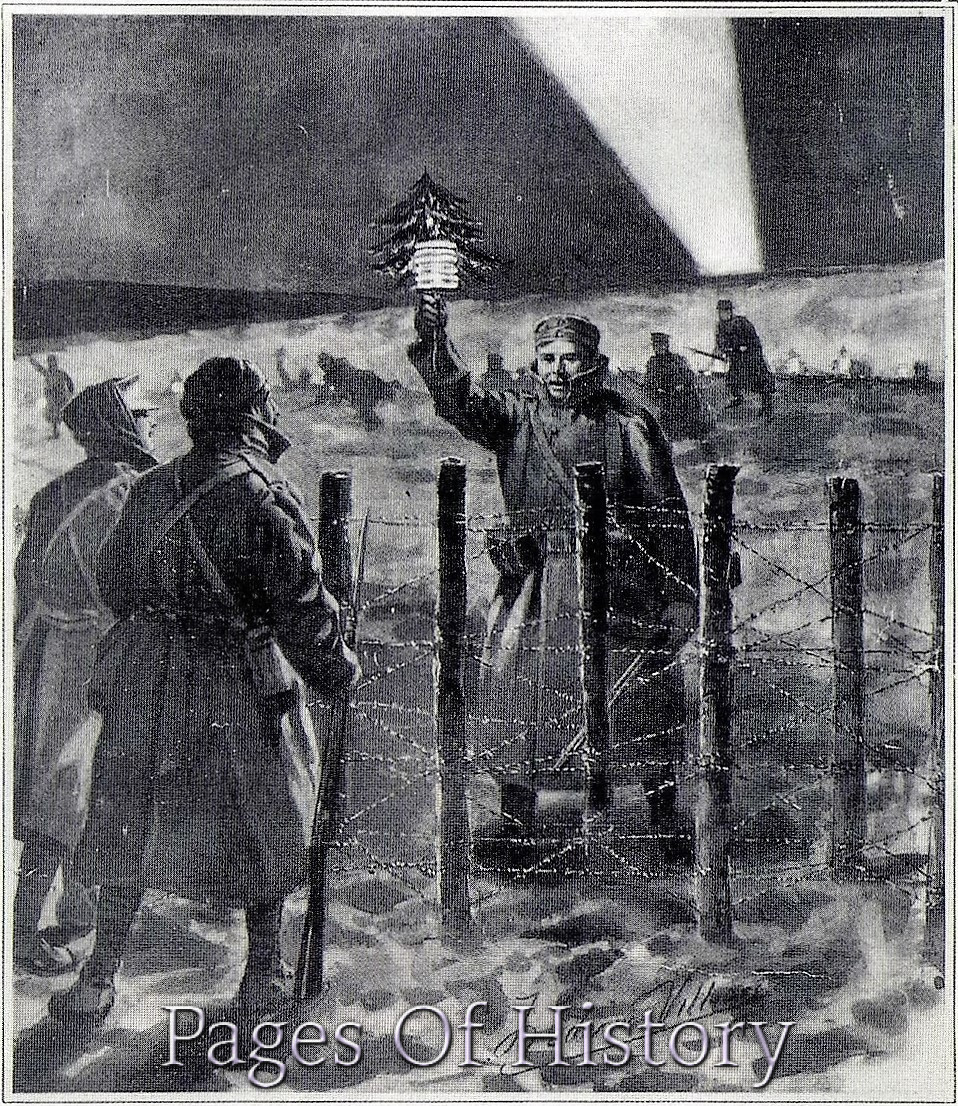
The first documented instances came on Christmas Eve, December 24, 1914. German troops in several sectors placed candles and small Christmas trees — Tannenbäume — on their parapets and began singing carols such as “Stille Nacht” (“Silent Night”). British soldiers, initially suspicious, responded with songs of their own. On Christmas morning, men from both sides climbed cautiously out of their trenches. In the sector near Ploegsteert Wood in Belgium — a place British troops nicknamed “Plugstreet” — soldiers met in no man’s land, shook hands, and exchanged gifts. Lieutenant Sir Edward Hulse of the Scots Guards recorded meeting a German officer who spoke excellent English and had lived in London; the two men exchanged addresses and promised to write after the war.
Captain Sir Edward Hulse’s letters home, preserved in the Imperial War Museum, describe the scene vividly: “We shook hands, wished each other a Merry Christmas, and were soon conversing as if we had known each other for years.” Similar accounts appear in the diaries of British rifleman Graham Williams, who described Germans rolling out a barrel of beer, and in the letters of German soldier Josef Sewald, who wrote of singing and smoking with “the English” in the days after Christmas.
The truce took many forms. In some sectors, it lasted only long enough to bury the dead who lay frozen in no man’s land — a practical necessity that both sides welcomed. In others, it lasted through New Year’s Day. Men exchanged tobacco, rum, tinned food, buttons, and hats. A few impromptu football matches were played, though the famous image of a full-scale “Christmas football match” is largely a later embellishment: most accounts describe kickabouts with a makeshift ball, and the scorelines quoted in newspapers were often invented. The Illustrated London News and other papers printed letters from the front describing the fraternization, which is partly why the story spread so quickly and became legendary.
Why the Trenches Made a Truce Possible — and Thinkable
To understand why the Christmas Truce 1914 happened at all, you have to understand the peculiar geography of trench warfare. By December 1914, the Western Front had settled into a static line of opposing trenches separated by no man’s land, sometimes as narrow as 30 yards and rarely more than 300. Opposing soldiers could hear each other cough, talk, and sing. They smelled the same cordite and rotting flesh. They endured the same freezing rain, the same rats, the same lice.
This proximity created a strange, involuntary intimacy. Soldiers developed a wary respect for their opponents and a shared understanding of the misery both sides endured. In quiet sectors, informal “live and let live” arrangements had already appeared before Christmas: troops would refrain from sniping during mealtimes, or fire artillery at predictable times to avoid causing casualties. The historian Tony Ashworth, in his study Trench Warfare 1914–1918: The Live and Let Live System, documented how these tacit truces were common on both sides and functioned as a rational survival strategy. The Christmas Truce was, in part, an extension of this existing culture of restraint.
There was also the timing. December 1914 marked the end of the first, mobile phase of the war. The German advance had been halted at the First Battle of the Marne (September 5–12, 1914) and then at the First Battle of Ypres (October 19 – November 22, 1914). Both sides were exhausted, depleted, and reeling from casualties that shocked even the generals. The British Expeditionary Force, a small professional army of around 100,000 men, had been shattered at Mons, Le Cateau, and Ypres. The Germans had lost hundreds of thousands. Neither side had planned for a long war, and neither was prepared for the winter stalemate.
Christmas itself mattered. For the German troops, many of whom had been mobilized from civilian life only months earlier, Christmas was a deeply emotional anchor to home. For the British, too, the holiday carried enormous cultural weight. The shared Christian calendar gave both sides a reason to pause — and, crucially, a shared language of ritual and song through which to communicate across the lines.
The Military Context: Why the Generals Did Not Plan It
It is essential to note that no high command ordered the truce. In fact, senior officers on both sides were alarmed by it. Field Marshal Sir John French, commander of the British Expeditionary Force, and General Joseph Joffre of the French army had no interest in fraternization. The German high command under Erich von Falkenhayn was equally hostile. When news of the truces reached headquarters, orders were issued forbidding any repetition.
The reasons were both military and psychological. Fraternization undermined the dehumanization that armies cultivate to make killing possible. If the enemy is a man who shares your cigarettes and your Christmas, he is harder to bayonet. Officers also feared that truces could be exploited for reconnaissance or surprise attacks — a legitimate concern, though in practice the 1914 truce was remarkably free of such treachery. There were isolated incidents of firing during the truce, and in some sectors the fighting continued without pause, but these were the exception.
The French and Belgian armies participated far less than the British. In part this was because much of the French front was in Alsace-Lorraine, where the war was fought with particular bitterness over lost territory. In part it was because the French and German armies had been fighting on French soil, with civilians caught in the middle; the emotional stakes were higher. Belgian troops, whose country had been invaded and occupied, were even less inclined to fraternize. The truce was thus predominantly a British-German phenomenon, concentrated in the sectors where the two armies faced each other directly.
A Timeline of the Christmas Truce 1914
The following table summarizes the key dates and developments of the truce, from the first signs of informal restraint to its suppression by military authorities.
| Date | Event | Location / Sector |
|---|---|---|
| November–December 1914 | Informal “live and let live” arrangements emerge in quiet sectors | Various points along the Western Front |
| December 24, 1914 | German troops place Christmas trees and candles on parapets; carols sung across no man’s land | Ploegsteert, Ypres salient, Neuve Chapelle |
| December 25, 1914 | Soldiers meet in no man’s land; exchange gifts, bury dead, hold informal kickabouts | Dozens of British-German sectors |
| December 26–31, 1914 | Truce continues in some sectors; elsewhere hostilities resume | Patchy across the front |
| January 1915 | High commands issue orders forbidding fraternization; truce largely suppressed | All sectors |
The Role of Religion and Shared Culture
One of the most underappreciated causes of the Christmas Truce 1914 was religion. Both the British and German armies were overwhelmingly Christian, and Christmas was the central festival of the year. German soldiers sang “Stille Nacht”; British soldiers responded with “The First Noel” and “O Come, All Ye Faithful.” The Latin hymn “Adeste Fideles” was known to both sides, and some accounts describe German and British troops singing it together in Latin — a language of the Church that transcended national borders.
Chaplains on both sides preached peace and goodwill, though many also preached patriotic duty. The tension between Christian universalism and national loyalty was real. Some soldiers saw the truce as a genuine expression of their faith; others saw it as a temporary lapse in the grim necessity of war. The German writer Erich Maria Remarque, in his novel All Quiet on the Western Front (1929), captured this ambivalence when he had a character reflect on how the enemy is “just a man like you” — a sentiment that the truce made concrete.
“We shook hands, wished each other a Merry Christmas, and were soon conversing as if we had known each other for years.” — Lieutenant Sir Edward Hulse, Scots Guards, December 1914
Why the Truce Did Not Last
The Christmas Truce 1914 was a brief flowering, not a turning point. By January 1915, it had been effectively suppressed. Several factors explain its failure to spread or endure.
- Command opposition: Senior officers on both sides issued explicit orders against fraternization, threatening courts-martial. The British Second Corps commander, Sir Horace Smith-Dorrien, issued a directive in December 1914 forbidding any communication with the enemy.
- Rotation of troops: Units were regularly rotated out of the front line, so the men who had fraternized were replaced by fresh troops who had no shared experience with the enemy opposite them.
- Escalation of violence: The introduction of poison gas at the Second Battle of Ypres (April 1915), the intensification of artillery bombardments, and the sheer accumulation of casualties made future truces far less likely.
- Propaganda and hatred: As the war dragged on, governments on both sides cultivated hatred of the enemy. Atrocity stories — some true, some exaggerated — made fraternization politically dangerous and emotionally harder.
- New weapons and tactics: Trench raids, sniping, and the use of machine guns and heavy artillery made the front line a more lethal and less intimate place. The conditions that had made the truce possible eroded.
There were smaller truces later in the war — around Easter 1915, for example — but nothing on the scale of December 1914. The window had closed.
Myth, Memory, and the Legacy of the Christmas Truce
The Christmas Truce 1914 has become a powerful cultural symbol, but its meaning has shifted over time. During the war itself, it was reported in newspapers as a heartwarming curiosity, then largely forgotten as the conflict’s horrors mounted. In the 1960s and 1970s, it was rediscovered by peace movements and anti-war campaigners, who saw in it proof that ordinary soldiers rejected the war imposed by their leaders. In the 1980s and 1990s, it became a staple of British popular culture, culminating in the 2005 film Joyeux Noël and the 2014 centenary commemorations.
Historians have pushed back against some of the more sentimental interpretations. The truce was not a mutiny or a mass refusal to fight; it was a temporary, localized pause, often driven by practical needs such as burying the dead. Many soldiers who participated returned to fighting with little apparent reluctance. The truce did not stop the war, and it did not represent a widespread desire for peace at any cost. What it did reveal, however, was the persistence of human connection even in the most dehumanizing conditions — and the power of shared culture, language, and ritual to bridge an otherwise unbridgeable divide.
The truce also had a darker side. In some sectors, the fraternization was followed by intensified fighting, as officers sought to reassert control and erase the memory of cooperation. And the truce was never universal: in many parts of the front, Christmas 1914 was marked by the same slaughter as any other day. Around 100,000 British and German soldiers are estimated to have taken part in some form of truce, but millions did not.
What the Truce Reveals About the First World War
The Christmas Truce 1914 matters less as a moment of peace than as a window into the nature of the war itself. It shows that the Western Front was not a monolithic killing machine but a complex human environment in which soldiers negotiated survival, boredom, and terror in ways their commanders did not always control. It shows that the enemy was not an abstraction but a man in a muddy uniform who missed his family and sang the same songs.
It also shows the limits of that humanity. The truce did not lead to peace because the structural forces driving the war — nationalism, imperial rivalry, alliance commitments, and the sheer momentum of mobilization — were far stronger than the goodwill of individual soldiers. The men who exchanged cigarettes in December 1914 went back to their trenches and, in many cases, killed each other in the months and years that followed. The truce was a pause, not a solution.
Yet the memory of the truce endures precisely because it captures something true about war: that even in the midst of industrial slaughter, people find ways to recognize each other. It is a reminder that history is not only made by generals and statesmen but by ordinary people making small, human choices in extraordinary circumstances.
The Christmas Truce 1914: A Conclusion
The Christmas Truce of 1914 happened because of a unique convergence of conditions: the static stalemate of the trenches, the shared Christian calendar, the exhaustion of the first winter, and the proximity that made the enemy visible and audible. It was not planned, not universal, and not lasting. It was suppressed by commanders who understood that fraternization threatened the discipline and hatred on which modern armies depend.
But it happened. Along dozens of miles of the Western Front, men who had been ordered to kill each other put down their rifles, climbed out of their trenches, and met in the mud of no man’s land. They exchanged gifts, buried their dead, and in some places kicked a ball around. The Christmas Truce 1914 did not end the First World War, and it did not prevent the horrors that followed. What it did was offer a fleeting, fragile proof that even in the worst of wars, the human capacity for recognition and kindness is not entirely extinguished. That is why we still remember it — and why it still troubles us.