
📅 Last updated: 01.10.2026
The Spanish Armada defeat of 1588 is one of history’s great turning points, yet it is also one of its most misunderstood. Ask most people why Philip II’s mighty fleet failed, and you will hear about a plucky English navy, Sir Francis Drake’s game of bowls, and a convenient “Protestant wind” that scattered the Spaniards. There is truth in each of these images, but none of them alone explains the outcome. The real story is a collision of strategic overreach, superior English seamanship and gunnery, brutal weather, and a fatal mismatch between Spanish plans and reality.
- Europe on a Knife's Edge: The Road to the Armada
- The Plan: A Fleet That Was Never Meant to Fight Alone
- Two Navies, Two Philosophies
- First Blood: The Fight Up the Channel
- Why the Spanish Armada Defeat Became Inevitable at Calais
- The Wind That Broke an Empire
- Was It Really the Weather? The Deeper Causes
- Aftermath: The Myth and the Meaning
- The Real Reason, in the End
Europe on a Knife’s Edge: The Road to the Armada
By the 1580s, Europe was split by a religious and political fault line that ran straight through the North Sea. On one side stood Catholic Spain, the wealthiest and most powerful state in Europe, ruled by Philip II from the grim palace of El Escorial. On the other stood Protestant England under Elizabeth I, a queen whom the Pope had declared illegitimate and whom Catholic Europe regarded as a heretic usurper.
The two crowns had been drifting toward war for two decades. Philip had once been married to Elizabeth’s sister, Mary I, and had hoped to keep England within the Catholic orbit. Instead, Elizabeth restored Protestantism, and England became the base of operations for privateers who plundered Spanish treasure fleets returning from the Americas. Drake’s audacious raid on Cádiz in 1587 — which he cheerfully called “singeing the King of Spain’s beard” — destroyed some 30 ships and vast quantities of supplies, delaying the Armada by a year.
Three events turned cold war into open conflict:
- The Dutch Revolt. Since 1568, the Protestant provinces of the Netherlands had been fighting Spanish rule. England quietly funded and supplied the rebels, and Spanish troops in Flanders under the Duke of Parma threatened to invade England by sea.
- The execution of Mary, Queen of Scots in February 1587. Mary, a Catholic with a strong claim to the English throne, had been the focus of plots to depose Elizabeth. Her death removed a rival — but also removed Philip’s last hope of a peaceful, Catholic succession.
- Papal blessing. Pope Sixtus V promised Philip a subsidy of a million ducats once Spanish troops landed in England, framing the expedition as a holy crusade.
Philip was not a warmonger by temperament; he was a cautious, methodical bureaucrat who agonized over decisions. But he believed God had called him to restore Catholicism in England. In 1588, he committed the largest fleet Europe had ever seen to that mission.
The Plan: A Fleet That Was Never Meant to Fight Alone
To understand why the Armada failed, you must first understand what it was supposed to do. The fleet was not designed to conquer England by itself. It was a floating bridge escort.
Philip’s strategy was a two-part pincer:
- The Armada, commanded by the Duke of Medina Sidonia, would sail from Lisbon to the English Channel.
- It would rendezvous with the Duke of Parma’s veteran army of roughly 30,000 troops in Flanders.
- The fleet would protect Parma’s barges as they crossed the narrow Strait of Dover, then land the army in Kent or Essex.
The plan had a fatal flaw baked into it from the start: the Armada could not enter the shallow, well-defended Flemish ports where Parma’s army waited. It had to anchor in deep water off Calais and wait for the army to come out to it. That meant the fleet would be stationary, exposed, and dependent on perfect coordination between two commanders who could barely communicate.
“If you are defeated, the King’s cause is lost; but if you succeed, you will be the instrument of God’s greatest work.” — attributed to Philip II’s instructions to Medina Sidonia, reflecting both the ambition and the pressure of the mission.
Two Navies, Two Philosophies
The Spanish Armada was a magnificent but old-fashioned instrument. Its ships were built for boarding actions — the traditional Mediterranean way of war. Spanish galleons carried large numbers of soldiers whose job was to grapple an enemy vessel, swarm aboard, and fight it out hand to hand. Their cannon were mostly short-range, designed to fire one devastating broadside before the boarding began.
The English navy had evolved differently. Its ships, including Drake’s famous Revenge and the Lord Admiral’s Ark Royal, were longer, lower, and faster. They carried more long-range culverins — cannon capable of firing a 17-pound iron shot over a mile — and fewer soldiers. English tactics emphasized speed, maneuverability, and standing off to pound the enemy from a distance rather than closing to board.
| Factor | Spanish Armada | English Fleet |
|---|---|---|
| Commanders | Duke of Medina Sidonia | Lord Howard of Effingham, with Drake, Hawkins, Frobisher |
| Number of ships | About 130 | About 200 (mostly smaller) |
| Primary tactic | Boarding and close combat | Long-range gunnery and maneuver |
| Guns (approx.) | 1,100, mostly short-range | 1,800, including many long-range culverins |
| Strategic goal | Escort Parma’s army across the Channel | Prevent invasion; harass and scatter |
The numbers look close, but the qualitative gap was decisive. English gunners could fire three shots to every one from a Spanish cannon, and they could do it from beyond boarding range. When the two fleets finally met, that difference would prove catastrophic for Spain.
First Blood: The Fight Up the Channel
The Armada left Lisbon on 28 May 1588 — but storms forced it into Corunna for repairs, and it did not truly get underway until 12 July. On 19 July, lookouts on the English coast spotted the fleet off the Lizard in Cornwall. The beacons were lit, and England’s militia prepared for invasion.
The English fleet, commanded by Charles Howard, Lord Effingham, with Drake as vice-admiral, shadowed the Armada as it sailed up the Channel in a tight, disciplined crescent formation. Medina Sidonia’s orders were explicit: avoid battle, reach the rendezvous, protect the fleet. So the Spanish resisted the temptation to chase the English ships, even as Drake snapped up stragglers.
On 21 July, the first major engagement took place off Plymouth. The English used their superior speed to “pluck the feathers” of the Armada — attacking the rear and edges of the formation, then pulling away before Spanish soldiers could board. The Spanish found their short-range guns almost useless. As one Spanish officer later wrote, the English “had the advantage of us in the length of their pieces.”
More skirmishes followed off Portland Bill (23 July) and the Isle of Wight (24 July). Each time, the pattern repeated: English ships darted in, fired, and withdrew; Spanish galleons lumbered after them, unable to close. The Armada lost a handful of ships and suffered significant casualties, but it kept its formation and pressed on toward Calais.
Why the Spanish Armada Defeat Became Inevitable at Calais
By the time the Armada anchored off Calais on 27 July 1588, the strategic situation had already turned against Spain. Medina Sidonia sent urgent messages to Parma, but Parma’s army was not ready. The barges needed to ferry 30,000 men across the Channel were not assembled. Parma’s troops were scattered in garrisons across the Netherlands, and the Dutch rebel fleet — the “Sea Beggars” — was blockading the ports. Parma could not simply march his men onto the beach and row out to the Armada.
Meanwhile, the English had a plan. At midnight on 28 July, they launched eight fire ships — old vessels packed with pitch, tar, and gunpowder — downwind toward the anchored Spanish fleet. The effect was pure panic. Spanish captains cut their cables and scattered into the night, desperate to avoid the burning hulks. The Armada’s tight crescent formation, its greatest defensive asset, disintegrated.
The next morning, 29 July, the English attacked the scattered Spanish ships off Gravelines, near Dunkirk. This was the decisive battle of the campaign. English ships rained long-range fire on the disorganized Spaniards, who could not board or effectively return fire. Several Spanish vessels were sunk or run aground; others were captured. The Armada was badly mauled and, crucially, could no longer protect Parma’s crossing. The invasion of England was dead in the water.
The Wind That Broke an Empire
What happened next was not an English victory — it was a Spanish catastrophe. The Armada, unable to return through the Channel (now blocked by the English fleet) and unable to anchor safely, was forced to sail north around Scotland and Ireland. It was a route no fleet of that size had attempted.
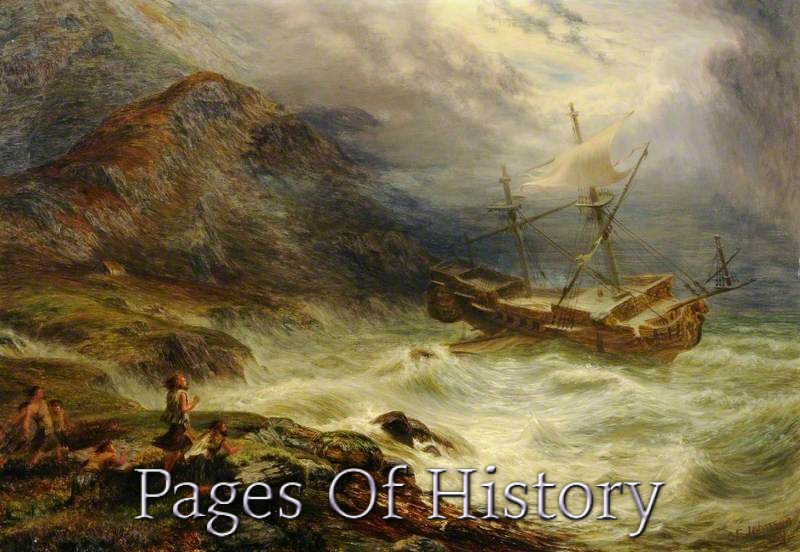
The weather turned monstrous. Storms — later romanticized as the “Protestant wind” — drove Spanish ships onto the rocky coasts of Scotland and Ireland. Shipwrecks littered the shores from the Hebrides to County Clare. Starving survivors who made it ashore were often killed by local authorities or English garrisons. Of the roughly 130 ships that set out, only about 67 limped back to Spain. Perhaps 15,000 men died from combat, disease, shipwreck, or execution.
Medina Sidonia himself survived the ordeal, though he was shattered by it. He wrote to Philip, “I am not fit for the sea, nor do I know how to serve Your Majesty in this.” Philip, reportedly, received the news with grim resignation: “I sent my ships to fight against men, not against the winds and waves of God.”
Was It Really the Weather? The Deeper Causes
The “Protestant wind” is the most famous explanation for the Spanish Armada defeat, but it is also the most misleading. Weather finished off a fleet that had already been beaten by strategy, technology, and logistics. To credit the storm alone is like blaming the final punch for a boxing match that was lost in the early rounds.
The real causes were structural:
- Strategic overreach. Philip tried to coordinate a fleet and an army across hundreds of miles of hostile water without reliable communication. The plan required perfect timing — and got none.
- Technological and tactical inferiority. Spanish guns were shorter-ranged; Spanish ships were slower; Spanish tactics were outdated. The English had learned from decades of privateering and had built a navy optimized for the Atlantic, not the Mediterranean.
- Logistical failure. The Armada carried enough food and water for a short campaign, not a long voyage around Britain. Once the Channel plan collapsed, the fleet had no way to resupply.
- Poor leadership at the top. Medina Sidonia was an experienced administrator but not a sailor. Philip’s insistence on micromanaging from Madrid — issuing detailed, inflexible orders — left his commander with little room to adapt.
- English seamanship. Drake, Hawkins, Frobisher, and Howard were not just captains; they were veterans of Atlantic exploration and piracy. They knew how to sail, fight, and survive in open water. Their crews were better fed, better paid, and more motivated.
It is also worth noting that the English did not win by sinking the Armada in a single grand battle. They won by attrition, harassment, and forcing the Spanish into a fatal position. The Armada was not destroyed; it was broken.
Aftermath: The Myth and the Meaning
News of the Armada’s fate electrified Europe. In England, Elizabeth I delivered her famous speech at Tilbury, declaring, “I know I have the body of a weak and feeble woman, but I have the heart and stomach of a king.” The victory was celebrated as a sign of divine favor — a Protestant nation saved from Catholic tyranny.
But the aftermath was more complex than the myth. England did not immediately become a global superpower. The war with Spain dragged on for another fifteen years. England’s own counter-armada in 1589 — the “English Armada” — was a humiliating failure. Spain remained rich and powerful for decades. The defeat of 1588 was a blow, not a knockout.
What the Spanish Armada defeat did do was shift the psychological balance of power. It proved that Spain could be beaten. It encouraged Protestant resistance across Europe. It gave England confidence to expand its navy and its overseas ambitions. And it became a founding story of English — later British — national identity.
For Spain, the Armada was a wound that never fully healed. Philip II’s treasury was drained, his reputation dented, and his hopes of restoring Catholicism in England dashed. The Dutch Revolt continued, and the Spanish Netherlands eventually slipped from Madrid’s grasp.
The Real Reason, in the End
Why did the Spanish Armada fail? Not because of a single storm, a single battle, or a single hero. It failed because Philip II attempted a mission that required flawless coordination, overwhelming firepower, and good luck — and he had none of the three. The English had the faster ships, the longer guns, the better sailors, and the strategic patience to avoid a decisive battle they might have lost. The Spanish had courage, discipline, and faith, but those qualities could not compensate for a plan that was, from the beginning, almost impossible to execute.
The Spanish Armada defeat of 1588 was not a miracle. It was the predictable result of sending a fleet built for one kind of war into another kind of war entirely. The winds and waves did the rest — but they only finished what English seamanship and Spanish overreach had already begun.