
📅 Last updated: 02.10.2026
The question of why the Spanish flu end is one of the most consequential puzzles in modern medical history. Between the spring of 1918 and the spring of 1920, a novel strain of influenza A (H1N1) swept across every inhabited continent, infecting roughly a third of the world’s population and killing somewhere between 50 and 100 million people — more than the combat deaths of both World Wars combined. And then, without a vaccine, without a cure, and with most of the world’s governments still reeling from the First World War, it simply faded away. Understanding how and why that happened requires looking past the myth of a single triumphant moment and into the messy, gradual, deeply human process by which a pandemic burns itself out.
- What Made This Influenza So Deadly
- The Three Waves and the Shape of the Decline
- Why Did the Spanish Flu End? The Role of Herd Immunity
- Public Health Measures and Their Impact
- The End of the War and the Decline of Transmission
- Why the Pandemic Ended Without a Vaccine — and What That Means
- Lessons and Legacy
- Conclusion: The Real Reason the Spanish Flu Ended
What Made This Influenza So Deadly
To understand how the pandemic ended, it helps to understand what made it so unusual. Influenza viruses had circulated among humans for centuries, producing the familiar seasonal “grippe” that killed the elderly and the frail. The 1918 strain was different in two alarming ways.
First, it was extraordinarily virulent. The virus triggered an overreaction of the immune system — what modern researchers call a cytokine storm — in which the body’s own defenses flooded the lungs with fluid and inflammatory proteins. This is why the 1918 flu killed so many young, healthy adults in their twenties and thirties, whose robust immune systems mounted the most violent response. A graph of mortality by age for 1918 famously forms a “W” shape: high death rates among the very young, the very old, and — uniquely — a towering spike in the prime of life.
Second, it appeared in multiple waves. The first, in the spring of 1918, was relatively mild. The second, beginning around August 1918, was catastrophic. A third wave followed in the winter and spring of 1919, and in some places a fourth in early 1920. Each wave behaved somewhat differently, and this wave structure is central to the story of how the pandemic ended.
The Role of the First World War
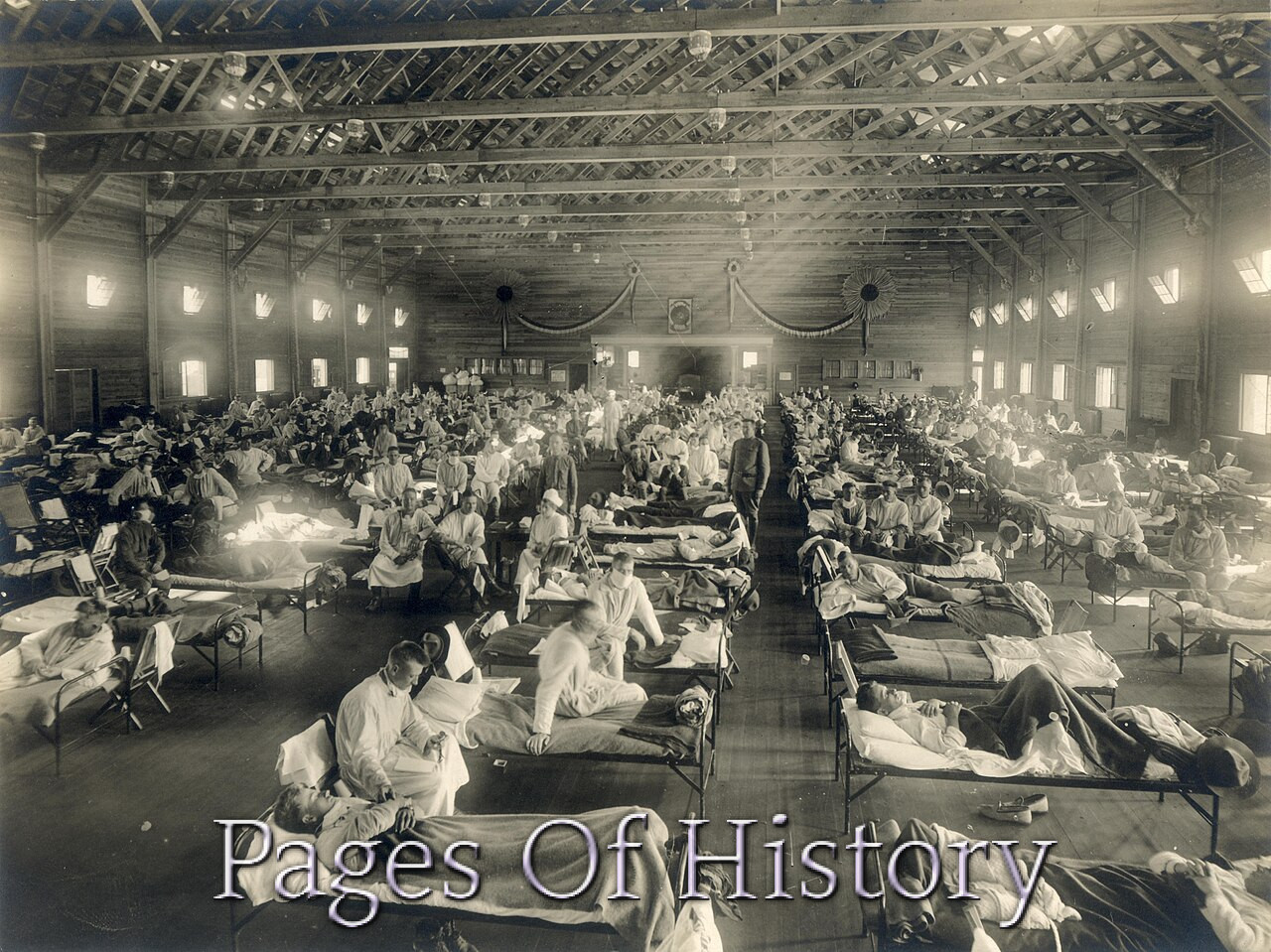
The pandemic did not emerge in a vacuum. The First World War created the perfect transmission engine. Troop ships packed thousands of soldiers into confined quarters; trench warfare crowded men into muddy, rat-infested ditches; and mass movements of laborers and refugees carried the virus across oceans and continents. The first major outbreak in the United States is often traced to Camp Funston, Kansas, in March 1918, and the virus traveled to Europe with the American Expeditionary Forces. Censorship kept the press from reporting the true scale of the disease in combatant nations — which is partly why neutral Spain’s uncensored coverage gave the pandemic its misleading name.
When the war ended on November 11, 1918, the massive demobilization that followed sent millions of soldiers home. That movement, paradoxically, both spread the virus further and then helped bring the pandemic to a close, as we will see.
The Three Waves and the Shape of the Decline
The single most important fact about the Spanish flu end is that it was not a single event. The pandemic subsided in stages, and each stage had different causes.
| Wave | Approximate Period | Key Characteristics |
|---|---|---|
| First wave | March–July 1918 | Mild; spread by troop movements; often mistaken for seasonal flu |
| Second wave | August–December 1918 | Deadliest; “W-shaped” mortality curve; overwhelmed hospitals worldwide |
| Third wave | January–May 1919 | Less severe but still lethal; hit isolated communities hard |
| Fourth wave | Late 1919–early 1920 | Localized; the pandemic effectively ends by mid-1920 |
By the summer of 1919, case numbers in most of Europe and North America had fallen sharply. By 1920, the disease had largely receded into the background of ordinary seasonal influenza. But why? There was no vaccine — the influenza virus itself would not even be identified until 1933, when British researchers Wilson Smith, Christopher Andrewes, and Patrick Laidlaw isolated it. So the end of the pandemic was not a medical triumph in the conventional sense. It was the result of several converging forces.
Why Did the Spanish Flu End? The Role of Herd Immunity
The most fundamental reason the Spanish flu end came about is biological: the virus ran out of easy targets. Influenza spreads most efficiently through populations with no prior exposure. Once a large fraction of a community has been infected and either died or recovered with immunity, the virus’s reproduction number — the average number of new people each case infects — falls below one. At that point, transmission chains break and the epidemic fades.
Because the 1918 virus swept through so much of the world so quickly, this process happened on a global scale within roughly two years. In cities like Philadelphia, which suffered one of the worst outbreaks in the United States — more than 12,000 deaths in six weeks in October 1918 — the virus burned through the population so intensely that it exhausted its supply of susceptible hosts. The same pattern occurred in London, Paris, Berlin, and Bombay.
“The 1918 pandemic ended not because we defeated the virus, but because the virus ran out of people to infect — and because the survivors carried immunity that blunted its return.”
This is a crucial and often misunderstood point. Herd immunity in 1918–1920 was achieved the hard way: through mass infection and mass death, not through vaccination. It was costly, uneven, and left deep scars. But it was decisive.
Immunity and the Evolution of the Virus
There is a second biological layer to the story. Influenza viruses mutate constantly, and the strain that produced the lethal second wave may have been slightly different from the one that circulated in later waves. Some researchers believe the virus became less lethal over time as it adapted to its human hosts — a common pattern in pandemics, because a pathogen that kills its host too quickly limits its own spread. Whether the 1918 virus genuinely attenuated or whether later waves simply met more immune populations remains debated, but both factors likely played a role.
Public Health Measures and Their Impact
If herd immunity was the underlying engine, public health interventions were the brakes. Cities and nations that acted early and aggressively suffered far less than those that did not, and their experience shaped how the pandemic ended.
In the United States, cities imposed a patchwork of measures: closing schools, churches, theaters, and saloons; banning public gatherings; requiring masks; and isolating the sick. The results varied enormously. Philadelphia, which delayed action and held a massive Liberty Loan parade on September 28, 1918, suffered a death rate roughly four times that of St. Louis, which closed schools and banned gatherings within days of its first cases. This comparison, documented by historians and epidemiologists, became a landmark case study in the value of early intervention.
- St. Louis, Missouri: Rapid closures in October 1918 flattened the curve dramatically.
- Philadelphia, Pennsylvania: Delayed response led to overwhelmed hospitals and mass graves.
- San Francisco, California: Aggressive masking and closures, though compliance waned and a third wave followed.
- New York City, New York: Staggered business hours and isolation measures kept mortality lower than in many peer cities.
These measures did not stop the virus, but they slowed it, bought time, and reduced the peak burden on hospitals. In doing so, they helped communities reach the point where transmission chains broke — contributing to the Spanish flu end not by eradicating the disease, but by preventing the kind of explosive spread that sustained it.
The Limits of 1918 Medicine
It is worth being clear about what medicine could not do. There were no antibiotics to treat secondary bacterial pneumonia, which killed many victims. There were no antivirals. There was no vaccine — though scientists in the United States and Britain did develop experimental bacterial vaccines against pneumonia, with mixed and largely unproven results. Treatments ranged from the useless to the harmful: aspirin in potentially toxic doses, bloodletting in some quarters, and a bewildering array of patent medicines. The pandemic ended in spite of medicine, not because of it.
The End of the War and the Decline of Transmission
Another underappreciated factor in why the Spanish flu end came when it did is the end of the First World War. The conditions that made the pandemic so explosive — mass troop movements, crowded barracks, trench warfare, and refugee flows — were precisely the conditions that sustained it. When the armistice was signed on November 11, 1918, those conditions began to dissolve.
Demobilization was not instantaneous, and in some ways the return of soldiers home spread the virus to new communities. But over the following months, the density of susceptible people in the most extreme transmission environments — the trenches and the transport ships — declined. The war’s end removed the pandemic’s most efficient delivery system.
At the same time, the sheer scale of the second wave had already infected so many people in the war zones that the pool of susceptible hosts was shrinking. The convergence of these trends — fewer crowded conditions, more immune survivors — set the stage for the pandemic’s decline through 1919 and 1920.
Why the Pandemic Ended Without a Vaccine — and What That Means
The Spanish flu end is a reminder that pandemics can end for reasons that have little to do with scientific breakthroughs. The 1918 pandemic was not defeated by a vaccine, an antiviral, or a miracle drug. It ended because the virus ran out of susceptible hosts, because the war that amplified it ended, and because communities — sometimes wisely, sometimes belatedly — took steps to slow transmission.
This has profound implications for how we think about pandemics generally. It explains why historians and epidemiologists often describe the 1918 pandemic as a “natural experiment” in what happens when a novel pathogen meets a fully susceptible global population. It also explains why the pandemic’s end was not celebrated the way the end of a war might be: there was no armistice for influenza, no single day when the world could say it was over. The disease simply became less visible, folded into the background of ordinary life, until it was no longer a pandemic but a memory.
The Cost of Herd Immunity in 1918
It is important not to romanticize this process. The herd immunity that ended the pandemic was purchased at a staggering price. Estimates of global mortality range from 50 million to as high as 100 million, with some recent scholarship suggesting the true figure may be even higher, particularly in India, where as many as 12 to 17 million people may have died. Entire villages in Alaska, Samoa, and parts of Africa were devastated. The pandemic shortened average life expectancy in the United States by roughly 12 years in 1918.
The end of the Spanish flu was not a victory in any conventional sense. It was a slow, painful, and uneven process of attrition that left the world exhausted and grieving.
Lessons and Legacy
The story of the Spanish flu end carries lessons that remain relevant more than a century later. The first is that pandemics are not ended by a single intervention but by the interaction of biology, behavior, and circumstance. Herd immunity, whether acquired through infection or vaccination, is the fundamental mechanism. Public health measures can buy time and save lives, but they are most effective when applied early and consistently. And the end of a pandemic is rarely a clean, dramatic moment — it is a gradual return to normalcy.
The second lesson concerns memory. The 1918 pandemic was largely forgotten for decades, overshadowed by the First World War and then the Second. It was only in the late twentieth century, as historians and scientists revisited the record, that its full scale became clear. The virus itself was reconstructed in 2005 by a team led by Jeffery Taubenberger and Terrence Tumpey, who sequenced and revived the 1918 strain to understand what made it so lethal. That research confirmed the cytokine storm hypothesis and underscored how much we still have to learn from the pandemic.
The third lesson is about preparedness. The 1918 pandemic ended without a vaccine, but it also ended without the tools that modern science could bring to bear: rapid diagnostics, antiviral drugs, intensive care, and vaccine platforms. The fact that it ended anyway is not a reason for complacency but a reminder of how much suffering could have been avoided with better systems in place.
Conclusion: The Real Reason the Spanish Flu Ended
So why did the Spanish flu end? The honest answer is that it ended for several reasons working together, and no single one tells the whole story. The virus ran out of susceptible hosts as herd immunity accumulated through mass infection. The end of the First World War removed the crowded conditions that had accelerated transmission. Public health measures in cities that acted early slowed the spread and reduced the peak toll. And over time, the virus may have evolved toward less lethal forms as it adapted to its human hosts.
What the Spanish flu end was not was a triumph of medicine. There was no vaccine, no cure, and no moment of victory. There was only the slow, costly, and largely unplanned process by which a pandemic burns itself out — leaving behind millions of dead, millions more with immunity, and a world that had learned, in the hardest possible way, what it means to live through a global plague. More than a century later, that lesson remains as relevant as ever.