
📅 Last updated: 24.11.2026
The Great Emu War of 1932 remains one of the strangest military episodes in Australian history: a government-sanctioned operation in which soldiers armed with two Lewis light machine guns and 10,000 rounds of ammunition were deployed against roughly 20,000 emus in the wheatbelt of Western Australia. What began as a response to crop destruction in the Campion district of the Wheatbelt escalated into a scattered, weeks-long campaign that the birds, by any honest accounting, won.
The Great Emu War was a military operation conducted in Western Australia between 2 November and roughly 10 December 1932, in which soldiers of the Royal Australian Artillery used Lewis machine guns against large emu populations damaging wheat crops around Campion and Walgoolan. Despite killing perhaps several hundred to a few thousand birds, the operation failed to reduce emu numbers or stop crop damage, was mocked in the press and Parliament, and was quietly abandoned. It is remembered today as a cautionary tale about the limits of military force against ecological and agricultural problems.
- Why Did Australia Declare War on Emus?
- The Great Emu War Begins: The First Campaign, November 1932
- Why Did the Great Emu War Fail So Badly?
- What Did the Great Emu War Actually Achieve?
- How Is the Great Emu War Remembered Today?
- What Lessons Does the Great Emu War Offer?
- Conclusion: The Lasting Legacy of the Great Emu War
Why Did Australia Declare War on Emus?
The roots of the conflict lay in the economics of post-First World War settlement. Under the Soldier Settlement Scheme, thousands of returned servicemen were granted marginal land in Western Australia’s Wheatbelt, often on country poorly suited to farming. These settlers were encouraged to grow wheat, and many borrowed heavily to do so. When the Great Depression struck after the Wall Street Crash of 1929, wheat prices collapsed. By 1932, Western Australian farmers were already under severe financial strain, and any additional loss to pests or weather could be ruinous.
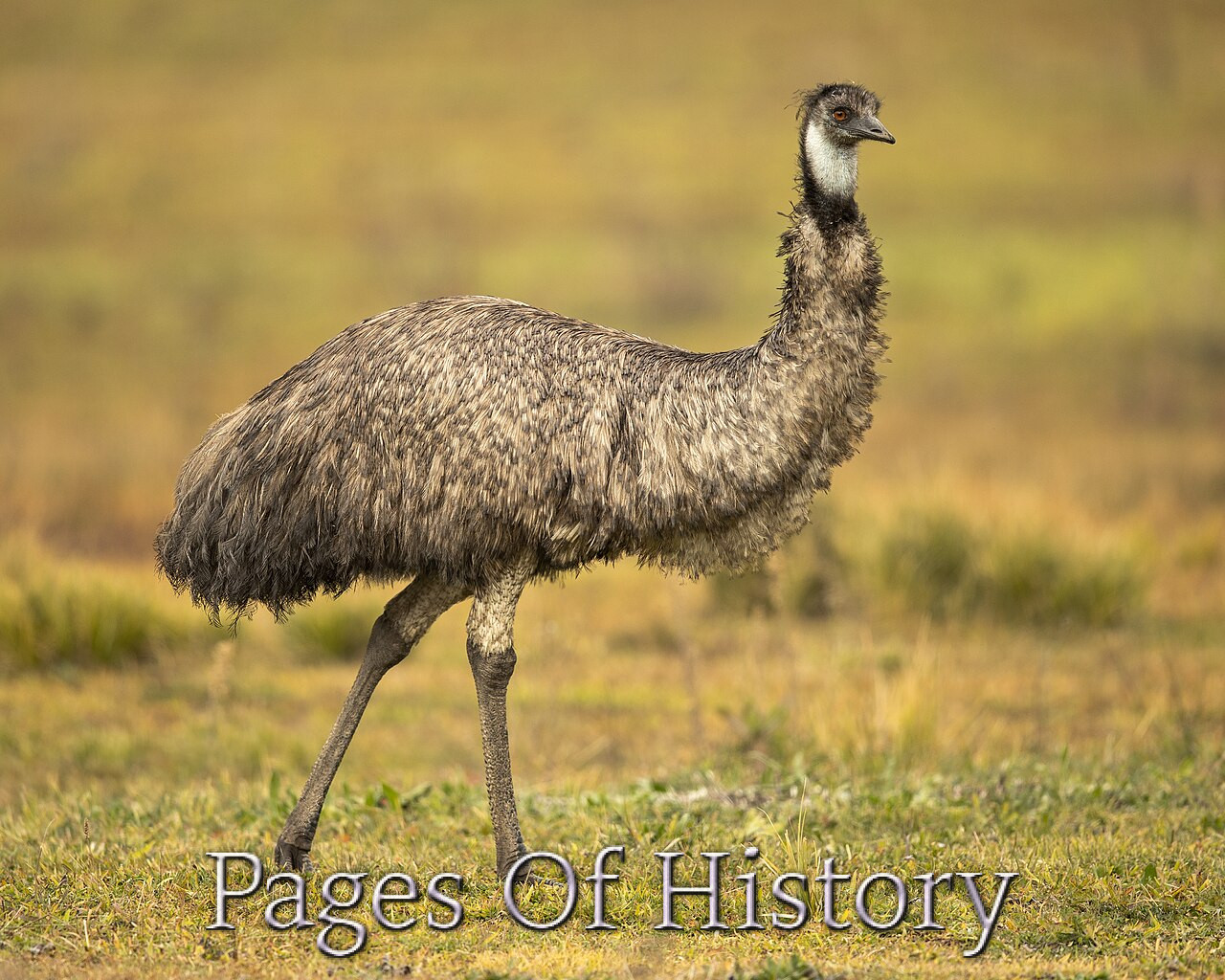
Emus, Australia’s largest native bird and a protected species under federal law, presented a particular problem. Emus are nomadic, following water and food across the interior. The clearing of land for wheat created an artificial abundance: open paddocks, reliable water sources from dams and troughs, and vast fields of ripening grain. Emus moved into the Wheatbelt in large numbers, and once inside fenced paddocks they trampled crops, knocked down fences, and fouled water supplies. The birds’ habit of pushing through wire fencing left gaps that allowed rabbits—already a devastating pest—to flood into the same paddocks.
By late 1932, the situation around Campion, roughly 200 kilometres east of Perth, had become acute. Local farmers, many of them veterans themselves, petitioned the Minister for Defence, Sir George Pearce, for military assistance. They wanted machine guns. Pearce, a Western Australian senator and a veteran of federal politics, agreed—partly because the settlers were ex-soldiers, and partly because the deployment offered a chance to test the guns in a practical setting while providing ammunition that could be supplied at low cost.
The Great Emu War Begins: The First Campaign, November 1932
The operation was placed under the command of Major G. P. W. Meredith of the Royal Australian Artillery, 7th Heavy Battery. Meredith was given two Lewis light machine guns, 10,000 rounds of ammunition, and two soldiers to operate the weapons. The military’s stated objective was not extermination but dispersal: to drive the emus out of the farming districts and, in the process, demonstrate to farmers that the birds could be managed.
The first engagement took place on 2 November 1932 near Campion. Meredith and his men set up an ambush at a watering point, waiting for a flock of about 50 emus to come within range. The birds appeared, the guns opened fire—and the emus scattered with astonishing speed. Emus can sprint at close to 50 kilometres per hour and change direction sharply, and the Lewis gun, accurate but cumbersome on its mount, proved poorly suited to moving targets. Only a handful of birds were killed in the opening salvo.
The pattern repeated over the following days. On 4 November, Meredith positioned his guns near a dam and managed to kill around a dozen emus before the flock broke apart. A larger engagement followed when the soldiers encountered a group of perhaps 1,000 emus. The gunners fired hundreds of rounds; the birds dispersed, and the soldiers later counted only a few dozen carcasses. The emus had learned to split into small groups, to run in erratic patterns, and to avoid the open ground where the guns could be brought to bear.
The Press and Parliament Weigh In
News of the operation spread quickly, and the coverage was not flattering. Australian newspapers ran accounts of soldiers outmanoeuvred by birds. In the federal Parliament, opposition members mocked the government for deploying military resources against wildlife while the Depression deepened. One member reportedly asked whether a medal would be struck for the campaign. Pearce, facing ridicule, withdrew the guns on 8 November 1932, after roughly a week of operations.
The withdrawal was brief. Farmers in the district reported that emu numbers remained high and that crop damage continued. With harvest approaching, pressure mounted for a second deployment. Pearce authorised the return of Meredith and his guns in mid-November, this time with a bounty system attached: farmers would be paid for emu beaks, providing an incentive for local participation that the military campaign had lacked.
Why Did the Great Emu War Fail So Badly?
The military’s failure was not a matter of poor marksmanship alone. The campaign ran into a series of structural problems that made success nearly impossible.
- Target behaviour: Emus are fast, erratic, and highly mobile. They disperse when threatened, making concentrated fire ineffective and forcing gunners to chase scattered birds across open country.
- Weapon mismatch: The Lewis gun was designed for suppressing infantry at fixed ranges, not for engaging fast-moving flocks in open terrain. Its weight and mounting made rapid re-aiming difficult.
- Scale: The emu population in the region numbered in the tens of thousands, spread across thousands of square kilometres. Two guns and a handful of soldiers could not meaningfully reduce such a population.
- Ecological logic: Emus moved into the Wheatbelt because farming created ideal conditions for them. Killing birds in one district simply left the habitat intact for others to occupy.
By early December, Meredith reported that the guns had fired thousands of rounds and that the operation had killed a disputed number of birds—estimates in contemporary reports ranged from a few hundred to around 1,000, with some claims of up to 3,000 when local bounty kills were included. The second campaign ended around 10 December 1932, and the military withdrew for good. The emus, for their part, continued to occupy the Wheatbelt.
| Date | Event | Outcome |
|---|---|---|
| 1929–1932 | Great Depression collapses wheat prices; Soldier Settlement farmers face ruin | Farmers under severe financial pressure |
| Late 1932 | Emu flocks move into Campion and Walgoolan districts | Crop and fence damage; farmers petition for military aid |
| 2 November 1932 | First campaign begins under Major G. P. W. Meredith | Opening ambush kills only a handful of emus |
| 8 November 1932 | Guns withdrawn after press and parliamentary ridicule | First campaign abandoned |
| Mid-November 1932 | Second campaign authorised with bounty system | More birds killed, but population unaffected |
| Around 10 December 1932 | Military operation ends permanently | Emus remain; farmers turn to bounties and fencing |
What Did the Great Emu War Actually Achieve?
The campaign’s practical achievements were modest. The military claimed a kill count in the hundreds to low thousands, but the emu population in the region was not visibly reduced. Crop damage continued, and farmers ultimately relied on the same tools they had before the guns arrived: bounty hunting, better fencing, and, in later decades, coordinated culling programs administered by state agriculture departments.
The operation did, however, produce two lasting results. First, it demonstrated—at some cost to the Army’s dignity—that military firepower was a poor instrument for managing a mobile, abundant native species across vast terrain. Second, it generated a body of press coverage and parliamentary record that has kept the episode alive in Australian memory. The Great Emu War became a staple of popular histories, museum exhibits, and, in the internet age, a widely shared piece of national folklore.
The Bounty System and the Shift to Civilian Control
After the military withdrew, the Western Australian government expanded the bounty system. Farmers and professional hunters were paid per bird, and over the following years tens of thousands of emus were killed under these schemes. The bounty approach was more effective than the machine guns precisely because it was decentralised: it mobilised hundreds of farmers across the Wheatbelt rather than relying on two guns in one district. It also reflected a broader shift in Australian pest management away from military intervention and toward agricultural administration.
Emus remained a protected species under federal law throughout, which created an awkward legal situation: the Commonwealth could not easily sanction a systematic cull, and the military deployment had been framed as a dispersal operation rather than an extermination campaign. The tension between protecting a national symbol and managing an agricultural pest persisted for decades and shaped later policy, including the construction of the famous emu-proof fence in Western Australia—a barrier that, unlike the machine guns, actually worked.
How Is the Great Emu War Remembered Today?
The episode occupies a peculiar place in Australian culture: it is simultaneously a genuine historical event, a running joke, and a case study in policy failure. The phrase “Great Emu War” appears in everything from school textbooks to video games, and the image of soldiers with machine guns being outrun by birds has proved irresistible to satirists. In 2019, the Australian Broadcasting Corporation and various international outlets revisited the story, cementing its status as one of the country’s most exportable historical anecdotes.
Historians tend to treat the episode more soberly. It is cited in discussions of the Soldier Settlement Scheme’s failures, the ecological consequences of land clearing, and the limits of top-down government responses to complex problems. The campaign also illustrates a recurring theme in Australian environmental history: native species that adapt well to European farming systems become extraordinarily difficult to control, and short-term military or bounty responses often fail to address the underlying causes of population growth.
What Lessons Does the Great Emu War Offer?
The campaign’s most durable lesson is about problem definition. The farmers and the Defence Department framed the issue as a military one—a matter of killing enough birds—when the real drivers were habitat change, the economics of marginal farming, and the absence of coordinated pest management. Two machine guns could never have solved a problem created by thousands of square kilometres of newly cleared wheatland.
- Match the tool to the problem: Military firepower was the wrong instrument for a mobile, dispersed species across open terrain.
- Address root causes: Emus moved into the Wheatbelt because farming created favourable habitat; killing birds without changing land use could not reduce the population durably.
- Decentralise where appropriate: The bounty system, though controversial, mobilised far more people than a single military unit and proved more effective at reducing local numbers.
There is also a political lesson. The operation became a public embarrassment almost immediately because it was visible, expensive, and easy to mock. Governments that deploy dramatic measures against problems that resist dramatic solutions invite ridicule—and the ridicule often outlasts the problem itself. The emus, after all, are still there.
Conclusion: The Lasting Legacy of the Great Emu War
The Great Emu War ended not with a treaty or a decisive battle but with a quiet withdrawal and a return to civilian pest control. Its significance lies less in what it accomplished than in what it revealed: that the Australian Wheatbelt was an ecological system transformed by settlement, that emus were superbly adapted to that transformation, and that the instruments of modern warfare were no match for a bird that could run faster than a soldier could aim. The episode has become a national joke, but it is also a serious historical document—a record of how economic desperation, bureaucratic momentum, and ecological ignorance combined to produce one of the most lopsided and least necessary campaigns in military history. The emus won, and Australia has been laughing about it ever since.