
📅 Last updated: 24.11.2026
The Roman testudo formation was one of the most distinctive tactical innovations of antiquity: a shield-roofed infantry block that turned a century of legionaries into a moving fortress. Roman soldiers locked their scuta edge to edge in front and overhead, creating a continuous wall of wood and leather that deflected arrows, sling stones, and javelins while the formation advanced steadily toward an enemy line or gate. What began as an improvised siege technique became a signature Roman response to missile-heavy warfare, and its disciplined execution demanded a level of drill and unit cohesion that few ancient armies could match.
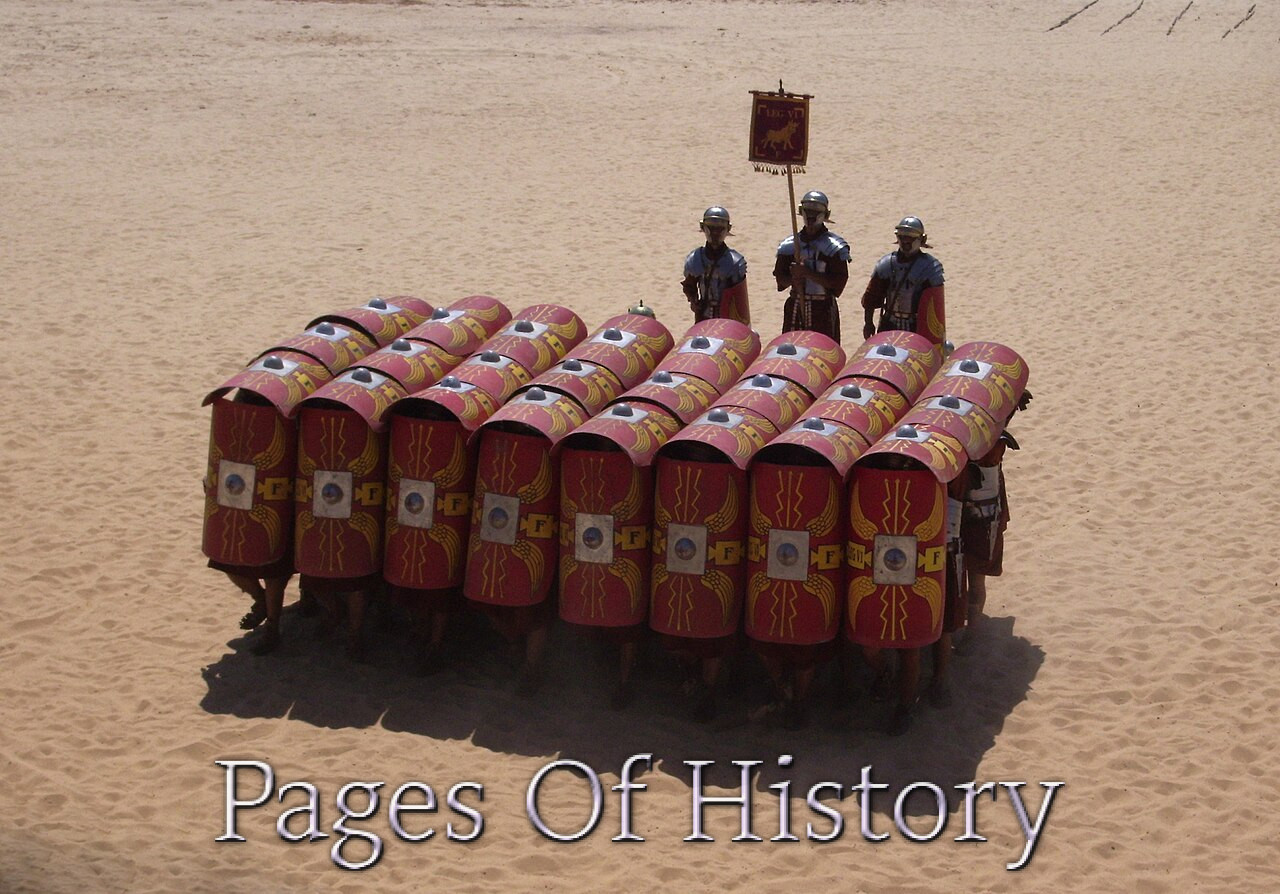
The Roman testudo formation was a defensive infantry maneuver in which legionaries overlapped their rectangular shields to form a protective shell—shields facing forward in the front ranks and raised overhead in the ranks behind. It neutralized missile fire during siege assaults and frontal advances, most famously at the siege of Avaricum in 52 BCE and during Mark Antony’s Parthian campaign in 36 BCE. Its effectiveness depended less on the shields themselves than on the relentless drill and unit cohesion of the Roman legion.
- What Exactly Was the Roman Testudo Formation?
- Origins: Did the Romans Invent the Shield-Roof?
- How Did the Roman Testudo Formation Work in Battle?
- Why Did the Roman Testudo Formation Crush Enemy Armies?
- Key Battles and Sieges Involving the Roman Testudo Formation
- What Were the Weaknesses of the Roman Testudo Formation?
- How the Testudo Fit Into Roman Military Doctrine
- Why the Testudo Still Matters
What Exactly Was the Roman Testudo Formation?
The word testudo is Latin for “tortoise,” and the comparison is apt. In its classic form, described by the Greek historian Plutarch and the military writer Vegetius, the front rank of legionaries held their curved rectangular shields (scuta) vertically before them, overlapping the edges. The ranks behind raised their shields flat above their heads, each row overlapping the one in front like roof tiles. The result was a near-seamless shell of shields on the front, sides, and top, with the men marching beneath it in tight order.
The shields themselves were formidable engineering. The imperial scutum was a laminated plywood construction of strip-layered wood, roughly 1 meter tall and 65 centimeters wide, bound with iron edging and covered in leather. Tests by modern experimental archaeologists, including the reconstructions carried out by the Ermine Street Guard in Britain, have shown that such a shield could stop arrows and sling bullets at typical combat ranges. Multiplied across a hundred men standing shoulder to shoulder, the protection became systemic rather than individual.
Roman writers distinguished between variants. A “full” testudo enclosed the formation on all four sides, useful when surrounded. A “front” testudo protected only the forward face during an advance. Vegetius, writing in the late 4th century CE in his Epitoma rei militaris, describes recruits being trained to interlock shields so tightly that “missiles slide off as if from a roof.” That training regime is the key: the formation was not a clever trick but a drilled reflex, rehearsed until a century could assemble it in seconds under fire.
Origins: Did the Romans Invent the Shield-Roof?
No—and this matters for an honest account. Shield-roof tactics appear in earlier Mediterranean warfare. Greek hoplites in the Archaic period used overlapping shield walls, and Assyrian reliefs from the 9th century BCE depict soldiers holding shields above their heads beside archers. The Romans’ contribution was systematization: they made the testudo a standard, named, drilled maneuver integrated into siege and field doctrine, rather than an ad hoc response.
The earliest clear literary reference comes from Polybius, the Greek historian who chronicled Rome’s rise in the 2nd century BCE. Describing the legionary’s equipment, he notes that the scutum could be used to cover the whole body, and Roman commanders of the Republic evidently exploited this. By the late Republic, the maneuver was famous enough that enemies anticipated it. At the siege of Avaricum (modern Bourges) in 52 BCE, Julius Caesar records in his Commentarii de Bello Gallico (Book VII) that his men advanced under a testudo of shields to fill the Gauls’ defensive ditch and reach the walls—an operation that required hours of exposed labor under missile fire.
How Did the Roman Testudo Formation Work in Battle?
The testudo excelled in three situations: approaching fortified positions, crossing killing zones swept by archers or slingers, and breaking through narrow gaps such as gates and breaches. It performed poorly in open maneuver warfare against mobile enemies, because the formation was slow, blind, and vulnerable to flanking. Roman commanders understood this trade-off and deployed it selectively.
The Siege of Avaricum, 52 BCE
Caesar’s account is the earliest detailed battle narrative of the testudo in action. Vercingetorix’s Gallic coalition had adopted a scorched-earth strategy, burning towns to deny Rome supplies. Avaricum, a wealthy Gallic stronghold, was spared by the Gauls themselves and became Caesar’s target. The town’s walls rose above a marsh and a ditch, and defenders poured down fire and missiles on Roman siege workers.
Caesar ordered his legions to advance testudine—under the tortoise—to fill the ditch and bring siege towers and mantlets to the wall. The Gauls responded by rolling heated clay balls and dropping burning pitch onto the shield roofs, and by hurling stakes and stones. Caesar reports the legionaries endured it, and after 25 days of siege operations the town fell. The episode shows both the formation’s value and its limits: it protected the approach but could not prevent casualties when defenders adapted with incendiaries.
Mark Antony’s Parthian Disaster, 36 BCE
The most instructive failure came during Mark Antony’s invasion of Parthia. Antony marched a force of roughly 60,000 Roman infantry and 10,000 cavalry deep into Mesopotamia, and his siege train was destroyed by a Parthian cavalry raid. On the retreat, Parthian horse archers harassed the column relentlessly. According to Plutarch’s Life of Antony, Antony ordered his men into testudo formation to shield against arrows, and the Parthians—astonished that their volleys bounced off—resorted to close-quarters charges.
The formation saved lives but could not win the campaign. Antony lost thousands of men to disease, hunger, and attrition, and the retreat cost him perhaps a third of his army. The lesson was clear: the testudo protected against missiles but could not solve a strategic problem. Its value was tactical and situational.
Why Did the Roman Testudo Formation Crush Enemy Armies?
The formation’s power rested on four interlocking factors, none of which worked alone.
- Standardized equipment: The curved rectangular scutum, iron-rimmed and leather-covered, was purpose-built for interlocking. Irregular warband shields could not match its coverage or uniformity.
- Drilled cohesion: Legionaries trained constantly in unit maneuvers. A testudo required dozens of men to move as one body; only professional, paid, long-service soldiers could execute it under fire.
- Combined-arms integration: The testudo was rarely used alone. Archers, slingers, and ballistae fired over the shield roof, and cavalry screened the flanks. The shell was a platform for the rest of the army.
- Psychological effect: Enemies expecting to break an advance with missile volleys found their ammunition useless. Plutarch’s account of Parthian astonishment captures this demoralizing shock.
The formation also had a logistical dimension. A testudo advance moved slowly but predictably, allowing engineers to bring up rams, towers, and ladders under cover. At sieges from Numantia (133 BCE) to Jerusalem (70 CE) and Masada (72–73 CE), Roman forces used shield-roofed approaches to close on walls that would otherwise have been suicide to reach.
Key Battles and Sieges Involving the Roman Testudo Formation
| Date | Event | Commander | Outcome |
|---|---|---|---|
| 52 BCE | Siege of Avaricum | Julius Caesar | Town captured after 25 days; testudo used to fill ditch and approach walls |
| 36 BCE | Antony’s Parthian retreat | Mark Antony | Testudo blunted horse-archer fire; campaign ended in costly failure |
| 70 CE | Siege of Jerusalem | Titus | Shield-roofed advances against the temple walls; city fell after months |
| 72–73 CE | Siege of Masada | Lucius Flavius Silva | Testudo-covered ramp and siege works against the fortress |
What Were the Weaknesses of the Roman Testudo Formation?
No formation is invincible, and Roman sources are candid about the testudo’s vulnerabilities. The most serious was immobility: a tight shield shell could not maneuver quickly, turn easily, or respond to threats from multiple directions. At the Battle of Carrhae in 53 BCE, Crassus’s legions faced Parthian horse archers on open desert. The Romans attempted to close ranks and shield themselves, but the Parthians simply withdrew, resupplied with arrows from camels, and returned. The result was annihilation—around 20,000 Romans killed and 10,000 captured. The testudo was not the cause of the defeat, but the battle demonstrated that shield tactics could not compensate for a lack of cavalry and missile troops.
Fire was another weakness. At Avaricum, Gallic defenders dropped burning pitch and heated clay onto the shield roofs; at Jerusalem, Jewish defenders used fire against Roman siege works. Shields were wood and leather—flammable and heavy. A testudo could also be broken by determined infantry assault at close quarters, since the men beneath the shell had limited visibility and reach.
Finally, the formation required flat, open ground. On broken terrain, in forests, or on steep slopes, the interlocking could not be maintained. Roman commanders adapted accordingly, using looser formations in rough country.
How the Testudo Fit Into Roman Military Doctrine
The testudo was one element of a broader Roman approach to war that emphasized engineering, logistics, and discipline over individual heroics. The legions built roads, bridges, camps, and siege machines with the same methodical precision they brought to shield drill. Vegetius devoted attention to training because he understood that the testudo was only as strong as the weakest man in the line.
The formation’s legacy extended beyond Rome. Medieval armies used shield walls and roofed siege approaches, and the concept of a protected advance under overlapping shields reappears in Byzantine military manuals. The word testudo itself entered military vocabulary as shorthand for any coordinated shield defense.
Why the Testudo Still Matters
The Roman testudo formation is a case study in how organization beats individual prowess. Its shields were not magic; its men were not superhuman. What crushed enemy armies was the combination of standardized equipment, relentless training, and the willingness of soldiers to trust the man beside them with their lives. The formation protected advances at Avaricum, Jerusalem, and Masada, and it saved lives on Antony’s disastrous retreat. It also failed at Carrhae, reminding us that no tactic exists in isolation.
For modern readers, the testudo offers a durable lesson: coordinated discipline multiplies strength, while fragmentation squanders it. The legions understood this two thousand years ago, and the tortoise shell of interlocked shields remains one of history’s clearest demonstrations of that principle.