
📅 Last updated: 06.10.2026
The Easter Island statues — nearly 900 of them, carved from volcanic rock and scattered across a remote Pacific island — are among the most recognizable monuments on Earth. They have been called the work of lost civilizations, space visitors, and ecological fools. None of those stories hold up. What the archaeological record actually shows is a society of Polynesian engineers who solved hard problems of quarrying, transport, and ritual for roughly five centuries, and whose descendants still live on the island today. Understanding why they built the statues means understanding a culture’s deepest beliefs about ancestors, power, and the sacred.
- A Tiny Island in the Middle of Nowhere
- What the Easter Island Statues Actually Are
- Why Build Them? Ancestors, Power, and the Sacred
- How Were the Easter Island Statues Made and Moved?
- Key Dates and Facts at a Glance
- The Birdman Cult and the End of the Moai Era
- What the Easter Island Statues Tell Us About Rapa Nui Society
- How the Statues Were Rediscovered and Studied
- Why the Easter Island Statues Still Matter
A Tiny Island in the Middle of Nowhere
Rapa Nui — the island’s Polynesian name, meaning “Great Rapa” — sits about 3,700 kilometers (2,300 miles) west of Chile and roughly 1,900 kilometers (1,200 miles) east of the nearest inhabited Polynesian island, Pitcairn. It is one of the most isolated inhabited places on the planet. The island is small: about 163 square kilometers (63 square miles), shaped roughly like a triangle, with three volcanic peaks at its corners — Rano Kau, Rano Aroi, and the largest, Ma’unga Terevaka. The Dutch explorer Jacob Roggeveen, the first European to land there, arrived on Easter Sunday, April 5, 1722, which is how the island got its English name.
The first settlers were Polynesian voyagers, probably from the Marquesas or Mangareva region, arriving around 1200 CE (recent radiocarbon dating, including work published in 2007 and refined since, places colonization roughly between 1200 and 1250 CE). They brought with them chickens, sweet potatoes, taro, bananas, and paper mulberry for making barkcloth. They also brought a cosmology in which ancestors, chiefs, and the sacred (tapu) were intertwined. That cosmology is the seed from which the statues grew.
What the Easter Island Statues Actually Are
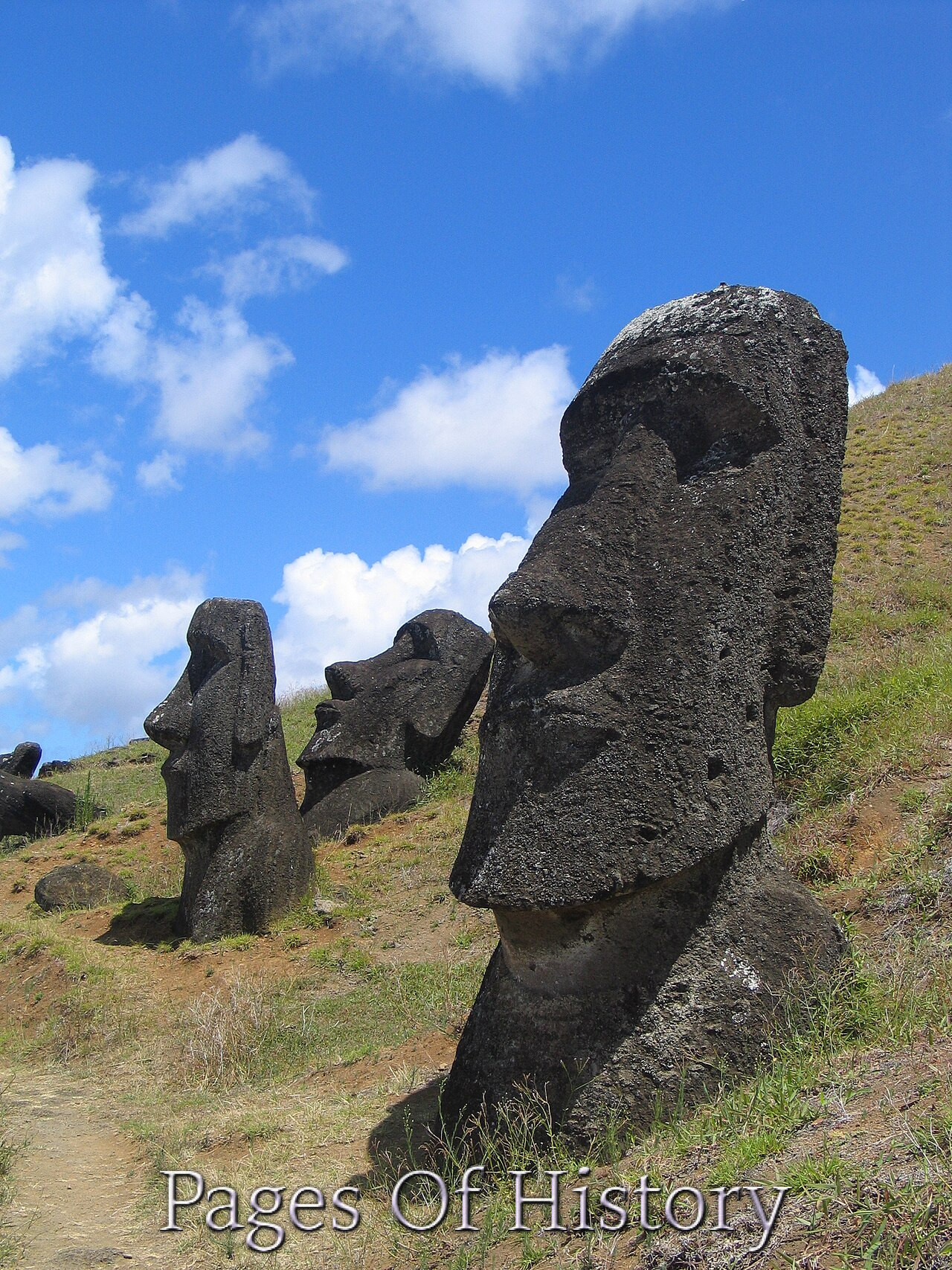
The statues are called moai in the Rapa Nui language. Most were carved from compressed volcanic ash (tuff) at the quarry of Rano Raraku, a crater on the eastern side of the island. A smaller number were carved from basalt (harder, darker stone) at other sites such as Rano Kau and Anakena. The typical moai is a stylized human head and torso, with heavy brow, long straight nose, thin lips, and elongated ears. Most faces point inland, toward the communities they watched over — not out to sea, as the popular “they look at the ocean” myth suggests.
The statistics are striking:
- Roughly 887 moai are documented across the island, according to the comprehensive survey by Jo Anne Van Tilburg and the Easter Island Statue Project.
- About 95% were carved at Rano Raraku; the quarry still contains nearly 400 statues in various stages of completion.
- The largest ever erected, at a platform called Ahu Te Pito Kura, was named Paro and stood about 10 meters (33 feet) tall, weighing an estimated 80 tonnes. It is now fallen and broken.
- The tallest ever carved, called El Gigante (or Te Tokanga), lies unfinished in the quarry at about 21 meters (69 feet) and an estimated 200 tonnes.
- Average moai height is about 4 meters (13 feet) and weight about 12.5 tonnes.
Almost all moai were placed on stone platforms called ahu, which were often burial sites for important ancestors. The moai on the ahu faced inland, looking over the villages and the living descendants of the person commemorated. This is the single most important fact for understanding why they were built: the statues were not decorative, and they were not astronomical instruments. They were ancestors made visible.
Why Build Them? Ancestors, Power, and the Sacred
The Ancestor Cult
In Rapa Nui religion, dead ancestors retained power over the living. They could bring rain, fertility, and success — or withhold them. A moai was a physical vessel (aringa ora, “living face”) through which a chief’s or ancestor’s mana (spiritual power) could continue to act. The eyes were especially important. Many moai originally had eyes of white coral and red scoria (or obsidian), inserted at the end of the carving process. Without eyes, the statue was inert; with eyes, it “saw” and could protect the community.
This makes sense of the labor. A community that invested months or years in carving and moving a multi-ton statue was not doing it for decoration. It was doing it because the statue was believed to be the ancestor, and the ancestor was believed to be watching.
Competition Between Clans
Rapa Nui society was divided into clans (mata) and kinship groups, each associated with specific land and coastal areas. The island’s resources were limited, and status was contested. Building bigger, better, or more moai was a way for a clan to demonstrate its mana and to secure the favor of its ancestors. Anthropologists such as Patrick Kirch and others have described this as a form of “competitive display” — not unlike potlatch among Northwest Coast peoples or pyramid-building in Mesoamerica. The statues were a public statement: our ancestors are powerful, and so are we.
This competitive dynamic helps explain why moai got larger over time. The earliest moai, from around 1250–1300 CE, were relatively small and stylized. By the 1400s and 1500s, they were bigger, more detailed, and more numerous. The peak of construction appears to have been roughly 1400–1600 CE.
How Were the Easter Island Statues Made and Moved?
This is where the popular imagination usually goes wrong. The moai were not moved by aliens, and they were not dragged on rolling logs that stripped the island of its trees in a single suicidal orgy of deforestation. The real story is more interesting — and more human.
Carving at Rano Raraku
At Rano Raraku, carvers used basalt hand adzes (toki) to cut the moai directly out of the bedrock. They worked on the back first, then the sides, then the front, leaving a keel-like spine connecting the statue to the rock. Once the front was finished, they undercut the keel and slid the statue down the slope. Many unfinished moai remain in the quarry, some still attached to the bedrock, which gives us a rare snapshot of the production process.
Carving was skilled, specialized work. Evidence suggests that carvers were fed and supported by the community — a moai was a communal project, not the work of a lone genius. The quarry itself was a sacred place, and the moai there were not abandoned failures; many were intended to remain in or near the quarry as part of the ritual landscape.
Transport: Walking, Sledging, or Rolling?
How the moai were moved from Rano Raraku to ahu up to 18 kilometers away is one of the great debates in Pacific archaeology. The main hypotheses are:
- Horizontal sledging or dragging on wooden sledges or ropes, possibly lubricated with water or mashed sweet potato.
- Rolling on logs — the traditional explanation, popularized by Thor Heyerdahl and others.
- “Walking” the statues upright, using ropes to rock them side to side and forward, a method experimentally tested by archaeologists Carl Lipo and Terry Hunt with a replica moai in 2012.
The walking hypothesis has gained traction because it requires fewer people and less timber than sledging, and because Rapa Nui oral tradition describes the moai as having “walked” to their platforms. Lipo and Hunt’s experiments showed that a 4.35-tonne replica could be moved upright by as few as 18 people using three ropes. That said, no single method is proven for all moai, and different statues may have been moved in different ways. The honest answer is that we have plausible, tested mechanisms, not a settled certainty.
The Deforestation Question
Rapa Nui was once covered in a palm forest (a now-extinct species, Paschalococos disperta), along with other trees and shrubs. Pollen analysis by John Flenley and others showed that the forest declined sharply between roughly 1200 and 1500 CE. The traditional narrative, popularized by Jared Diamond in Collapse (2005), is that the Rapa Nui cut down all their trees to move moai, then descended into warfare and cannibalism. That story is now heavily contested.
More recent research — including work by Hunt and Lipo, and by archaeologists studying the island’s gardens — suggests that deforestation was driven by a combination of factors: rats (introduced by the settlers) eating palm seeds, climate variability, and land clearing for agriculture. The islanders also developed sophisticated rock gardens (manavai) and lithic mulch to grow crops in a harsher environment. The “ecocide” narrative oversimplifies a complex story and, some scholars argue, unfairly blames the Rapa Nui for their own collapse. The population likely peaked at somewhere between 3,000 and 15,000 people — estimates vary widely — and did decline, but the causes are debated.
Key Dates and Facts at a Glance
| Date / Period | Event or Development |
|---|---|
| c. 1200–1250 CE | Polynesian settlement of Rapa Nui |
| c. 1250–1500 CE | Main period of moai carving and ahu construction |
| c. 1400–1600 CE | Peak of moai production; largest statues erected |
| c. 1500–1700 CE | Deforestation accelerates; construction declines |
| 1722 | Dutch explorer Jacob Roggeveen lands on Easter Sunday |
| 1774 | Captain James Cook visits; many moai already toppled |
| 1862–1863 | Peruvian slave raids devastate the population; many Rapa Nui die |
| 1888 | Chile annexes Easter Island |
The Birdman Cult and the End of the Moai Era
By the time Europeans arrived, the moai era was over. Many statues had been toppled — some deliberately, during internal conflict, and some by earthquakes. A new religious and political system had emerged: the tangata manu, or Birdman cult, centered on the village of Orongo on the rim of Rano Kau crater. Each year, representatives of different clans competed in a dangerous race to retrieve the first egg of the sooty tern (manu tara) from the islet of Motu Nui. The winner’s clan chief became the Birdman for the year, holding religious authority.
The Birdman cult was not a replacement for ancestor veneration so much as a shift in how sacred power was accessed. The moai had been fixed, permanent, and tied to specific lineages and land. The Birdman ritual was cyclical, competitive, and open to different clans. It reflected a society that had become more fluid and more focused on the annual contest for mana. The last known Birdman ceremony took place in the 1860s, around the time of the Peruvian slave raids.
This transition matters because it shows that the moai were not built by a society that simply “ran out of steam.” They were built by a society that changed — politically, religiously, and environmentally — and then moved on to a different way of organizing its sacred life.
What the Easter Island Statues Tell Us About Rapa Nui Society
The moai are a window into a sophisticated, stratified, and deeply religious Polynesian society. They show us:
- Engineering skill: quarrying, transporting, and erecting multi-ton statues without wheels, metal tools, or draft animals.
- Labor organization: the ability to mobilize and feed large workforces over long periods.
- Ritual priority: the willingness to invest enormous resources in ancestors rather than, say, fortifications or luxury goods.
- Competition and hierarchy: the drive to out-build rival clans, which fueled the scale of the monuments.
- Adaptation: the development of rock gardens and other techniques to survive on a marginal island.
They also show us the limits of a system. Once the forest was gone, moving and erecting moai became harder. Once the ancestor cult lost its grip, the statues lost their purpose. The moai were not abandoned because the Rapa Nui were stupid or self-destructive; they were abandoned because the world that gave them meaning had changed.
How the Statues Were Rediscovered and Studied
European contact brought catastrophe. In 1862–1863, Peruvian slave raiders took about 1,500 Rapa Nui — roughly half the population — to work in guano mines and plantations. Most died. Missionaries arrived in 1864, and by the late 19th century the population had fallen to around 110 people. Much traditional knowledge was lost, including the ability to read rongo rongo, the island’s undeciphered script.
Scientific study began in earnest in the 20th century. The Norwegian explorer Thor Heyerdahl, famous for the Kon-Tiki expedition (1947), led an archaeological expedition to Easter Island in 1955–1956. Heyerdahl argued that the island had been settled from South America, a theory now rejected by genetic and linguistic evidence showing Polynesian origins. Later researchers — including William Mulloy, who restored several ahu in the 1960s and 1970s; Jo Anne Van Tilburg, who has documented the statues systematically since the 1980s; and more recently Carl Lipo, Terry Hunt, and others — have built a far more accurate picture.
In 2019, a team led by Jo Anne Van Tilburg excavated two moai at Rano Raraku and found that they had been buried up to their shoulders, with petroglyphs on their backs. This suggested that some moai were not just statues but part of a larger ritual landscape, possibly marking water sources or agricultural fertility. The research continues, and each new study complicates the simple stories.
“The moai were not a monument to a dead civilization. They were a living relationship between the living and their ancestors.” — a sentiment echoed by many Rapa Nui elders and archaeologists who work closely with the community.
Why the Easter Island Statues Still Matter
The Easter Island statues matter because they are a case study in how human societies make meaning — and how that meaning shapes the landscape, the economy, and the environment. They are not a cautionary tale about “primitive” people destroying their island. They are a story about people who, facing isolation, limited resources, and a demanding spiritual world, chose to carve their ancestors into stone and set them up to watch over their communities.
That choice had consequences. It required labor, timber, and food. It intensified competition between clans. It left a permanent mark on the island. But it also produced something extraordinary: a collection of nearly 900 monumental sculptures that have survived for centuries and continue to fascinate the world.
Today, the moai are a source of pride and identity for the Rapa Nui people, who make up a significant portion of the island’s population. In 1995, UNESCO designated Rapa Nui National Park a World Heritage Site. The statues are protected, studied, and — in a few cases — restored to their upright positions. They are no longer objects of worship in the old sense, but they remain powerful symbols of a culture that endured.
The next time you see a photograph of a moai, look at its eyes — or the empty sockets where eyes once were. That is where the answer to “why” lives. The statues were built to see, to protect, and to remind the living that the dead were still present. They were built because the Rapa Nui believed that ancestors mattered, and that belief was strong enough to move mountains of stone.