
📅 Last updated: 07.10.2026
The story of why the Concorde stop flying is one of the most fascinating cautionary tales in aviation history — a saga of engineering brilliance, national prestige, economic gravity, and a single catastrophic accident. For twenty-seven years, the sleek, delta-winged supersonic airliner sliced across the Atlantic at twice the speed of sound, carrying passengers from London and Paris to New York in under three and a half hours. It was a technological marvel that seemed to belong to the future. And yet, on 26 November 2003, the last Concorde touched down at Filton, Bristol, and the era of supersonic passenger travel came to an abrupt, permanent end.
- The Dream of Supersonic Travel: How Concorde Was Born
- Engineering Marvel, Economic Disaster
- Why the Concorde Stop Flying: The Turning Point of 25 July 2000
- Rising Costs, Shrinking Demand
- The Final Flights and the End of an Era
- Why No Successor Has Replaced Concorde
- The Legacy of Concorde
- Conclusion: What Concorde's Grounding Teaches Us
Understanding why requires looking far beyond the aircraft itself. Concorde’s demise was not caused by any single failure. It was the product of a decades-long collision between soaring operating costs, a shrinking market, political and environmental opposition, and a tragedy on a Paris runway that destroyed public confidence in an instant. This is the full story of how one of humanity’s greatest flying machines was grounded for good.
The Dream of Supersonic Travel: How Concorde Was Born
Concorde’s origins lie in the geopolitical anxieties of the late 1950s and early 1960s. Britain, France, and the United States were locked in a contest for technological prestige, and supersonic transport — an airliner capable of cruising faster than the speed of sound — became the ultimate prize. The Soviet Union was developing its own rival, the Tupolev Tu-144, and the United States launched a programme that would eventually produce the Boeing 2707.
Facing costs that neither nation could easily bear alone, Britain and France signed a treaty on 29 November 1962 to jointly develop a supersonic airliner. The project was a remarkable act of cross-Channel cooperation — the name “Concorde” itself was chosen partly because it worked in both English and French. Two manufacturers led the effort: British Aircraft Corporation (BAC) in Britain and Sud Aviation (later Aérospatiale) in France. The engine maker Rolls-Royce and France’s SNECMA collaborated on the Olympus 593 turbojet engines.
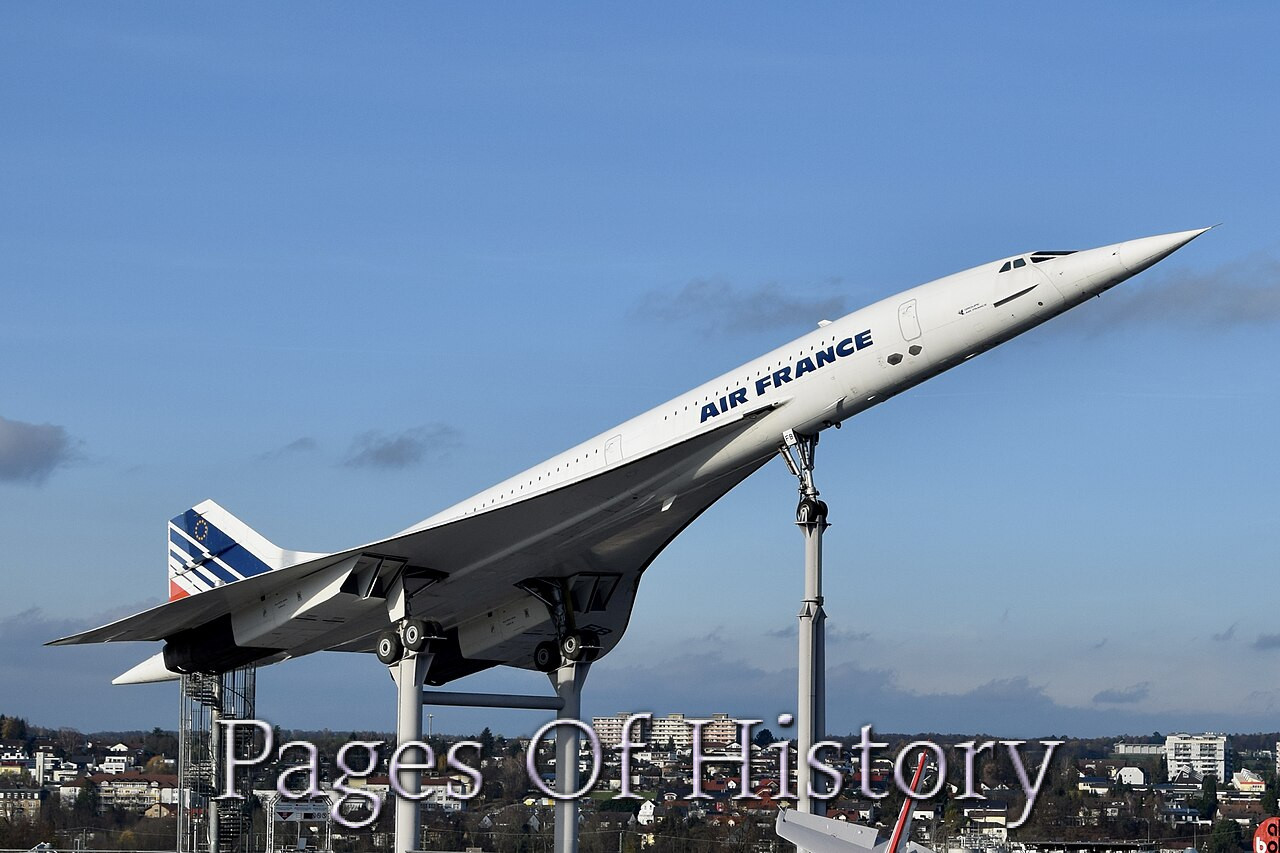
The technical challenges were staggering. To fly efficiently at Mach 2 — roughly 2,180 km/h (1,350 mph) — Concorde needed engines that could handle extreme temperatures, a fuselage that would stretch and contract with heat, and a wing design that worked at both low and supersonic speeds. The solution was an elegant ogival delta wing and a drooping nose that lowered for takeoff and landing to give pilots visibility. The airframe was built largely from aluminium alloys that could withstand skin temperatures of over 100°C, heated by friction with the air.
The first prototype, Concorde 001, took to the air from Toulouse on 2 March 1969, piloted by André Turcat. The British prototype followed from Filton on 9 April 1969. Commercial service finally began on 21 January 1976, with British Airways flying London Heathrow to Bahrain and Air France flying Paris to Rio de Janeiro via Dakar. The age of supersonic passenger travel had arrived — but the economics were already troubling.
Engineering Marvel, Economic Disaster
From the very beginning, Concorde was a commercial gamble that never paid off for the manufacturers. The original development budget was estimated at around £70 million; the final cost ballooned to roughly £1.3 billion — an overrun of staggering proportions. The two governments effectively wrote off this investment, never expecting to recover it through sales.
The real problem was the market. Airlines had placed over 70 options and orders for Concorde in the late 1960s, but these evaporated as the aircraft’s true operating costs became clear. The 1973 oil crisis sent fuel prices soaring, and Concorde was a voracious consumer of fuel. Its four Rolls-Royce/SNECMA Olympus engines burned roughly 20 tonnes of fuel per hour — dramatically more per passenger than a conventional wide-body jet. Only 20 aircraft were ever built, and only 14 entered commercial service: seven with British Airways and seven with Air France.
No American airline ever bought Concorde. Pan American World Airways, which had held options, cancelled them. Boeing’s 747, which entered service in 1970, could carry more than 400 passengers at a fraction of the fuel cost per seat. The economic logic was brutally simple: Concorde could only ever be profitable by charging premium fares to a small number of wealthy passengers, and even then only on a handful of routes.
“Concorde was never a commercial aircraft in the conventional sense. It was a statement — a flying symbol of national ambition — and symbols are expensive to operate.”
Why the Concorde Stop Flying: The Turning Point of 25 July 2000
If any single event sealed Concorde’s fate, it was the crash of Air France Flight 4590 on 25 July 2000. The aircraft, registration F-BTSC, was departing Paris Charles de Gaulle Airport bound for New York’s John F. Kennedy International Airport. On the runway, it ran over a strip of metal that had fallen from a Continental Airlines DC-10 that had taken off moments earlier. The debris shredded a tyre, and fragments struck the underside of the wing, rupturing a fuel tank. A massive fire erupted, and the aircraft lost thrust on two engines.
Barely two minutes after takeoff, Concorde crashed into a hotel in Gonesse, near Paris. All 109 people on board — 100 passengers, nine crew members — were killed, along with four people on the ground. It was the first fatal crash in Concorde’s history and the only one involving a commercial Concorde flight.
The psychological impact was immediate and devastating. Concorde’s reputation had rested on an aura of safety and prestige. Suddenly, the aircraft was seen as vulnerable. Its operating certificate was suspended, and the entire fleet was grounded for modifications. Engineers introduced reinforced tyres, Kevlar lining for the fuel tanks, and more robust electrical systems. The French authorities also investigated the crash in forensic detail, and in 2010 a French court convicted Continental Airlines and one of its mechanics of manslaughter — a verdict later partially overturned on appeal.
Concorde returned to service on 11 September 2001 — a date that would prove catastrophic for the aviation industry for entirely different reasons. The 9/11 attacks in the United States triggered a global collapse in air travel, hitting premium transatlantic traffic especially hard. Concorde’s core market — wealthy business travellers and celebrities crossing the Atlantic — shrank dramatically.
Rising Costs, Shrinking Demand
Even before the crash, Concorde’s operating economics were precarious. After the 2000 accident and the 2001 downturn, they became unsustainable. The numbers tell the story plainly.
| Factor | Concorde | Conventional Subsonic Jet (e.g. Boeing 747) |
|---|---|---|
| Typical cruising speed | Mach 2.04 (about 2,180 km/h) | Mach 0.85 (about 900 km/h) |
| Passenger capacity | 92–128 seats | 400+ seats |
| Fuel burn per passenger | Extremely high | Far lower |
| Transatlantic crossing time | About 3.5 hours | About 7–8 hours |
| Seats sold per aircraft | Only 14 ever in service | Hundreds in service worldwide |
British Airways and Air France each struggled to make the aircraft pay. In the late 1990s, British Airways had cleverly repositioned Concorde as a luxury brand, raising fares sharply and marketing it to the elite. This made the London–New York route profitable for a time. But the model was fragile. The aircraft required bespoke maintenance, a specialised workforce, and spare parts that were no longer being manufactured. As the fleet aged, maintenance costs spiralled.
By 2003, the writing was on the wall. On 10 April 2003, British Airways and Air France jointly announced that Concorde would be retired later that year. The reasons cited were falling passenger numbers, rising maintenance costs, and the withdrawal of Airbus — which had inherited responsibility for the aircraft’s support — from providing ongoing technical assistance. Without manufacturer support, keeping Concorde airworthy was legally and practically untenable.
The Final Flights and the End of an Era
The farewell was carefully stage-managed and deeply emotional. British Airways operated a series of final “farewell tours” in October 2003, flying Concorde to cities including Toronto, New York, and Edinburgh. On 24 October 2003, three British Airways Concordes made simultaneous landings at Heathrow Airport — one from New York, one from Edinburgh, and one from a round trip over the Bay of Biscay. The aircraft taxied past crowds of spectators and former crew, many in tears.
Air France had already ended its services on 31 May 2003, with a final flight from New York to Paris. The very last Concorde flight of all took place on 26 November 2003, when an aircraft was flown from Heathrow to Filton, near Bristol, to become a museum piece. In total, Concorde had carried more than 2.5 million passengers over its career.
The final Concordes were distributed to museums around the world — in Britain, France, the United States, and Barbados. They remain objects of fascination, preserved reminders of a road not taken in commercial aviation.
Why No Successor Has Replaced Concorde
The reasons Concorde stopped flying were not purely about one aircraft. They reflected fundamental barriers that still prevent a viable supersonic airliner today. Understanding these barriers explains why, more than two decades later, no successor has entered commercial service.
- Physics and fuel: Supersonic flight creates enormous drag, and drag demands fuel. The faster you fly, the more energy you burn per passenger. Until propulsion technology changes fundamentally, supersonic travel will always be fuel-inefficient.
- The sonic boom problem: Concorde was banned from flying at supersonic speeds over land in most countries because of the disruptive sonic boom. This restricted it to over-water routes, dramatically limiting its market.
- Environmental opposition: Concorde was a target of environmental campaigners from the 1970s onward, concerned about noise pollution around airports and the impact of high-altitude emissions. These concerns have only intensified with the climate crisis.
- Economic reality: Airlines operate on thin margins. A supersonic aircraft that carries fewer passengers and burns more fuel than a subsonic jet can only survive in a niche premium market.
- Regulatory and certification hurdles: Modern safety and environmental standards are far stricter than those of the 1960s. Certifying a new supersonic airliner today would be enormously expensive.
Several companies have attempted to revive supersonic travel. Boom Technology’s “Overture” airliner, announced in the 2010s, aims to fly at Mach 1.7 with a focus on over-water routes. NASA has worked on the X-59 QueSST, an experimental aircraft designed to reduce the sonic boom to a soft “thump.” But none of these projects has yet produced an aircraft in commercial service, and the economics remain daunting.
The Legacy of Concorde
Concorde’s legacy is paradoxical. As a commercial venture, it was a failure — a machine that never repaid its development costs and that airlines could not operate profitably without government support or luxury pricing. As a feat of engineering, it was a triumph. It demonstrated that sustained supersonic passenger flight was technically possible, and it did so with a safety record that, apart from the 2000 disaster, was remarkable.
Concorde also left a cultural imprint that is hard to overstate. It became a symbol of glamour, speed, and the optimism of the jet age. It carried royalty, heads of state, rock stars, and business titans. The sight of its drooping nose and the roar of its Olympus engines became iconic. For many people, Concorde represented a future that never quite arrived — a future in which travel was faster, more exciting, and more connected.
Its retirement also marked a shift in how the aviation industry thought about progress. After Concorde, the industry prioritised efficiency, range, and environmental performance over raw speed. The Boeing 787 Dreamliner and the Airbus A350, with their composite airframes and fuel-efficient engines, represent the opposite philosophy: slower, but far cheaper and greener per passenger.
Conclusion: What Concorde’s Grounding Teaches Us
The question of why the Concorde stop flying has a layered answer. In the simplest terms, it stopped because it became too expensive to operate, too costly to maintain, and too difficult to justify in a market that no longer valued speed above all else. The 25 July 2000 crash was the catalyst that shattered confidence and triggered the regulatory and financial cascade that ended the programme. The 9/11 attacks and the subsequent collapse in premium air travel removed the last viable market. And the withdrawal of manufacturer support in 2003 made continued operation impossible.
But beneath these immediate causes lies a deeper lesson. Concorde was built in an era when national prestige and technological ambition could override commercial logic. It was a product of Cold War competition and state-funded engineering, not of market demand. When the subsidies and the prestige faded, the aircraft had to stand on its own — and it could not.
Concorde’s story is ultimately about the tension between what is technologically possible and what is economically and environmentally sustainable. It remains a beautiful, brilliant, and bittersweet chapter in aviation history — a reminder that not every magnificent machine can survive the harsh arithmetic of the real world. The Concorde stop flying not because it failed as an aircraft, but because the world around it changed in ways its designers could never have foreseen.