
📅 Last updated: 09.10.2026
The Colosseum decline was not a single dramatic event but a slow, uneven unravelling that stretched across nearly a thousand years. Completed in 80 AD under the emperor Titus, the Flavian Amphitheatre hosted gladiatorial combats, wild beast hunts, and even mock naval battles for centuries. Yet by the early Middle Ages, the world’s most famous arena had fallen silent as a venue for spectacle. What happened in between is a story of economic collapse, religious transformation, barbarian invasions, earthquakes, and — perhaps most surprisingly — the building’s own reuse as a quarry, fortress, and church. Understanding why the Colosseum stopped being used means tracing the entire arc of Roman decline and the birth of medieval Europe.
- The Colosseum at Its Peak: Why It Mattered
- Early Cracks: The Severan and Crisis Eras (Third Century AD)
- Christianity and the End of Blood Sport
- Political Collapse and the End of the Western Empire
- Earthquakes, Neglect, and the Colosseum Decline as a Quarry
- From Fortress to Church: The Colosseum's Medieval Afterlife
- Why the Colosseum Decline Still Matters
The Colosseum at Its Peak: Why It Mattered
To grasp the significance of the Colosseum’s decline, we must first understand what it represented. Inaugurated in 80 AD with 100 days of games that reportedly killed over 9,000 wild animals, the amphitheatre was a political instrument as much as an entertainment venue. Emperors used the games — the ludi — to demonstrate generosity, distract the urban poor, and reinforce social hierarchy. Seating was strictly stratified: senators sat closest to the arena, then equestrians, then ordinary citizens, with women and the poor relegated to the uppermost wooden tiers.
The building itself was an engineering marvel. It could hold an estimated 50,000 to 80,000 spectators (modern scholars still debate the exact figure), and its complex system of vomitoria allowed crowds to fill and empty within minutes. Beneath the arena floor lay the hypogeum, a two-level subterranean network of tunnels, animal pens, and trapdoors that enabled sudden, theatrical appearances of beasts and gladiators. A retractable awning called the velarium, operated by sailors from the imperial fleet, shaded spectators from the Roman sun.
For over three centuries, the Colosseum was the beating heart of Roman public life. Its games marked imperial victories, religious festivals, and the birthdays of emperors. When it worked, it worked brilliantly. Its decline, therefore, was not merely the decay of a building — it was the decay of an entire political and social order.
Early Cracks: The Severan and Crisis Eras (Third Century AD)
The first signs of trouble appeared long before the empire’s final collapse. The Crisis of the Third Century (roughly 235–284 AD) nearly destroyed Rome. During this half-century, the empire endured more than 20 emperors, most of whom died violently, plus constant civil wars, plague, and invasions. Emperors had neither the money nor the stability to stage lavish games.
Some historians point to a specific turning point: in 217 AD, the Colosseum was struck by lightning, which ignited a fire that damaged the upper wooden tiers. It was repaired, but the incident foreshadowed the building’s vulnerability. More consequentially, the emperor Philip the Arab celebrated Rome’s 1,000th anniversary in 248 AD with spectacular games — including, according to some accounts, a thousand gladiators — but such extravagance was becoming unsustainable.
The emperor Diocletian (r. 284–305) restored order and even staged games, but the empire’s center of gravity was shifting eastward. In 330 AD, Constantine the Great founded Constantinople as a new capital, redirecting wealth and attention away from Rome. The western city remained prestigious, but it was no longer where power lived.
Christianity and the End of Blood Sport
The rise of Christianity dealt the games a slow but decisive blow. Early Christians opposed gladiatorial combat on moral grounds — it was, in their view, a pagan blood ritual that degraded both spectator and participant. Yet the transformation was gradual, not instantaneous.
Constantine’s Edict and Its Limits
In 325 AD, Constantine issued an edict that banned gladiatorial games, but scholars debate its scope. Some argue it applied only to certain regions or was weakly enforced; gladiators continued to fight for decades afterward. What is clear is that imperial patronage of the games began to wane. Constantine’s successors, particularly Constantius II (r. 337–361), issued further restrictions on pagan sacrifices, which were intertwined with the games.
Honorius and the Final Ban
The decisive blow came in 399–404 AD. The emperor Honorius, ruling the Western Roman Empire from Ravenna, banned gladiatorial combat after the monk Telemachus was killed trying to stop a fight in the arena. According to the church historian Theodoret, Telemachus leapt into the arena to separate two gladiators and was stoned to death by the crowd. Honorius, moved by the monk’s martyrdom, outlawed the games. The last recorded gladiatorial combat in Rome occurred in 404 AD.
Wild beast hunts (venationes) persisted longer because they were less objectionable to Christian sensibilities. The last known venatio at the Colosseum took place in 523 AD, under the Ostrogothic king Theodoric the Great. After that, the arena fell silent as a venue for spectacle.
“The Colosseum did not die in a day. It was starved of purpose, one prohibition at a time, until only the stones remained.”
Political Collapse and the End of the Western Empire
Even if Christianity had never triumphed, the Colosseum’s games might have ended anyway — because the empire that funded them was disintegrating. The Western Roman Empire entered its terminal phase in the late fourth century.
In 410 AD, Alaric the Visigoth sacked Rome, the first time the city had fallen to a foreign enemy in nearly 800 years. The shock was immense. Though the Colosseum itself was not destroyed, the city’s population plummeted. By 476 AD, when the Germanic chieftain Odoacer deposed the last western emperor, Romulus Augustulus, Rome was a shadow of its former self. Its population had fallen from perhaps a million at its peak to fewer than 100,000.
With no imperial treasury to fund them, no political need to stage them, and no large urban audience to fill the seats, the games simply ceased. The Colosseum, like the empire, had lost its reason to exist.
Earthquakes, Neglect, and the Colosseum Decline as a Quarry
If the end of the games marked the Colosseum’s functional death, the centuries that followed marked its physical dismantling. The Colosseum decline entered a new phase: from arena to ruin to building site.
The Earthquakes of 442 and 508 AD
Two major earthquakes — one in 442 AD and another in 508 AD — caused significant damage to the structure. The 442 quake toppled parts of the outer arcade, and the 508 quake further weakened the south side. Repairs were attempted, but with Rome’s economy in ruins, they were patchwork at best.
The Great Earthquake of 1349
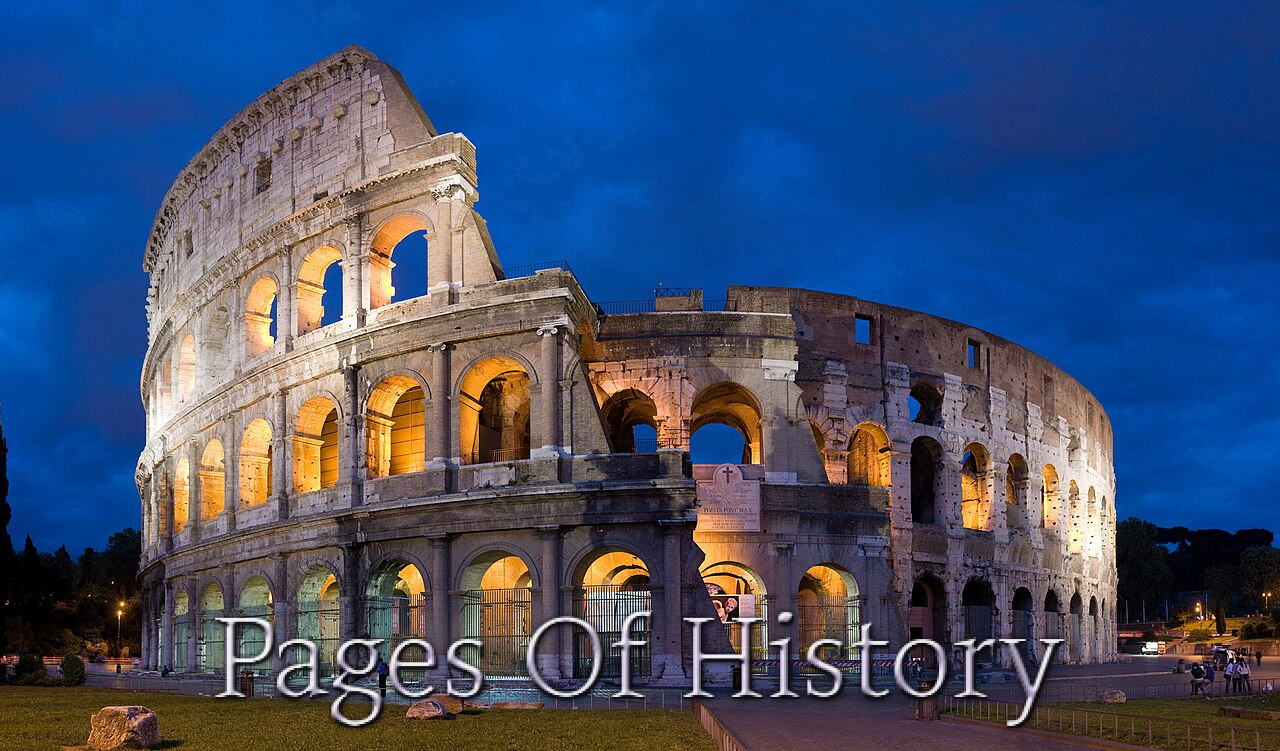
The most devastating blow came in 1349, when a massive earthquake struck central Italy. The southern outer wall of the Colosseum — already weakened — collapsed entirely. That rubble became a quarry. For centuries afterward, the Colosseum was mined for travertine, the limestone used in its construction.
Quarrying and Reuse
From the 11th century onward, Roman families and institutions treated the Colosseum as a ready-made supply of building material. The powerful Frangipane family fortified it as a castle in the 12th century. Later, the Annibaldi and Colonna families controlled it. In the 14th century, the papacy and various Roman churches carted off stone for projects including St. Peter’s Basilica and the Palazzo Venezia.
The scale of the plunder is staggering. Roughly two-thirds of the original Colosseum has been stripped away. The travertine blocks were prized for their durability and could be reused without re-cutting. Iron clamps that held the stones together were also pried out and melted down.
| Date | Event | Impact on the Colosseum |
|---|---|---|
| 404 AD | Honorius bans gladiatorial combat | End of the primary spectacle |
| 442 & 508 AD | Major earthquakes | Structural damage to outer arcades |
| 523 AD | Last recorded venatio (beast hunt) | Final use as an arena |
| 12th century | Frangipane family fortifies it | Reuse as a castle |
| 1349 | Great earthquake | Southern wall collapses; quarrying intensifies |
From Fortress to Church: The Colosseum’s Medieval Afterlife
The Colosseum’s story might have ended as a pile of rubble were it not for an unexpected savior: the Catholic Church. In the 16th century, Pope Sixtus V (r. 1585–1590) considered demolishing the Colosseum entirely and turning the site into a wool factory — a plan that would have employed Rome’s poor. He died before it could be carried out.
Instead, in 1675, Pope Clement X consecrated the Colosseum as a sacred site, commemorating the Christian martyrs who, according to tradition, had been killed there. (Modern historians debate how many Christians actually died in the arena — the evidence is thinner than popular legend suggests.) This consecration effectively ended the quarrying. The building was now a church, and churches were not to be dismantled.
In the 18th century, Pope Benedict XIV (r. 1740–1758) declared the Colosseum a protected monument and installed the Stations of the Cross around the arena. The papacy, which had once plundered the Colosseum for stone, now became its guardian.
Why the Colosseum Decline Still Matters
The Colosseum’s decline is more than an architectural tragedy. It is a case study in how civilizations lose their cultural anchors. The games ended not because Romans woke up one day and decided they were barbaric, but because the entire system that supported them — imperial patronage, a vast urban population, a thriving economy, and a shared pagan worldview — collapsed.
Consider what the Colosseum’s silence meant. For centuries, it had been where Romans gathered to see and be seen, where emperors performed generosity, and where the social order was enacted in stone and blood. When the games stopped, Rome lost a central ritual of civic identity. The city that had once been the capital of the world became a provincial backwater, its monuments scavenged for churches and palaces.
Yet the Colosseum survived — battered, hollowed, but standing. Its endurance is a reminder that even in decline, great structures can outlast the civilizations that built them. Today, it is one of the most visited monuments on Earth, attracting millions of tourists each year. But its true story is not one of glory. It is a story of slow, grinding change — of an empire that faded, a religion that rose, and a building that refused to disappear.
The next time you see a photograph of the Colosseum’s broken outer wall, remember: those missing stones are not just rubble. They are the physical record of a thousand years of decay, reuse, and survival. The Colosseum decline is written in every gap.