
📅 Last updated: 02.11.2026
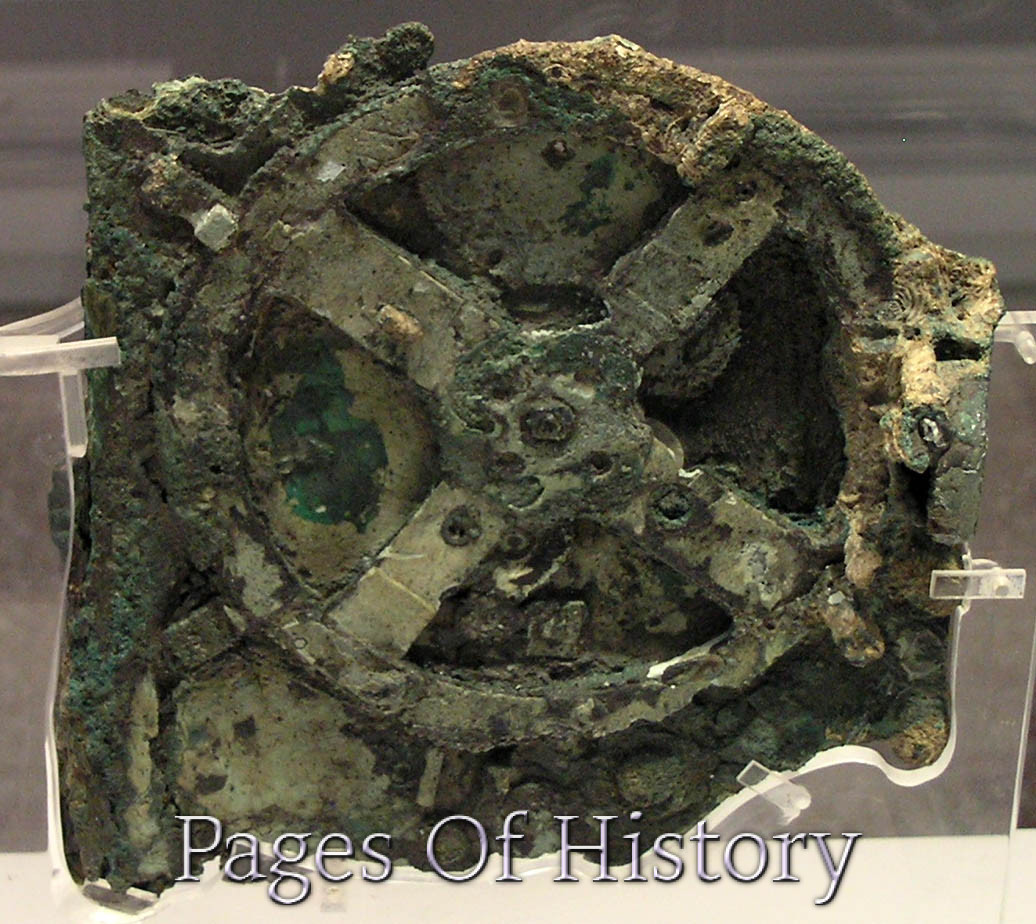
The Antikythera mechanism is the world’s oldest known analog computer, a bronze-geared astronomical calculator built by Greek craftsmen and lost in a shipwreck around 60 BCE. Recovered by sponge divers off the island of Antikythera in 1901 and decoded over the following century, it predicted eclipses, tracked the Sun and Moon through the zodiac, and modeled the irregular motions of the planets. No comparably complex geared device is known to have existed again until the astronomical clocks of medieval Europe, more than a thousand years later.
The Antikythera mechanism is a hand-powered bronze analog computer built in the second century BCE, most likely by Greek astronomers associated with Rhodes or Syracuse. Dating to roughly 150–100 BCE, it used at least 30 interlocking gears to calculate celestial positions, eclipse cycles, and the timing of the Olympic Games. Its sophistication was not matched again until the 14th century CE.
- What Is the Antikythera Mechanism and Why Does It Matter?
- Inside the Machine: How the Antikythera Mechanism Worked
- Who Built the Antikythera Mechanism? The Evidence and the Candidates
- How Was the Antikythera Mechanism Decoded?
- Timeline: Key Dates in the Antikythera Mechanism's Story
- Why Did This Technology Disappear?
- What the Antikythera Mechanism Tells Us About Ancient Science
- Frequently Asked Questions About the Antikythera Mechanism
- The Lasting Perspective: A Computer Before Its Time
What Is the Antikythera Mechanism and Why Does It Matter?
In the spring of 1900, a crew of Greek sponge divers sheltering from a storm off the barren islet of Antikythera, between Crete and the Peloponnese, surfaced with a startling report: a wreck on the seabed, strewn with bronze and marble statues. Working with primitive suits and immense risk, the divers—led by Elias Stadiatis—recovered the cargo of a large Roman-era freighter over the following months. Among the marble limbs, coins, and amphorae was a corroded lump of bronze and wood that nobody initially recognized as significant.
In 1902, the archaeologist Valerios Stais noticed a gear wheel embedded in the calcified mass. The object was deposited in the National Archaeological Museum in Athens, where it sat largely misunderstood for decades. Only in 1959 did Derek de Solla Price, a British physicist and historian of science at Yale, publish the first serious analysis, arguing that the fragment contained a differential gear—a device otherwise unknown before the 16th century. His 1974 monograph, Gears from the Greeks, established the object as a genuine ancient mechanical calculator and ignited a research program that continues today.
The mechanism matters because it overturns a comfortable narrative. The conventional story of technology holds that Greek science was theoretical and abstract, while practical mechanics belonged to later Roman engineers and medieval Islamic and European craftsmen. The Antikythera device is a physical refutation: a miniaturized, geared cosmos, built with a precision that required a mature tradition of metalworking, astronomical modeling, and mechanical design. It is, in effect, evidence of a lost engineering culture.
Inside the Machine: How the Antikythera Mechanism Worked
The surviving fragments—originally perhaps 19, later consolidated into 82 catalogued pieces—preserve at least 30 bronze gears, though the original count may have been closer to 37. The device was housed in a wooden box roughly the size of a shoebox, with a front face showing a dial of the zodiac and the Egyptian calendar, and a rear face carrying two large spiral dials. A handle on the side turned the entire gear train.
The Front Dial: A Moving Map of the Heavens
On the front, a pointer tracked the Sun’s annual progress through the zodiac, while a second pointer showed the Moon’s position. A rotating silver-and-black sphere displayed the Moon’s phase. The genius of the design lies in its handling of astronomical irregularity. The Greeks knew that the Moon does not move at constant speed across the sky—a phenomenon called the first anomaly. The mechanism models this with a pin-and-slot device: a gear mounted slightly off-center drives a pin that rides in a slot, producing a variable output speed that mimics the Moon’s acceleration and deceleration. It is the earliest known mechanical implementation of a non-uniform motion.
The Back Dials: Eclipses and the Games
The upper rear dial was a 223-month spiral tracking the Saros cycle, the 18-year, 11-day period after which eclipses recur in nearly identical geometry. Glyphs on the dial marked predicted solar and lunar eclipses and even noted the expected time of day and the color of the Moon—information useful for anticipating lunar eclipses. The lower rear dial tracked the Metonic cycle, a 19-year lunisolar period, and, ingeniously, a smaller subsidiary dial showed the dates of the Panhellenic Games, including the Olympics. The machine was therefore not purely astronomical: it was a calendar of civic and religious life, a portable almanac for a Greek world in which the timing of festivals carried political weight.
Who Built the Antikythera Mechanism? The Evidence and the Candidates
No inscription names the maker. The device’s dials and instructions are written in Koine Greek, and the astronomical conventions—the use of the Egyptian calendar, the inclusion of the Saros cycle, the reference to the Games—place it firmly in the Hellenistic world. But which city, and which school?
The leading candidate is Rhodes. The island was a major center of astronomy and mechanical craft in the second century BCE. Hipparchus of Rhodes (c. 190–120 BCE), arguably the greatest observational astronomer of antiquity, developed the lunar theory that the mechanism’s pin-and-slot device appears to implement. The ship that carried the device was likely sailing from the eastern Aegean toward Rome when it sank, consistent with a Rhodian origin. The astronomer Geminus of Rhodes and the Stoic philosopher Posidonius, who ran a school on the island, both fit the intellectual milieu.
Other scholars argue for Syracuse, the Sicilian city of Archimedes, whose mechanical planetarium was described by Cicero. In the Tusculan Disputations (1.63), Cicero reports that the Roman general Marcellus brought back to Rome a bronze sphere made by Archimedes that showed “the motions of the sun, moon, and five wandering stars.” Cicero’s contemporary, the poet Claudian, later described a similar device. The Archimedean tradition of geared planetaria may well be the direct ancestor of the Antikythera device, though the surviving machine’s specific design points more toward the second century BCE than to Archimedes’ lifetime (c. 287–212 BCE).
A third possibility is Pergamon, the Attalid capital, which was a center of learning and where the mathematician Apollonius of Perga had worked on the geometry of epicycles. Some researchers, including those behind the 2006 Antikythera Mechanism Research Project, have noted that the device’s eclipse predictions align with a Babylonian-derived method that circulated widely in the Hellenistic world, making a single point of origin hard to pin down.
What is clear is that the maker was not a lone genius but the product of a tradition: the mechanicians of the Hellenistic courts, men who combined geometry, observation, and metalwork. The device’s existence implies workshops capable of cutting precise gear teeth by hand—a skill requiring years of training and a supply of high-quality bronze.
How Was the Antikythera Mechanism Decoded?
The decoding of the mechanism is one of the great detective stories of archaeology, and it unfolded in stages, each enabled by new technology.
- 1902–1959: Valerios Stais identifies the gears; Derek de Solla Price begins systematic study, using X-rays and gamma radiography to peer inside the corroded mass.
- 1974: Price publishes Gears from the Greeks, establishing the device as an astronomical calculator and proposing the differential gear.
- 2005–2006: The Antikythera Mechanism Research Project, using a purpose-built microfocus CT scanner and reflectance imaging, reads thousands of hidden characters and maps the gear train in three dimensions.
- 2008–2021: Scholars including Tony Freeth, Alexander Jones, and the late Michael Wright refine the reconstruction, publishing the Cosmos model and identifying the Games dial and planetary mechanisms.
The 2006 CT scans were transformative. They revealed inscriptions that had been invisible for two millennia, including a “user manual” describing the front and rear dials and, crucially, a parapegma—a calendar of stellar risings and settings. The scans also showed that the device originally had a planetary display, with epicyclic gearing for the five visible planets, though only fragments of that section survive.
Timeline: Key Dates in the Antikythera Mechanism’s Story
| Date | Event | Significance |
|---|---|---|
| c. 150–100 BCE | Mechanism constructed, probably on Rhodes | Hellenistic astronomy and metalwork at their peak |
| c. 70–60 BCE | Shipwreck off Antikythera | Cargo of statues and the device lost en route to Rome |
| 1900–1901 | Sponge divers recover the wreck | First artifacts raised; mechanism among them |
| 1902 | Valerios Stais spots the gear | Recognition that the object is mechanical |
| 1974 | Derek de Solla Price publishes Gears from the Greeks | Establishes the device as an analog computer |
| 2006 | CT scanning by the Antikythera Mechanism Research Project | Hidden inscriptions and gear train revealed |
| 2012–2021 | New reconstructions and the “Cosmos” model | Planetary display and Games dial clarified |
Why Did This Technology Disappear?
The most striking fact about the Antikythera mechanism is not that it was built but that nothing like it survived in the written or material record for over a millennium. The reasons are partly historical and partly structural.
First, the device was almost certainly a luxury object, not a tool of daily life. It required skilled artisans, expensive bronze, and years of labor. Its patrons were likely kings, wealthy merchants, or civic institutions—not farmers or sailors. When the Hellenistic kingdoms fell to Rome in the first century BCE, the courtly patronage that sustained such workshops eroded. Roman engineering excelled at roads, aqueducts, and siege engines; it showed little interest in precision geared astronomy.
Second, the knowledge was embodied in the object itself, not fully in texts. The surviving treatises of Hero of Alexandria (first century CE) describe geared devices and automata, and the Mechanica attributed to Aristotle mentions gear trains, but no ancient text explains how to build a planetary computer. When the workshops closed, the tacit knowledge died with them.
Third, the physical fragility of bronze gearing meant that surviving examples were rare. Most ancient bronze was recycled; the Antikythera device survived only because it sank. The absence of evidence is therefore not evidence of absence—other devices may have existed and been melted down.
The legacy, however, is real. The Antikythera mechanism demonstrates that the ancient Greeks possessed the conceptual and technical tools for mechanical computation. The pin-and-slot device, the differential gear, and the epicyclic train are all present. The question historians now ask is not whether the Greeks could have built a computer, but why the tradition did not persist.
What the Antikythera Mechanism Tells Us About Ancient Science
The device forces a revision of how we understand Hellenistic science. It was not merely a body of geometric theory; it was an engineering practice capable of translating theory into metal. The mechanism’s designers had to solve problems of backlash, friction, and calibration that would challenge a modern machinist working with hand tools. The gear teeth, cut by hand, are remarkably uniform.
It also reveals the interconnectedness of Greek intellectual life. Astronomy, mathematics, mechanics, and civic religion were not separate domains. The Games dial, which tracked the Olympic, Pythian, Nemean, and Isthmian festivals, shows that the machine served a social function: it told its owner when the great festivals would occur, information of real political and religious importance. The device was a status symbol, a scholarly instrument, and a calendar in one.
Finally, the mechanism’s eclipse predictions carry a Babylonian inheritance. The Saros cycle and the Metonic cycle were both known in Mesopotamia centuries before they reached Greece. The Antikythera device is therefore a node in a long chain of transmission—from Babylonian astronomers to Greek geometers to Hellenistic mechanicians—and a reminder that ancient science was a collaborative, cross-cultural enterprise.
Frequently Asked Questions About the Antikythera Mechanism
Who built the Antikythera mechanism?
The maker is unknown, but the device was almost certainly built by Greek craftsmen in the Hellenistic world, most likely on Rhodes, in the second century BCE. The astronomical theory it implements is associated with Hipparchus of Rhodes, and the shipwreck’s cargo suggests an east-to-west route toward Rome.
How old is the Antikythera mechanism?
Dating of the wreck and the device’s inscriptions places its construction around 150–100 BCE, with some scholars favoring a date near 205 BCE. The ship sank around 70–60 BCE.
Was the Antikythera mechanism really a computer?
Yes, in the technical sense. It is an analog computer: a physical device that performs calculations through the interaction of its parts. Turning the handle input a date; the gear train output the positions of the Sun and Moon, eclipse predictions, and festival dates.
Why is the Antikythera mechanism important?
It is the earliest known geared mechanism of comparable complexity, predating the next such devices by more than a thousand years. It proves that Hellenistic engineers had mastered precision gear-cutting and non-uniform motion, and it reshapes our understanding of ancient science.
The Lasting Perspective: A Computer Before Its Time
The Antikythera mechanism is often described as a device “ahead of its time,” but that framing misses the point. It was not an anomaly dropped into an unsuspecting world; it was the logical product of a specific culture at a specific moment—Hellenistic Greece, where geometry, observation, and craftsmanship converged under royal patronage. Its loss was not a failure of ancient intelligence but a consequence of historical contingency: the fall of the kingdoms that funded such work, the recycling of bronze, and the absence of a textual tradition that could transmit the design.
What survives is a fragment of a machine and a challenge to our assumptions. The Antikythera mechanism reminds us that technological progress is not a straight line. Civilizations can possess sophisticated tools and then lose them. The device sat in a museum drawer for half a century before anyone understood what it was; it took another century of X-rays, CT scans, and patient scholarship to read its secrets. The lesson is not that the ancients were like us, but that they were capable of things we are still learning to see.
For historians, the mechanism is a corrective to the habit of treating the past as a prelude to the present. For engineers, it is a case study in elegant design under constraint. For anyone who has ever wondered how a civilization can forget its own achievements, it is a bronze-and-wood reminder that knowledge is fragile, and that the sea keeps what the world discards.