
📅 Last updated: 08.11.2026
The Great Emu War of 1932 stands as one of history’s strangest military episodes: a mechanized campaign by the Australian Army against tens of thousands of emus, waged with Lewis machine guns, trucks, and a military observer, and ultimately abandoned in defeat. The Great Emu War unfolded in the wheat belt of Western Australia over roughly six weeks, produced thousands of spent rounds and a few hundred dead birds, and became an enduring national joke—one that still shapes how Australians talk about pest control, bureaucracy, and the limits of firepower.
The Great Emu War was a military operation conducted in Western Australia between November and December 1932, in which soldiers of the Royal Australian Artillery, armed with Lewis machine guns, attempted to cull emus destroying wheat crops near Campion and Walgoolan. The operation failed to reduce the emu population meaningfully, was withdrawn after two phases, and was widely mocked in the press. It remains the clearest historical example of a modern army being outmaneuvered by a large flightless bird.
- What Caused the Great Emu War? The Wheat, the Soldiers, and the Birds
- Who Fought the Great Emu War? Major Meredith and the Lewis Guns
- Why Did the Great Emu War Resume? The Second Phase
- How Did the Press Turn the Great Emu War into a Legend?
- What Were the Real Lessons of the Great Emu War?
- Why Does the Great Emu War Still Matter?
- The Great Emu War in Perspective: A Failure of Tools, Not of Will
What Caused the Great Emu War? The Wheat, the Soldiers, and the Birds
The roots of the conflict lay in the economics of the Great Depression and the geography of the Western Australian wheat belt. After World War I, the Australian government ran soldier settlement schemes, granting Crown land to returned servicemen on the condition that they clear it and farm it. By the late 1920s and early 1930s, these marginal farms—often in semi-arid country around Campion, Walgoolan, and the Chandler and Campion districts—were struggling. Wheat prices had collapsed after 1929, and many settlers were deep in debt to the government for land, machinery, and seed.
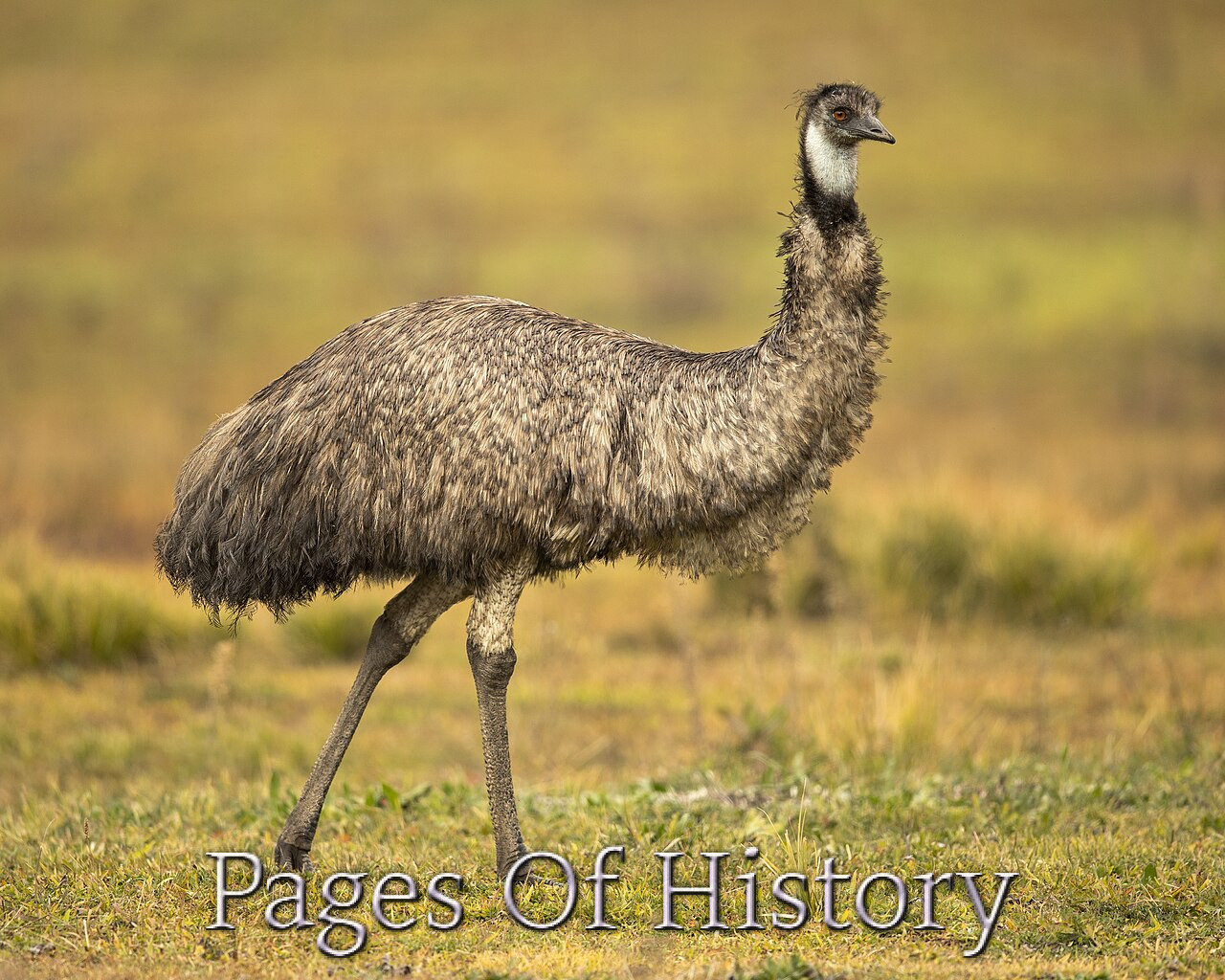
Then came the emus. Dromaius novaehollandiae, Australia’s largest native bird at up to 1.9 metres tall and roughly 45 kilograms, had long lived in the interior. But the clearing of land and the creation of water points—dams, tanks, and troughs built for sheep and wheat—created ideal conditions for them. In 1932, an unusually large migration pushed thousands of emus westward into the settled wheat belt. The birds arrived in mobs, trampled crops, and, critically, damaged the rabbit-proof fences that farmers depended on to keep out another pest, the European rabbit. Emus also followed the water and grain trails, returning again and again to the same paddocks.
The settlers, many of them veterans, had a natural instinct for the solution: machine guns. They had seen what concentrated firepower could do in France and Flanders. A delegation of farmers, led by figures including the local member of parliament for the district, approached the Minister of Defence, Sir George Pearce, and requested military assistance. Pearce, a former soldier and a pragmatic politician, agreed—but with conditions designed to keep the operation quasi-civilian: the farmers would supply food, accommodation, and transport, and the operation would be conducted by soldiers under the direction of the farmers themselves. The army would supply the guns and the gunners. It was, in bureaucratic terms, a pest-control contract dressed in khaki.
Who Fought the Great Emu War? Major Meredith and the Lewis Guns
The force assigned to the task was small: a handful of soldiers from the Royal Australian Artillery, equipped with two Lewis light machine guns and 10,000 rounds of ammunition, under the command of Major Gwynydd Purves Wynne-Aubrey Meredith of the 7th Heavy Battery, Royal Australian Artillery. Meredith was a career officer, not a naturalist, and his orders were straightforward: destroy the emus. He set up a forward base near Campion and, on 2 November 1932, began operations.
The first engagement set the tone for what followed. Meredith’s party encountered a mob of roughly 50 emus near Campion and opened fire at long range. The birds scattered, and the soldiers killed perhaps a dozen. A second attempt against a larger mob—by some accounts several hundred birds—saw the Lewis guns jam and the emus disperse into the scrub. The birds, it turned out, were remarkably resilient: their dense plumage and loose skin absorbed hits, and their speed, up to 50 km/h over short distances, made them difficult targets. They also learned. After the first few days, emus appeared to associate the trucks and guns with danger and began avoiding them, splitting into smaller groups and posting what observers described as sentries.
The Tactics That Failed
Meredith tried several approaches. He mounted a Lewis gun on a truck and attempted to chase the birds down, but the rough terrain and the emus’ agility made this ineffective. He tried ambushes at waterholes, which produced modest results. He tried night operations, which were hampered by poor visibility and the birds’ ability to slip away. The press, alerted to the operation, descended on the district. Journalists from Perth and the eastern states filed dispatches that treated the campaign as comedy, and photographers captured soldiers posing with dead emus and machine guns. The narrative of a modern army losing to birds was born almost immediately.
By early November, the operation had accounted for perhaps a few hundred emus—estimates vary widely, and the army’s own figures were inconsistent—against thousands of rounds expended. The farmers were not satisfied, and the press coverage was embarrassing. On 8 November 1932, the operation was withdrawn, and Meredith and his men returned to barracks. The withdrawal was portrayed in some quarters as a victory for the emus.
Why Did the Great Emu War Resume? The Second Phase
The emus did not oblige by leaving. Within days of the withdrawal, farmers reported that the birds had returned in even greater numbers, emboldened by the absence of gunfire. The wheat harvest was at risk, and the settlers again appealed for help. The Minister of Defence, under pressure, authorized a second phase. Meredith returned to the district in mid-November with the same guns, more ammunition, and a renewed mandate.
The second phase was more methodical. Meredith concentrated on water points and known crossing routes, and his men achieved better results—by some accounts killing several hundred emus in a few weeks. But the fundamental problem remained: the emu population was far larger than the operation could meaningfully reduce, and the birds’ mobility and wariness made systematic culling impossible with two machine guns and a handful of men. By early December 1932, the operation was again wound down. The army had expended roughly 9,860 rounds of ammunition—some accounts say 10,000 were issued and nearly all used—and killed an estimated 986 emus, with perhaps another 2,500 wounded that died later. Against a population in the tens of thousands, this was a rounding error.
| Date | Event | Outcome |
|---|---|---|
| 2 November 1932 | First engagement near Campion | About a dozen emus killed; mob scattered |
| 4–7 November 1932 | Ambushes and truck-mounted gun attempts | Lewis guns jam; emus avoid trucks and guns |
| 8 November 1932 | First phase withdrawn | Operation suspended amid press ridicule |
| Mid-November 1932 | Second phase authorized and begins | More methodical culling at water points |
| Early December 1932 | Operation ends | Roughly 986 emus killed for ~9,860 rounds; population largely unaffected |
How Did the Press Turn the Great Emu War into a Legend?
The Great Emu War became famous not because of its military significance—it had none—but because of how it was reported. Australian newspapers, already inclined to treat the campaign as a curiosity, ran headlines that framed the army as incompetent and the emus as cunning adversaries. The Sunday Herald and other papers published cartoons and satirical pieces. In the United Kingdom and the United States, wire services picked up the story, and the image of Australian soldiers with machine guns being outwitted by birds traveled around the world.
The press narrative was not entirely fair. Meredith’s men were operating under severe constraints: they were not allowed to use the most effective tactics (such as poisoning or aerial shooting), they were dependent on farmers for transport and intelligence, and the emus were genuinely difficult targets. The operation was also, in a narrow sense, a success in that it dispersed the birds and reduced local crop damage for a time. But the story that stuck was the comedy, and it stuck because it fit a broader Australian self-image: a nation of practical people who distrust military pomposity and enjoy a story where the underdog—or in this case, the underbird—wins.
The Great Emu War also entered the language of Australian politics. It has been invoked repeatedly in debates about pest control, government spending, and military procurement. When politicians propose expensive solutions to problems, critics compare them to the emu war. When bureaucracies overreach, the emu war is the cautionary tale. The phrase “emu war” has become shorthand for a campaign that costs more than it achieves.
What Were the Real Lessons of the Great Emu War?
The Great Emu War is often told as a joke, but it contains serious lessons about ecology, agriculture, and the limits of military thinking applied to civilian problems. The first lesson is ecological: the emu migration of 1932 was not an invasion but a consequence of land clearing, water development, and the disruption of the birds’ natural range. The farmers had, in effect, created the conditions for the problem they were trying to solve. The second lesson is tactical: machine guns are designed for warfare against humans, not for culling mobile, dispersed, wary animals. The third lesson is bureaucratic: a quasi-military operation with divided command, civilian logistics, and political oversight was never likely to succeed.
- Ecological cause: Land clearing and water points drew emus into the wheat belt; the birds were following habitat changes, not waging war.
- Tactical mismatch: Lewis guns and trucks were poorly suited to culling fast, dispersed, wary birds in open scrub.
- Command confusion: Soldiers were directed by farmers, constrained by politicians, and dependent on civilian transport and supply.
- Press effect: Media coverage turned a minor pest-control operation into a global symbol of military overreach.
The Aftermath and the Real Solution
After the army withdrew, the Western Australian government turned to a more practical solution: a bounty system. Farmers were paid for emu beaks or scalps, and over the following decades, bounties and improved fencing reduced the birds’ impact on crops. The emu remains a protected native species today, and the bounty system was eventually abolished. The rabbit-proof fence, ironically, became more important than the machine guns: it kept out rabbits, and the emus’ damage to the fence was one of the reasons the farmers were so alarmed in the first place.
The Great Emu War also had a small but real effect on military thinking. It reinforced the view that military assets should not be used for civilian pest control, and it contributed to the development of more specialized approaches to wildlife management in Australia. The operation was, in the end, a failure of imagination: the army treated the emus as an enemy to be defeated rather than a population to be managed.
Why Does the Great Emu War Still Matter?
The Great Emu War endures because it is a perfect story: a modern, mechanized army, fresh from the trenches of World War I, defeated by a flightless bird. It is funny, and it is also instructive. It shows how institutions can misapply their tools, how politics can distort military decisions, and how the press can turn a minor episode into a national myth. It also shows something about Australia: a country that has always had a complicated relationship with its wildlife, and that has learned, sometimes painfully, that the environment is not an enemy to be conquered.
The Great Emu War is remembered in books, documentaries, and popular culture, and it is still invoked in Australian public life. It has become a byword for a campaign that was doomed from the start—not because the soldiers were incompetent, but because the problem was never military. The emus won not by strategy but by being what they were: numerous, mobile, and indifferent to machine guns. That is the lasting lesson of the Great Emu War, and it is why the story still resonates nearly a century later.
The Great Emu War in Perspective: A Failure of Tools, Not of Will
The Great Emu War was not a battle in any meaningful sense. It was a pest-control operation that borrowed the language and equipment of war and failed because the problem it addressed was ecological and economic, not military. Major Meredith and his men did what they were asked, within the constraints they were given, and the result was a few hundred dead birds, a lot of spent ammunition, and a legend. The farmers got temporary relief, the press got a story, and the emus got a reprieve. The episode matters because it illustrates a persistent human tendency: to reach for the most dramatic tool available rather than the most appropriate one. In that sense, the Great Emu War is less a story about birds than a story about us—and about the cost of treating a complex problem as a simple target.