
📅 Last updated: 12.11.2026
The Sea Peoples are the name historians give to a loose, shifting coalition of seaborne raiders and migrants who attacked the eastern Mediterranean world in the late 13th and early 12th centuries BCE, and who are often blamed—sometimes too neatly—for the collapse of the Bronze Age. Between roughly 1200 and 1150 BCE, the interconnected palace economies of the Aegean, Anatolia, Cyprus, and the Levant came apart within a few generations, and Egyptian and Ugaritic records name these sea-borne attackers among the agents of destruction. The story of who they were, where they came from, and how much responsibility they bear for the catastrophe is one of the most contested problems in ancient history.
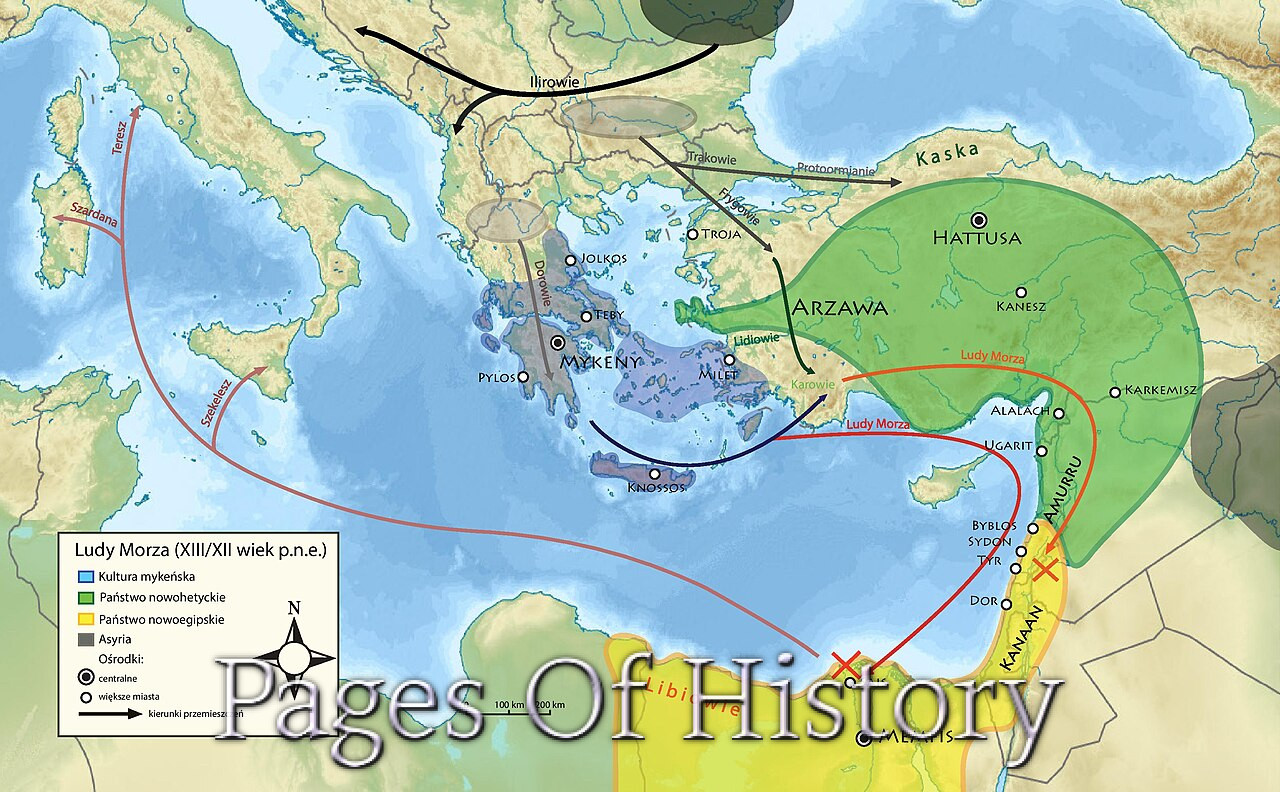
The “Sea Peoples” were a coalition of seafaring raiders and displaced populations—including groups the Egyptians called the Peleset, Tjeker, Shekelesh, Denyen, Weshesh, and Sherden—who attacked Egypt and the eastern Mediterranean around 1200–1175 BCE. They did not single-handedly destroy the Bronze Age: drought, earthquakes, internal rebellion, and collapsed trade networks all contributed. But their raids delivered the final blows to an already fragile system, and one group, the Peleset, settled on the Levantine coast and became the Philistines.
- What Do We Actually Know About the Sea Peoples?
- Who Were the Sea Peoples? Names, Origins, and Identities
- Why Did the Bronze Age Collapse? The Sea Peoples in Context
- The Great Battles: Ramesses III and the Year 8 Campaign
- How Did the Sea Peoples Change the Ancient World? Lasting Consequences
- Were the Sea Peoples Really to Blame? The Historiographical Debate
- What Can the Sea Peoples Teach Us About Collapse?
- The Sea Peoples in Memory and Myth
- The Lasting Perspective: A Collapse That Made the Modern World
What Do We Actually Know About the Sea Peoples?
Almost everything we “know” comes from the losing side—or rather, from the people who fought them. There is no Sea Peoples archive, no letter written in their own hand, no settlement that archaeologists can confidently label as their homeland. The evidence is Egyptian, Levantine, and Cypriot, filtered through the propaganda and anxiety of the societies under attack.
The two great Egyptian sources are the Great Harris Papyrus and the inscriptions and reliefs of Medinet Habu, the mortuary temple of Ramesses III at Thebes. The Medinet Habu reliefs, carved around 1175 BCE, show the famous naval battle in which Egyptian ships and archers defeated a fleet of invaders wearing feathered headdresses and horned helmets. The accompanying text lists the enemies by name and describes a war of annihilation:
“The foreign countries made a conspiracy in their islands. All at once the lands were removed and scattered in the fray. No land could stand before their arms, from Hatti, Kode, Carchemish, Arzawa, and Alashiya on, being cut off at one time.” — Medinet Habu inscription of Ramesses III
The other crucial text is the Rhind Papyrus and related documents from the reign of Ramesses II (r. 1279–1213 BCE), which describe the Sherden as mercenaries and captives employed in the Egyptian army decades before the great invasions. The Amarna Letters from the 14th century BCE mention raiders called the Shardanu operating in the Levant. In other words, the Sea Peoples were not a sudden apparition—they were a known, feared presence on the maritime fringe of the Bronze Age world long before the collapse.
Who Were the Sea Peoples? Names, Origins, and Identities
The Egyptian scribes gave the invaders names that have tantalized scholars for two centuries. The most frequently cited are the Peleset, Tjeker, Shekelesh, Denyen, Weshesh, and Sherden, with the Ekwesh and Lukka appearing in earlier campaigns. Matching these names to known peoples is an exercise in informed speculation.
- Peleset — almost certainly the Philistines, who settled the southern Levantine coast (Gaza, Ashkelon, Ashdod, Ekron, Gath) and gave their name to Palestine.
- Sherden — often linked to Sardinia, though the connection is debated; they served as Egyptian mercenaries from the reign of Ramesses II onward.
- Shekelesh — frequently associated with Sicily (the Sicels), a link that remains unproven.
- Ekwesh — plausibly the Achaeans (Mycenaean Greeks), named in Hittite texts as Ahhiyawa.
- Lukka — the Lycians of southwestern Anatolia, attested as raiders as early as the 14th century BCE.
- Denyen — possibly the Danaoi, another Greek name, or a people of Cilicia.
The temptation to treat these names as a tidy ethnic map should be resisted. The coalition was almost certainly multi-ethnic and opportunistic: displaced warriors, mercenaries, pirates, and whole families on the move. The Medinet Habu reliefs show ox-carts carrying women and children, suggesting migration as much as raid. The Sea Peoples were less a nation than a phenomenon—a maritime frontier coming apart at the seams.
Why Did the Bronze Age Collapse? The Sea Peoples in Context
The collapse of the Late Bronze Age was not a single event but a cascade of failures between about 1200 and 1150 BCE. The Mycenaean palaces burned. The Hittite capital at Hattusa was abandoned around 1180 BCE. Ugarit, the great trading city on the Syrian coast, was destroyed. Cyprus was devastated. Egypt survived, but shrunken and poorer, and never again projected power into the Levant as it had under Thutmose III or Ramesses II.
No single cause explains this. The most persuasive modern accounts emphasize systemic fragility: the Late Bronze Age was a tightly interlocked network of palace economies dependent on long-distance trade in copper, tin, olive oil, and luxury goods, sustained by diplomatic gift exchange and royal marriage alliances. When several stresses hit at once, the network had no redundancy.
The converging stresses
- Climate and drought: Pollen cores and isotope data from the Levant and Anatolia indicate a multi-decade drought around 1200–1150 BCE, devastating harvests and starving populations.
- Earthquakes: A cluster of seismic events in the Aegean and Anatolia damaged cities already weakened by other pressures.
- Internal rebellion: Hittite texts record famine and revolt; Mycenaean palaces show signs of destruction from within as well as without.
- Collapse of trade: Once one node failed, the whole exchange system unraveled, cutting off the tin supply essential to bronze production.
- Migration and raiding: Displaced populations moved by sea, sometimes as refugees, sometimes as raiders, sometimes as both.
The Sea Peoples were both cause and consequence. Their raids accelerated the breakdown of trade and destroyed key ports; but they were also pushed by the same droughts and famines that were wrecking the societies they attacked. The distinction between “invader” and “climate refugee” was often blurred.
The Great Battles: Ramesses III and the Year 8 Campaign
The decisive confrontation came in year 8 of Ramesses III, around 1175 BCE. The Medinet Habu inscriptions describe a two-front war: a land battle in the Levant or the Egyptian Delta, and a naval battle in which Egyptian ships lured the enemy fleet into a trap near the mouth of the Nile.
The Egyptian account is vivid and partisan. The pharaoh claims to have “made them come to land like fish” and to have “slain them in heaps.” The reliefs show Egyptian archers firing from ships while grappling hooks capsize enemy vessels. Whether the victory was as total as claimed is uncertain—pharaohs were not above exaggeration—but Egypt did survive as an independent state, while the Hittite empire did not.
The aftermath was significant. Ramesses III settled defeated Sea Peoples, including the Peleset, in fortified garrisons in Canaan. These settlements became the Philistine pentapolis—Gaza, Ashkelon, Ashdod, Ekron, and Gath—which would dominate the southern Levant for centuries and feature prominently in the Hebrew Bible as the enemies of Israel. The Sherden, meanwhile, were incorporated into the Egyptian army, and their descendants appear in later Egyptian records as loyal soldiers.
How Did the Sea Peoples Change the Ancient World? Lasting Consequences
The Sea Peoples matter less for what they destroyed than for what came after. The Bronze Age collapse cleared space for new political and cultural forms. The age of palace bureaucracies and chariot aristocracies gave way to smaller, more decentralized states: the Phoenician city-states of Tyre and Sidon, the kingdoms of Israel and Judah, the Neo-Hittite principalities of northern Syria, and eventually the Iron Age empires of Assyria and Persia.
| Date (BCE) | Event | Significance |
|---|---|---|
| c. 1279–1213 | Reign of Ramesses II; Sherden serve as Egyptian mercenaries | Shows Sea Peoples already active as soldiers, not just raiders |
| c. 1200–1180 | Destruction of Ugarit; fall of Hattusa; Mycenaean palace burnings | The core of the Bronze Age collapse |
| c. 1175 | Ramesses III defeats the Sea Peoples at the Nile (year 8) | Egypt survives; the invasion is repelled |
| c. 1175–1150 | Philistine settlement in Canaan | Peleset become the Philistines of the Hebrew Bible |
| c. 1150–1050 | Emergence of Iron Age states: Phoenicia, Israel, Neo-Hittites | A new political order replaces the palace economies |
The technological shift was equally profound. The collapse disrupted the tin trade that had sustained bronze production, and iron—more widely available and cheaper—gradually replaced bronze for tools and weapons. The alphabet, already developing among the Phoenicians and Canaanites, spread as the old scribal monopolies of the palaces vanished. The world that emerged from the wreckage was more fragmented, more literate in a popular sense, and more dynamic.
Were the Sea Peoples Really to Blame? The Historiographical Debate
Modern scholarship has grown skeptical of the traditional narrative that casts the Sea Peoples as the sole agents of destruction. The Egyptian texts are propaganda, the archaeological record is ambiguous, and the chronology is imprecise. Some scholars, notably those working on the Journal of Ancient Egyptian Interconnections and the Sea Peoples conference volumes edited by Seymour Gitin and others, argue that the Sea Peoples were a symptom rather than a cause—one factor among many in a systemic collapse.
Others push back. The destruction layers at Ugarit, the abandonment of Hattusa, and the sheer scale of the Medinet Habu campaign suggest that maritime raiding was a genuine and devastating military threat. The truth likely lies in between: the Sea Peoples were a real and violent force, but they succeeded because the societies they attacked were already hollowed out by drought, famine, and internal dissent.
There is also the question of numbers. The Medinet Habu reliefs show a large fleet, but whether the invaders numbered in the thousands or tens of thousands is unknowable. A relatively small, mobile, and desperate force can do enormous damage to a fragile network of undefended ports.
What Can the Sea Peoples Teach Us About Collapse?
The Bronze Age collapse is one of the few well-documented cases of a complex, interconnected civilization failing across an entire region. It has become a touchstone for modern discussions of systemic risk—of what happens when supply chains, trade networks, and political alliances are optimized for efficiency rather than resilience.
The lesson is not that migration or climate change inevitably destroy civilizations. It is that societies with little slack—no stored grain, no redundant trade routes, no political legitimacy beyond the palace—are vulnerable to shocks that a more resilient system would absorb. The Sea Peoples were the shock; the fragility was the cause.
The Sea Peoples in Memory and Myth
The Sea Peoples left no literature, but they left a deep imprint on the imagination of the cultures that survived them. The Philistines appear throughout the Hebrew Bible as the archetypal enemy—Goliath, Delilah, the Ark of the Covenant captured at Aphek. The Egyptian reliefs at Medinet Habu preserved their images for three thousand years. In the modern era, they have been cast as everything from proto-Vikings to climate refugees to the first victims of globalization.
What remains is a puzzle. We know their names, their ships, their weapons, and the fear they inspired. We do not know their language, their gods, or their own account of why they sailed. The Sea Peoples are a reminder that history is written by the survivors—and that the losers of the Bronze Age left only the wreckage of their enemies’ cities and the boasts of the pharaohs who stopped them.
The Lasting Perspective: A Collapse That Made the Modern World
The Sea Peoples did not destroy the Bronze Age world alone. They were the visible edge of a much larger crisis—a convergence of drought, earthquake, rebellion, and economic breakdown that no single actor could have caused or prevented. Yet their raids were real, their victims were real, and the world that emerged from the ashes of the 12th century BCE was fundamentally different from the one that preceded it.
The palace economies of Mycenae and Hattusa gave way to the city-states of Phoenicia and the kingdoms of Israel and Judah. Bronze gave way to iron. The age of the chariot aristocracy gave way to the age of the alphabet and the merchant. The Sea Peoples were, in a sense, the midwives of the Iron Age—unwitting agents of a transformation they could not have imagined. Their story is not one of simple destruction but of a world remade, and it remains one of the most sobering and instructive episodes in the history of civilization.