
📅 Last updated: 10.09.2026
The Salem witch trials of 1692 remain one of the most haunting episodes in American colonial history — a year in which neighbor turned against neighbor, courts accepted spectral visions as evidence, and twenty innocent people were executed in a corner of Massachusetts Bay. But the deeper question is not what happened; it is why. The trials did not erupt from nowhere. They were the product of a specific place, a specific moment, and a combustible mix of fear, faith, economics, and political collapse. Understanding why they happened requires looking far beyond the courtroom in Salem Town.
Setting the Stage: Salem in the 1690s
To understand the Salem witch trials, you have to understand the world that produced them. Seventeenth-century New England was a society built on religious covenant. The Puritans who settled Massachusetts Bay in the 1630s believed they were constructing a “city upon a hill” — a godly community bound by a contract with God. Any sign of divine displeasure, from crop failure to Indian raids to illness, was read as evidence that the covenant had been broken.
Within that worldview, the devil was not a metaphor. He was an active, predatory presence. Puritan theology taught that Satan recruited human agents — witches — to do his work on earth, offering them power or wealth in exchange for their souls. This was not superstition on the fringe; it was mainstream doctrine preached from every pulpit. When people in 1692 spoke of witches, they were describing what they genuinely believed to be a literal threat to their community and their eternal souls.
Salem itself was a community under strain. The town was split between Salem Village (now Danvers), a farming hinterland, and Salem Town, a prosperous port whose merchants grew wealthy on Atlantic trade. The villagers resented the town’s commercial culture, its taxes, and its apparent worldliness. Many villagers had also grown frustrated with their own ministers, and disputes over land, church leadership, and local autonomy had simmered for years. These tensions did not cause the trials by themselves, but they supplied the fault lines along which accusations would eventually travel.
A Colony Without a Charter
Timing mattered enormously. In 1684, King Charles II revoked the Massachusetts Bay Colony’s original charter. In 1686, the crown established the Dominion of New England, dissolving local self-government and placing the region under a royal governor, Sir Edmund Andros. Then came the Glorious Revolution in England: in 1688, James II was overthrown and William III and Mary II took the throne. When news reached Boston in 1689, colonists arrested Andros and threw off the Dominion.
But that left Massachusetts in legal limbo. For roughly three years, the colony had no valid charter and no clear legal foundation. A new charter finally arrived with Governor Sir William Phips in May 1692 — precisely as the witch crisis was accelerating. Into that vacuum of authority stepped a court system willing to accept evidence that more cautious jurists would have rejected.
The Spark: Bewitchment in Salem Village
The crisis began in the home of the village minister, Samuel Parris. In January 1692, his nine-year-old daughter Elizabeth and his eleven-year-old niece Abigail Williams began suffering fits — contortions, trances, and complaints of being pinched and pricked by invisible forces. A local doctor, William Griggs, could find no physical cause and suggested the girls were bewitched.
Under pressure to name their tormentors, the girls accused three women: Sarah Good, a homeless beggar; Sarah Osborne, a woman who had rarely attended church; and Tituba, an enslaved woman of African or indigenous descent held in the Parris household. All three were outsiders in some way — poor, religiously irregular, or enslaved — and all three fit the profile of people a Puritan community might suspect.
Tituba’s confession in late February or early March proved pivotal. She described the devil appearing to her as a man, spoke of signing his book, and claimed other witches were conspiring in the village. Her testimony gave the accusations a narrative shape and a growing cast of characters. The hunt was no longer about three marginal women; it was about a conspiracy.
“The Devil hath been raised amongst us, and his rage is vehement and terrible, and when he shall be silenced, the Lord only knows.”
— Rev. Samuel Parris, in a contemporary sermon
How the Salem Witch Trials Unfolded
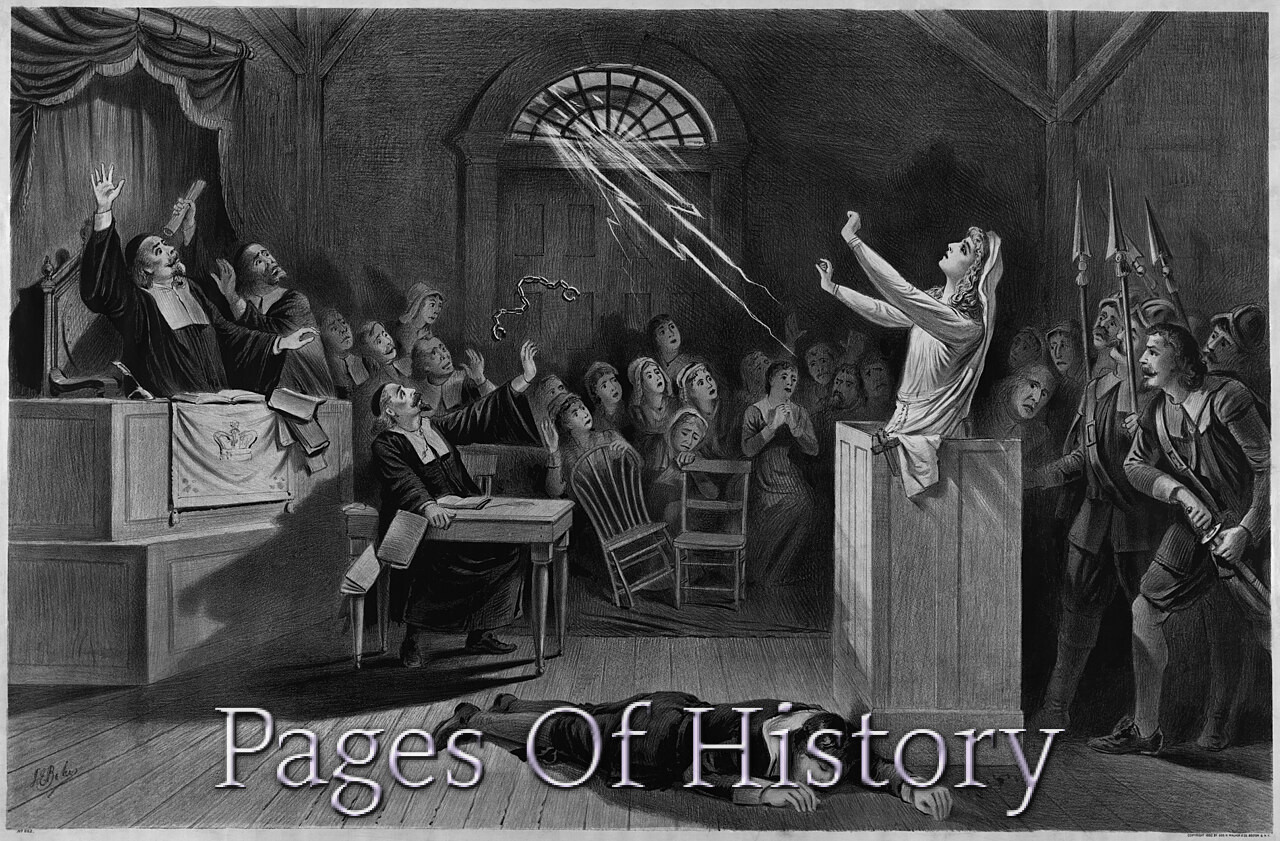
What followed was a legal catastrophe that unfolded with terrible speed. Arrests multiplied through the spring. By May, the new governor, William Phips, had established a special Court of Oyer and Terminer — “to hear and determine” — to handle the backlog. Its chief justice was William Stoughton, a hardline magistrate with no legal training in witch cases and a strong personal conviction that the accused were guilty.
The court’s procedures were the engine of the disaster. Rather than requiring direct evidence of a crime, the judges admitted “spectral evidence” — testimony that the accused’s spirit or ghostly shape had tormented the victim. Because no one but the afflicted could see these specters, the accusation was effectively unanswerable. The accused could deny it, but denial was taken as further proof of the devil’s influence.
Other forms of evidence compounded the problem:
- Confessions: Suspects who confessed and named others were spared execution, creating a powerful incentive to accuse.
- Touch tests: If a fits-stricken accuser calmed upon touching the accused, it was read as proof of guilt.
- Witch marks and “devil’s marks”: Moles, scars, or unusual blemishes were treated as evidence of a familiar spirit.
- Dreams and visions: The afflicted were permitted to describe encounters that no one else could verify.
Between June and September 1692, nineteen people were hanged on Gallows Hill in Salem. One man, Giles Corey, refused to enter a plea and was pressed to death with heavy stones over two days in September — a form of torture meant to force a plea, and the only such execution in colonial New England. Several others died in jail, including the infant of Sarah Good. In total, roughly 200 people were accused across dozens of towns, though the heaviest concentration remained in Essex County.
Key Dates and Events
| Date | Event | Why It Mattered |
|---|---|---|
| January 1692 | Fits begin in the Parris household | Ignited the initial accusations |
| February–March 1692 | First arrests; Tituba confesses | Turned a local scare into a conspiracy narrative |
| May 1692 | Gov. Phips arrives; Court of Oyer and Terminer created | Gave the trials legal machinery and official backing |
| June–September 1692 | 19 hanged; Giles Corey pressed to death | Peak of the executions |
| October 1692 | Gov. Phips dissolves the court | Began the collapse of the proceedings |
| 1693–1697 | Convictions reversed; fast day declared | Official acknowledgment of error |
Why Did the Salem Witch Trials Really Happen? The Deeper Causes
If you ask why the Salem witch trials happened, the honest answer is that no single cause explains them. Historians have identified a cluster of overlapping pressures, each of which made the community more willing to believe the worst about its own members.
1. Religious Belief and the Reality of the Devil
This is the factor modern readers most often underestimate. For the Puritans, witchcraft was not folklore; it was a crime against God and a threat to the entire community. The Bible commanded, “Thou shalt not suffer a witch to live” (Exodus 22:18), and ministers like Cotton Mather actively promoted the idea that New England was under satanic assault. Mather’s 1689 book Memorable Providences, Relating to Witchcrafts and Possessions described a case in Boston that many saw as a template for Salem. His later Wonders of the Invisible World (1693) defended the trials even as they were collapsing.
2. Political Instability and the Absence of Authority
The colony had been operating without a charter for years. When the new government finally arrived in May 1692, it inherited a crisis already in motion. Officials eager to demonstrate control and godliness had every incentive to take the accusations seriously. A strong response to the devil could be framed as strong governance.
3. Economic and Social Friction
Many of the accused were relatively prosperous or independent — people who had accumulated land, challenged local elites, or declined to conform. The accusers, by contrast, were often poorer, younger, and female. Historian Paul Boyer and Stephen Nissenbaum argued in Salem Possessed (1974) that the trials channeled a long-running conflict between the commercial town and the agrarian village, with accusations moving along lines of family alliance, debt, and resentment. This thesis has been debated, but the pattern is hard to ignore.
4. Gender and the Status of Women
The overwhelming majority of the accused were women — roughly three-quarters. Many were middle-aged or older, widowed, or otherwise outside male protection. Women who inherited property, spoke too freely, or lacked male guardians were especially vulnerable. The trials were not simply a “war on women,” but gender shaped who was suspected, who was believed, and who was condemned.
5. Trauma, Fear, and Frontier War
Essex County in the early 1690s was a society under siege. King William’s War (1688–1697) brought brutal raids along the northern frontier. In 1690, the failed expedition against Quebec and the destruction of Schenectady, New York, spread panic. Refugees poured into Salem and surrounding towns, carrying stories of massacre, captivity, and torture. When a community is already terrified, the idea that the devil has infiltrated it becomes far more plausible.
6. The Dynamics of Accusation Itself
Once the process began, it became self-sustaining. Confessing suspects named others to save themselves. Accusers gained attention, status, and a kind of power. The afflicted girls — including Abigail Williams, Elizabeth Parris, Ann Putnam Jr., Mercy Lewis, and Mary Walcott — became the center of a drama that authorities could not easily stop without admitting they had been wrong. The machinery of accusation had its own momentum.
The Collapse and Aftermath
The trials did not end because the judges suddenly saw reason. They ended because the evidence became impossible to sustain. When prominent figures were accused — including the wife of Governor Phips — the political cost became unbearable. In October 1692, Phips dissolved the Court of Oyer and Terminer and replaced it with a new Superior Court that excluded spectral evidence.
That change was decisive. Without spectral testimony, convictions collapsed. In January 1693, the new court acquitted most remaining defendants, and the governor pardoned those still under sentence. By 1697, the colony had declared a day of fasting and repentance. Samuel Sewall, one of the judges, publicly acknowledged his guilt. In 1702, the Massachusetts legislature declared the trials unlawful, and in 1711 it passed an act reversing attainders and compensating survivors. It took until 1957 for Massachusetts to formally exonerate the last of the accused, and until 2001 for the state to clear the names of those convicted.
The human cost was permanent. Families were shattered. Farms were abandoned. Tituba, after being sold to pay her jail fees, disappears from the historical record. Giles Corey’s estate was forfeited. The reputations of the dead were not fully restored for centuries.
Why the Salem Witch Trials Still Matter
The Salem witch trials were not an isolated outburst of medieval superstition in an otherwise enlightened society. They were a modern crisis of evidence, authority, and fear. The colony had courts, juries, and legal procedures — and those institutions failed because they accepted testimony that could not be tested and because leaders were unwilling to challenge a popular panic.
That is why the episode remains so resonant. It is a case study in how fear can override reason, how legal systems can be bent to serve social pressure, and how ordinary people can be destroyed by accusations that no one can disprove. The trials also left a lasting mark on American law and culture: the presumption of innocence, the rejection of spectral evidence, and the caution against “witch hunts” in politics and public life all trace back, in part, to 1692.
In the end, the question “why did the Salem witch trials really happen?” has no single answer — and that is precisely the point. They happened because a frightened, divided, politically unstable community, armed with sincere religious conviction and flawed legal tools, chose certainty over doubt. The lesson is not that the Puritans were uniquely credulous. It is that any society, under enough pressure, can mistake its fears for facts.