
📅 Last updated: 25.11.2026
The Battle of Carrhae, fought in 53 BCE near the ancient city of Harran in what is now southeastern Turkey, stands as one of the most catastrophic defeats in Roman military history. A Roman army of roughly 40,000 men under the triumvir Marcus Licinius Crassus marched into the Mesopotamian desert expecting an easy triumph over the Parthian Empire. Instead, it was annihilated by a far smaller force of horse archers and armored cataphracts, and the legionary standards—the sacred eagles—fell into enemy hands for the first time in Rome’s history.
The Battle of Carrhae (53 BCE) was a decisive Parthian victory in which a Roman invasion force under Marcus Licinius Crassus was destroyed by a smaller Parthian cavalry army near Carrhae (modern Harran, Turkey). Crassus and his son Publius were killed, roughly 20,000 Romans died, and about 10,000 were captured, while the legionary eagles were seized—an humiliation Rome did not fully avenge for decades.
- Why Did Crassus Invade Parthia? The Politics Behind the Battle of Carrhae
- The Campaign Begins: Invasion, Misjudgment, and the Road to Carrhae
- How Did Surena Defeat a Roman Army at the Battle of Carrhae?
- Key Facts and Timeline of the Carrhae Campaign
- The Death of Crassus and the Capture of the Eagles
- Why Did Rome Lose at Carrhae? The Strategic Lessons
- What Were the Consequences of the Battle of Carrhae?
- How Did Ancient Sources Remember Carrhae?
- What Is the Lasting Legacy of the Battle of Carrhae?
Why Did Crassus Invade Parthia? The Politics Behind the Battle of Carrhae
To understand the disaster, you have to understand the man who caused it. Marcus Licinius Crassus was the wealthiest man in Rome, the financier of the First Triumvirate alongside Pompey and Julius Caesar, and the general who had crushed the slave revolt of Spartacus in 71 BCE. Yet among the three partners, he alone lacked the kind of military glory that Roman politics demanded. Pompey had conquered the East and celebrated multiple triumphs; Caesar was carving out a legendary reputation in Gaul. Crassus, approaching sixty, wanted a triumph of his own—and a spectacular one.
The opportunity came through the tribune Publius Clodius Pulcher’s legislation and the political maneuvering of 55 BCE, when the triumvirs renewed their alliance at Luca. Crassus received the province of Syria as his command for five years, with explicit authority to wage war. He announced that he would campaign against Parthia, Rome’s great rival to the east, which had never been conquered and which had humiliated earlier Roman commanders.
Not everyone approved. The tribune Ateius Capito tried to block the expedition with religious obstruction and, according to the historian Cassius Dio, pronounced curses on Crassus as he left Rome. Cicero, writing later, was blunt about the motives: the war was launched “sine causa”—without just cause. Crassus, in other words, was not responding to a Parthian threat. He was manufacturing a casus belli to win personal prestige.
The Geopolitical Context
Parthia, ruled at the time by Orodes II, was no minor power. The Arsacid dynasty controlled an empire stretching from the Euphrates to the Hindu Kush, and its army was built around two formidable cavalry types: light horse archers who could harass and outmaneuver heavy infantry, and cataphracts—armored lancers whose horses and riders were clad in mail or scale. Rome and Parthia had clashed before, notably when Pompey had settled the Euphrates frontier, but full-scale invasion was a different matter. Crassus ignored the strategic realities and the warnings of local allies who knew Parthian warfare firsthand.
The Campaign Begins: Invasion, Misjudgment, and the Road to Carrhae
Crassus arrived in Syria in 54 BCE and immediately began preparations. He crossed the Euphrates, occupied several Mesopotamian cities, and installed a garrison in the region. The early moves looked promising, and he returned to Syria for the winter to gather more troops and funds—including, according to some sources, plundering the temple treasury at Jerusalem. By the spring of 53 BCE, he had assembled a substantial army:
- Seven legions of heavy infantry, roughly 35,000–40,000 men
- About 4,000 light infantry and 3,000–4,000 cavalry, including Gallic horsemen under his son Publius Crassus
- Local guides and auxiliaries, including a dubious Arab chieftain named Ariamnes (or Abgarus)
The army’s composition was its first weakness. Rome’s legions were designed for close-quarters combat against infantry and could dominate open battlefields—but they had no answer to mobile cavalry in flat, waterless terrain. Crassus had almost no archers and no reliable cavalry screen, and he was marching into country where the Parthians held every advantage.
The Fatal Advice of Ariamnes
As Crassus advanced, the Parthian general Surena—a young nobleman commanding perhaps 10,000 men, including about 1,000 cataphracts and 9,000 horse archers—used a deliberate strategy. He kept his main force hidden and sent Ariamnes to advise Crassus to pursue the Parthians quickly into the desert. The guide promised that the enemy was fleeing and that speed would bring a decisive victory. Crassus, hungry for a quick triumph, took the bait. He left the river and the safety of his supply lines, marching his army into the arid plains near Carrhae.
How Did Surena Defeat a Roman Army at the Battle of Carrhae?
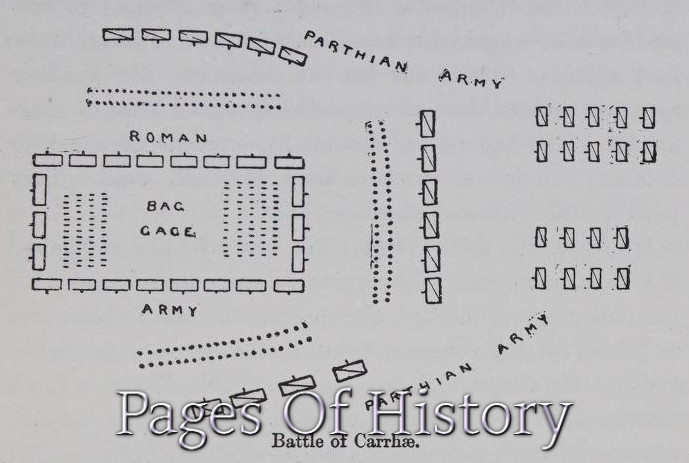
The answer lies in terrain, tactics, and the Parthian mastery of combined cavalry warfare. When the Romans finally met the enemy in June 53 BCE, they found not a fleeing army but a disciplined force waiting on open ground. Crassus deployed his legions in a massive square formation, hoping to present a solid front in every direction. It was a defensive posture that played directly into Parthian hands.
The Horse Archers and the “Parthian Shot”
Surena’s horse archers encircled the Roman square and unleashed volleys of arrows. The legionaries could not close the distance; the Parthians simply rode away, firing backward over their horses’ tails—the maneuver that gave us the phrase “Parthian shot.” Roman armor and shields were pierced by the heavy bows, and the arrows kept coming. According to Plutarch, the Parthians had camels loaded with arrows to resupply the archers, ensuring a virtually endless barrage. The Romans could neither catch the enemy nor escape the rain of missiles.
The Cataphract Charge and the Death of Publius Crassus
When Crassus ordered his son Publius to counterattack with cavalry and supporting troops, the Parthians lured the detachment away from the main body. The cataphracts then charged, breaking the Roman cavalry, while horse archers surrounded the isolated infantry. Publius Crassus, a capable and popular officer, was killed along with most of his men. Plutarch records that his head was later carried on a spear and shown to his father—a psychological blow that shattered Roman morale. The main army, still under arrow fire and unable to fight back effectively, began to disintegrate.
Key Facts and Timeline of the Carrhae Campaign
| Date | Event |
|---|---|
| 55 BCE | Crassus receives command of Syria and the right to wage war against Parthia; triumvirs renew their alliance at Luca. |
| 54 BCE | Crassus invades Mesopotamia, captures several cities, and winters in Syria, raising troops and funds. |
| Spring 53 BCE | Crassus crosses the Euphrates with about 40,000 men; Ariamnes misleads him into the desert. |
| June 53 BCE | The Battle of Carrhae: Surena’s cavalry destroys the Roman army; Publius Crassus is killed. |
| Aftermath | Crassus is killed during negotiations; roughly 20,000 Romans die and 10,000 are captured; the eagles are taken. |
| 20 BCE | Augustus negotiates the return of the standards from Parthia—a diplomatic triumph that ends the humiliation. |
The Death of Crassus and the Capture of the Eagles
With his army broken, Crassus retreated toward the city of Carrhae and then attempted to escape under cover of darkness. His remaining men were exhausted, wounded, and leaderless in the chaos. Local guides and the treacherous Ariamnes again played a role, leading the Romans astray. When Surena offered a truce and a meeting, Crassus was persuaded—or forced—to attend. According to Plutarch and Cassius Dio, the meeting turned violent, and Crassus was killed, reportedly by having molten gold poured down his throat in a grotesque mockery of his legendary greed. The story may be embellished, but its symbolic power stuck.
The human cost was staggering. Of the roughly 40,000 Romans who entered the campaign, perhaps 20,000 were killed and about 10,000 were taken prisoner. The legionary eagles—the aquilae that symbolized the soul of each legion—were captured and carried off to Parthia. For Rome, this was not merely a defeat; it was a sacrilege. The eagles had been lost before in ambushes, but never to a foreign power in a set-piece war of this scale.
The Captives and the “Roman” City of the East
The fate of the captured legionaries became one of history’s most fascinating footnotes. Ancient sources and later scholarship suggest that some of these prisoners were settled in Margiana, near Merv in modern Turkmenistan, and may have been used as frontier soldiers. The theory that they ended up in the Chinese city of Liqian—sometimes linked to the Roman-style tactics of the nomadic Zhizhi—remains speculative and debated by historians. What is certain is that thousands of Roman soldiers vanished into the Parthian East, a grim reminder of how completely Crassus’s army was erased.
Why Did Rome Lose at Carrhae? The Strategic Lessons
The defeat was not simply bad luck. It was the product of identifiable failures that Rome’s own commanders studied for generations:
- Intelligence failure: Crassus trusted a local guide who was working for the enemy and marched into terrain that favored the Parthians.
- Tactical mismatch: Heavy infantry without adequate cavalry and missile support could not cope with mobile horse archers on open ground.
- Political motivation over strategy: The invasion was launched for personal glory rather than a coherent plan to conquer or pacify Parthia.
- Overconfidence: Crassus ignored warnings and assumed Roman discipline would carry the day against an unfamiliar enemy.
The Parthians, by contrast, demonstrated a sophisticated understanding of their own strengths. Surena’s use of feigned retreat, resupply by camel, and the coordination of horse archers with cataphracts was textbook cavalry warfare. The battle became a case study in how a smaller, mobile force can destroy a larger, slower army when it controls the terms of engagement.
What Were the Consequences of the Battle of Carrhae?
The immediate political consequences in Rome were dramatic. The triumvirate, already strained, lost its balancing force. Pompey and Caesar drifted toward civil war, and within a decade the Roman Republic itself was collapsing. Crassus’s death removed the one figure who might have mediated between them, though it is doubtful he could have prevented the conflict.
On the eastern frontier, the balance of power shifted. Parthia had proven it could defeat a Roman army in the field, and Rome’s eastern ambitions were checked for decades. It was not until the reign of Augustus that Rome recovered the captured standards, and even then through diplomacy rather than conquest. In 20 BCE, Augustus negotiated the return of the eagles from the Parthian king Phraates IV—a triumph he celebrated on coins and in his Res Gestae, where he boasted that he had compelled the Parthians to return the standards without war. The episode became a cornerstone of Augustan propaganda: the humiliation of Carrhae was finally erased, at least symbolically.
The Long Shadow on Roman-Parthian Relations
Carrhae set the tone for centuries of Roman-Parthian conflict. Subsequent campaigns—Trajan’s invasion of Mesopotamia in 114–117 CE, the wars of Lucius Verus and Septimius Severus, and the later conflicts with the Sasanian successors of Parthia—all operated in the shadow of Crassus’s failure. Rome never fully conquered Parthia, and the frontier remained a zone of rivalry, trade, and occasional catastrophe. The lost eagles became a symbol of what could go wrong when Rome underestimated an eastern enemy.
How Did Ancient Sources Remember Carrhae?
The primary sources are rich but must be read with care. Plutarch’s Life of Crassus is the most detailed narrative, written more than a century after the event and shaped by moral lessons about greed and hubris. Cassius Dio, writing in the third century CE, provides additional detail and a more analytical perspective. Cicero, a contemporary, mentions the campaign and its consequences in his letters and speeches. The Roman poet Horace later wrote of the shame of the lost standards, and Augustus’s Res Gestae framed their recovery as a national vindication.
These sources agree on the broad outlines—the overwhelming Parthian victory, the death of Crassus, the capture of the eagles—but differ on details and motives. Modern historians, drawing on archaeology and comparative study of cavalry warfare, have confirmed the essentials while cautioning against some of the more colorful anecdotes, such as the molten gold. The consensus is that Carrhae was a genuine military disaster caused by a combination of poor leadership, inadequate intelligence, and a fundamental mismatch between Roman and Parthian ways of war.
What Is the Lasting Legacy of the Battle of Carrhae?
Carrhae endures as a cautionary tale about the dangers of overconfidence and the cost of wars launched for personal ambition. It demonstrated that Rome’s legions, however formidable, were not invincible—and that the empire’s eastern frontier demanded a different kind of warfare than the close-quarters battles of the Mediterranean world. The battle also shaped the relationship between Rome and Parthia for generations, establishing a pattern of rivalry that would outlast both empires.
For military historians, Carrhae is a classic study in asymmetry: a smaller, mobile force defeating a larger, heavier army by controlling distance and tempo. For students of Roman politics, it is a reminder that the Republic’s greatest generals were often driven by personal rivalries as much as by strategic necessity. And for anyone interested in the fragility of power, it is a vivid illustration of how quickly a triumphant march can turn into a catastrophe.
The eagles that fell at Carrhae were eventually returned, but the memory of the defeat never faded. It remained a stain on Roman honor, a lesson in humility, and a warning that even the mightiest empire can be undone by a general who mistakes ambition for strategy.