
📅 Last updated: 26.07.2026
- The Weakening Empire: Byzantine Decline Before the Fall of Constantinople
- The Great Siege Begins: Forces, Weapons, and Strategy in the Fall of Constantinople
- Key Dates and Turning Points of the Siege
- Aftermath and Legacy: The Fall of Constantinople in World History
- Lessons and Misconceptions About the Fall of Constantinople
- Conclusion: The Conquest That Changed Two Worlds
On May 29, 1453, the Fall of Constantinople ended more than a thousand years of Byzantine rule and reshaped the political and religious map of Europe and the Middle East. This single event, long prophesied and grimly anticipated, did not happen overnight; it was the culmination of decades of decline, brilliant Ottoman strategy, and a desperate last stand by a handful of defenders. To understand why this ancient capital fell—and why its loss still echoes today—we must examine not only the fifty-three-day siege but the forces that made it inevitable.
The Weakening Empire: Byzantine Decline Before the Fall of Constantinople
By the dawn of the fifteenth century, the Byzantine Empire was a ghost of its former self. Once stretching from the Balkans to the Euphrates, it had been reduced to little more than the city of Constantinople itself, a few Aegean islands, and the Peloponnese. The Fourth Crusade in 1204 had dealt a blow from which the empire never fully recovered, leaving it territorially shattered and financially crippled. Even after the recapture of Constantinople in 1261 under Michael VIII Palaiologos, the empire remained a pawn in the games of larger powers.
Territorial and Economic Strangulation
By the reign of Emperor Constantine XI Palaiologos (1449–1453), the empire controlled almost no productive land. The Ottoman Turks had long since taken over the rich farmlands of Anatolia and Thrace. The city’s population, once half a million, had dwindled to perhaps 50,000 souls, many of them impoverished. Trade, the lifeblood of Constantinople for centuries, had shifted to Italian maritime republics like Genoa and Venice; the Byzantine treasury was so bare that Constantine could barely pay his few soldiers or maintain the city’s legendary walls.
The empire’s isolation was nearly complete. A failed union with the Roman Catholic Church at the Council of Florence (1439) had alienated most of the Orthodox population, who preferred Ottoman rule to papal interference. When Constantine XI appealed to Western Europe for help, the response was meager: a few hundred archers from Genoa under the brilliant condottiero Giovanni Giustiniani Longo, and a small fleet of Venetian and Genoese ships. The vast crusading army that had once marched to save Byzantium was a memory.
Mehmed II: The Architect of Conquest
On the other side of the Bosporus stood Sultan Mehmed II, just twenty-one years old but already consumed by a singular ambition. From his grandfather Murad II, Mehmed had inherited not only a powerful army but a clear strategic vision: Constantinople was the key to unifying the Ottoman domains and cementing his legitimacy. Mehmed was no simple warrior; he was a student of history, philosophy, and military engineering. He spoke several languages, including Greek and Latin, and had studied the city’s defenses for years.
Almost immediately after his second accession to the throne in 1451, Mehmed began preparations. He constructed the fortress of Rumelihisarı on the European shore of the Bosporus in just four months (1452), directly opposite an older Ottoman fort. This move gave the Turks complete control over the strait, strangling any potential grain shipments from the Black Sea to Constantinople. The die was cast.
The Great Siege Begins: Forces, Weapons, and Strategy in the Fall of Constantinople
Mehmed assembled an army that contemporary chroniclers estimated at 80,000 to 100,000 men, though modern historians lean toward 60,000 to 80,000. This force included elite Janissaries, Balkan infantry (Azabs), Anatolian cavalry, and a large contingent of miners and engineers. The defenders, by contrast, numbered no more than 7,000 to 8,000 men, including perhaps 2,000 foreign volunteers. The disparity was staggering, but the Theodosian Walls had repelled far larger armies for centuries.
The Theodosian Walls: A Test of Engineering
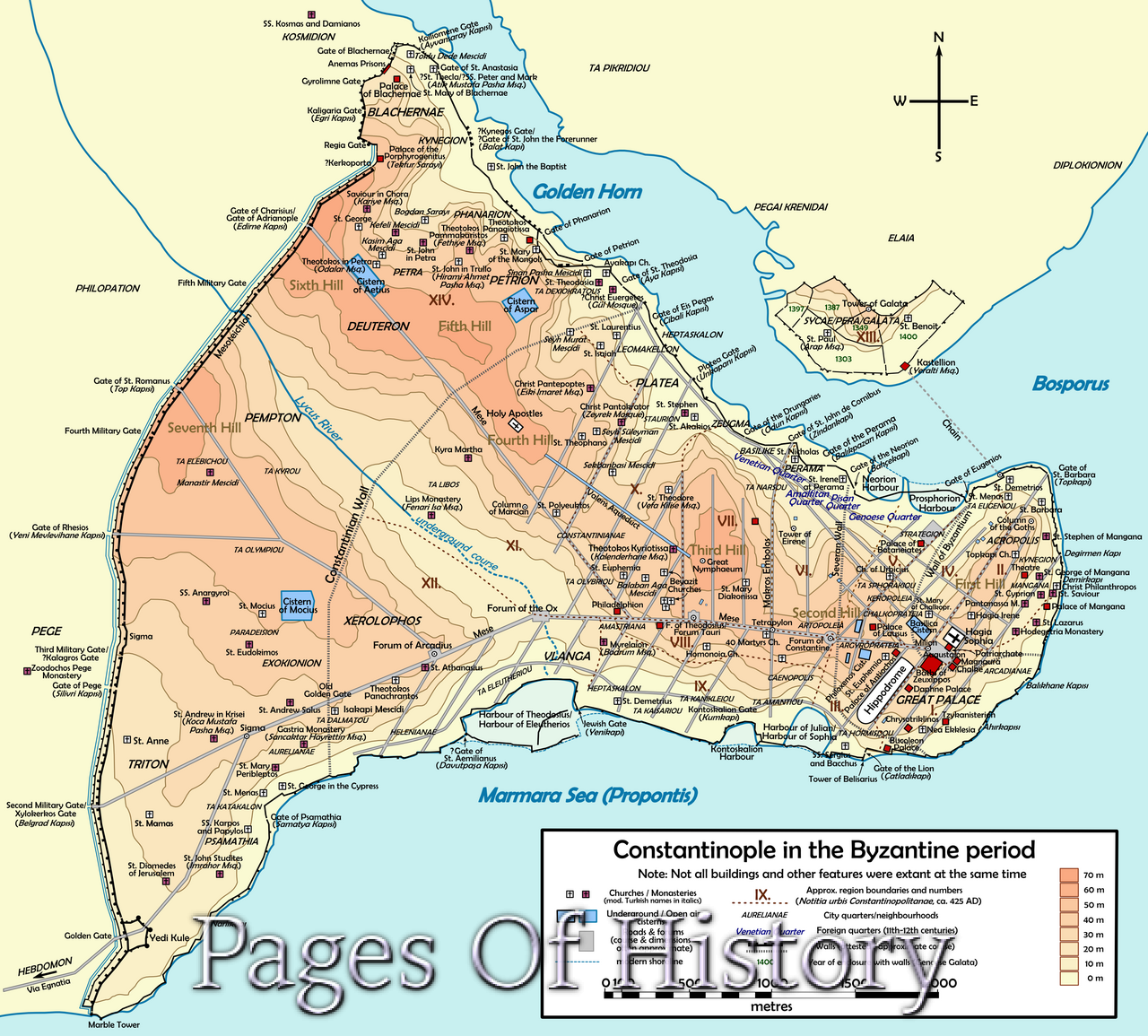
Constantinople’s defenses were the most formidable of the medieval world. The Theodosian Walls, built in the fifth century, consisted of three lines: a deep moat, a low outer wall (proteichisma), and a massive inner wall some 12 meters high, studded with 96 towers. For a thousand years, no enemy had breached them. But Mehmed had a new tool: gunpowder artillery on an unprecedented scale.
The Hungarian Gunsmith and the Bombard
The key weapon of the siege was the great bombard, cast by a Hungarian (or Wallachian) engineer named Orban. Orban had first offered his services to Constantine XI in 1452, but the Emperor could not afford his fee, nor could the Byzantine foundries supply enough bronze. Orban then went to Mehmed, who paid him handsomely and gave him endless resources. The resulting cannon was monstrous: over 8 meters long, with a bore of 75 centimeters, firing stone balls weighing over 600 kilograms. It took 60 oxen and 400 men to move the massive gun into position, and it could only be fired seven or eight times a day due to the need to cool the barrel. Yet each shot sent fear through the defenders’ hearts.
Mehmed also deployed dozens of smaller cannons, and his engineers built huge siege towers, battering rams, and mobile wooden mantlets. He ordered the digging of tunnels under the walls, hoping to collapse them from below.
The Naval Blockade and the Chain of the Golden Horn
The Ottoman navy played a crucial role. Mehmed assembled a fleet of over 100 ships, mostly galleys and transports, to blockade the city by sea. Yet the defenders had one trump card: a massive iron chain stretched across the entrance to the Golden Horn, the deep-water harbor that shielded the city’s northern flank. Venetian and Genoese ships guarded the chain, and Ottoman attempts to break through failed repeatedly in the first weeks of April.
In an extraordinary feat, Mehmed ordered his ships to be dragged overland across the hill of Pera, bypassing the chain entirely. On the night of April 22, 1453, Ottoman sailors hauled about 70 galleys on greased logs over a two-kilometer path of wooden planks, sliding them down into the Golden Horn. This move stunned the defenders and allowed the Ottomans to threaten the city’s northern seawall, forcing Constantine to spread his already thin forces even thinner.
Key Dates and Turning Points of the Siege
The following table summarizes the critical moments that determined the Fall of Constantinople:
| Date (1453) | Event | Significance |
|————-|——-|————-|
| April 6 | Siege officially begins with the first artillery bombardment. | Ottoman cannons open fire on the Theodosian Walls. |
| April 12–18 | Naval battles; Ottoman fleet fails to break the chain. | Constantine allows merchant ships to escape with refugees. |
| April 22 | Ottoman ships dragged overland into the Golden Horn. | Strategic shock; defenders now face attacks from both sea and land. |
| May 7 | First major assault repelled by Giustiniani’s men. | High Ottoman casualties; morale among defenders remains high. |
| May 22 | Lunar eclipse seen as an ill omen in the city. | Psychological blow; many defenders believe the end is near. |
| May 29 (early morning) | Final assault: multiple waves of Ottoman troops break through the Kerkoporta gate. | City falls; Emperor Constantine XI dies fighting. |
The Final Assault: May 29, 1453
Mehmed had offered terms several times throughout April, but Constantine refused to surrender, stating that he would rather die in the breach than yield his city. By late May, the defenders were exhausted. The walls had been pounded for weeks; many sections were barely standing; the population had taken refuge in churches, praying for a miracle that never came.
On the night of May 28, Mehmed ordered a night of rest and prayer for his troops, promising them the city’s immense riches for three days if they succeeded. Then, at about 1:30 AM on May 29, the assault began in three waves. First came the Azabs, irregular troops sent to tire the defenders and fill the moat with their bodies. Then the Anatolian regiments, who fought fiercely but were beaten back by Giustiniani’s Genoese. Finally, the elite Janissaries advanced.
The decisive moment came when a small gate, the Kerkoporta, was found unlocked or forced open—accounts differ—and a group of Janissaries entered the outer wall. Simultaneously, a stray bullet or arrow struck Giustiniani, wounding him severely. He was carried away to his ship, causing panic among his men. With the best defenders in disarray, the Ottomans poured through the breach near the Gate of St. Romanus (Topkapı). Emperor Constantine XI, throwing off his imperial regalia, charged into the melee and died fighting, his body never identified.
Aftermath and Legacy: The Fall of Constantinople in World History
The Fall of Constantinople did not end with the battle. Mehmed II, known thereafter as “the Conqueror,” entered the city in the afternoon and rode to the Hagia Sophia, where he transformed the great cathedral into a mosque. He then declared himself the new Kayser-i Rum (Caesar of Rome), laying claim to the legacy of the Roman Empire. The city was systematically looted for three days, as promised, and thousands of civilians were killed or enslaved.
Immediate Consequences: Refugees and Knowledge
The fall sent shockwaves through Europe. Many Greek scholars fled to Italy, carrying with them ancient manuscripts of Plato, Aristotle, and the Greek dramatists. These refugees helped fuel the Italian Renaissance, which had already begun but gained enormous momentum from the influx of classical knowledge. The fall also disrupted trade routes to the East, increasing European desire for alternative paths to Asia—a desire that eventually propelled the Age of Discovery, with Columbus seeking a western route just four decades later.
Political and Religious Ramifications
For the Ottoman Empire, the conquest was a turning point. Constantinople (soon renamed Istanbul) became the new capital, a cosmopolitan center of Islamic civilization and a strategic hub linking Europe and Asia. The Ottomans now commanded the major trade routes through the Bosporus and Dardanelles, giving them enormous economic and military leverage over the Christian states of Europe.
Yet the fall also intensified the rivalry between the Ottoman and European powers. The idea of a crusade to recover Constantinople lingered for centuries, though it never materialized. The conquest accelerated the development of national monarchies in Western Europe, as the old feudal order gave way to centralized states capable of raising the kind of armies needed to counter Ottoman expansion.
Lessons and Misconceptions About the Fall of Constantinople
Many myths surround the Fall of Constantinople. One common claim is that the Ottomans cut the leather straps of their cannons to fire faster—a story invented much later. Another suggests that the defenders were betrayed from within, but most evidence points to simple exhaustion and the weight of numbers. The real lesson of 1453 is about the power of siege artillery to overcome even the best static defenses, and the danger of diplomatic isolation for a small state facing a determined enemy.
The Role of Technology and Logistics
Mehmed’s victory was not just due to his massive army; it was a triumph of logistics and engineering. Orban’s giant bombard, while unreliable and slow, broke morale and shattered stone in a way that no previous weapon had. The overland transport of ships into the Golden Horn showed an innovative use of terrain that caught the defenders off guard. Furthermore, Mehmed maintained a steady supply line from his Balkan and Anatolian provinces, while the besieged city began to starve within weeks.
The Human Element: Constantine XI and His Defenders
The Emperor’s final stand became legendary. Though he had few resources, he fought alongside his men, refusing to escape. His death marked the end of the Roman imperial line, but his courage inspired later Greek national identity. The Genoese captain Giovanni Giustiniani, despite his controversial departure from the walls, had held the line for weeks with only a few hundred men. Their sacrifice delayed the inevitable, but could not change the outcome.
Conclusion: The Conquest That Changed Two Worlds
The Fall of Constantinople was far more than a military conquest; it was a pivot point in world history. For the Christian world, it marked the end of the Eastern Roman Empire and a psychological wound that persisted for centuries. For the Islamic world, it was a monumental victory, fulfilling a prophecy attributed to the Prophet Muhammad and establishing Istanbul as a great imperial capital. The event also accelerated the flow of Greek learning into Renaissance Italy, reshaped global trade routes, and set the stage for Ottoman dominance in the eastern Mediterranean.
Today, Istanbul stands as a bridge between continents and civilizations. The Hagia Sophia, now a museum and later a mosque again, still bears the marks of both Christian and Muslim traditions. The story of 1453 remains a cautionary tale of how even the mightiest walls can fall, and how a single city’s fate can alter the course of centuries. The Fall of Constantinople is not just a forgotten trope of medieval history; it is a living legacy that still influences politics, religion, and identity in the modern world.