
📅 Last updated: 19.07.2026
- The Combustible City: Chicago on the Eve of the Great Chicago Fire
- The Night of the Great Chicago Fire: October 8, 1871
- The Firestorm: How a Barn Fire Became a City-Destroying Inferno
- Key Figures and the Response to the Great Chicago Fire
- The Aftermath and the Great Rebuilding
- Analyzing the Myths and the Legacy of the Great Chicago Fire
- The Enduring Lessons from the Great Chicago Fire
The story of the Great Chicago Fire is one of the most enduring and mythologized disasters in American history. For over a century, the tale of a careless cow kicking over a lantern in a cramped barn has served as a tidy, almost folkloric explanation for a catastrophe that leveled a major American city. The reality, however, is far more complex, involving a perfect storm of meteorological conditions, urban planning failures, industrial negligence, and a series of unlucky coincidences that turned a small barn fire into an inferno of biblical proportions. While the cow remains the most famous scapegoat, a deeper investigation reveals that the true origins of the Great Chicago Fire are rooted not in a single moment of bovine clumsiness, but in a combustible combination of human error, environmental tinder, and a city that had grown too fast for its own good.
The Combustible City: Chicago on the Eve of the Great Chicago Fire
To understand how a fire could become so devastating, one must first understand the nature of Chicago in 1871. It was a city of astonishing, almost reckless, growth. In just three decades, its population had exploded from a few thousand to over 300,000, making it the fastest-growing city in the United States. This frantic expansion came at a cost. The city was, quite literally, built to burn.
A City of Wood
The most critical factor was the building material of choice: wood. While other major cities like New York and Boston were increasingly using brick and stone for construction, Chicago was a city of timber. The vast forests of the Great Lakes region provided cheap, abundant lumber, and it was used for everything. An estimated two-thirds of the city’s buildings were constructed entirely of wood, including many of its sidewalks, streets, and even its commercial blocks. The city was a massive, dry tinderbox.
– Sidewalks and Streets: Most sidewalks were made of pine planks. Many streets were paved with wooden blocks, which, after a long, dry summer, were as dry as kindling.
– Construction Quality: Buildings were often thrown up hastily to meet demand. Gaps between boards and poorly fitted joints created natural chimneys for flames.
– Commercial Structures: Even “fireproof” buildings often had wooden interiors, wooden trim, and wooden roofs. The Palmer House hotel, considered one of the city’s finest, was a five-story wood-framed building.
The Summer of 1871: A Drought of Historic Proportions
The summer and autumn of 1871 had been exceptionally dry. From July 4th to October 8th, Chicago received only about one inch of rain. The city was in the grip of a severe drought. The wooden buildings, sidewalks, and streets had been baking in the sun for months, becoming desiccated and highly flammable. The air was so dry that spontaneous combustion of hay and other materials was a known risk. This was not just a dry spell; it was a climatic precondition for a firestorm.
The “Fire Limits” and a Lax City Council
In an effort to mitigate fire risk, the city had passed ordinances establishing “fire limits” — districts where only brick or stone construction was permitted. However, these limits were small, poorly enforced, and constantly being pushed back by developers and property owners who found wood cheaper. The city council was notoriously corrupt and susceptible to pressure from the powerful lumber and real estate interests. As a result, even within the supposed fire limits, wooden buildings proliferated. The city’s fire department, while competent, was underfunded, understaffed, and relied on outdated hand-pumped engines in a city that was expanding far faster than its fire-fighting capacity.
The Night of the Great Chicago Fire: October 8, 1871
The fire began on the evening of Sunday, October 8, in the barn of Patrick and Catherine O’Leary, an Irish immigrant family living at 137 DeKoven Street on the city’s rapidly growing West Side. The exact cause remains officially unknown, but the historical evidence points away from the famous cow and toward more mundane, human failures.
The O’Leary Barn and the “Cow Theory”
The legend, as reported by a reporter named Michael Ahern of the Chicago Evening Post, was that Catherine O’Leary had gone to the barn to milk a cow, and the animal kicked over a kerosene lantern, igniting the hay. Ahern later admitted he had invented the story because he thought it made for colorful copy. The “cow theory” was a convenient, sensational narrative that deflected blame from more systemic problems. The true cause is more likely one of several other possibilities.
More Plausible Explanations
Historians and fire investigators have proposed several alternative scenarios, each grounded in the realities of 19th-century urban life.
– A Careless Smoker: Daniel “Pegleg” Sullivan, a neighbor who was the first to raise the alarm, claimed to have seen the fire start in the barn. However, some historians have suggested that Sullivan himself might have accidentally started the fire while sneaking a smoke in the barn, then concocted the story to avoid blame.
– A Spark from a Chimney: The O’Learys’ chimney, like many in the neighborhood, was likely in poor repair. A spark from the chimney could have easily landed on the dry, wooden shingles of the barn or the dry grass of the yard.
– A Natural Fireball: This is the most intriguing and scientifically supported theory. In the days prior, a massive fire had been raging in the forests of Michigan, Wisconsin, and upstate New York. It is well documented that “fire devils” and large embers from these distant fires were carried by strong winds and fell on Chicago. On the night of October 8, a series of other major fires broke out across the region, including the devastating Peshtigo Fire in Wisconsin (which killed 1,200-2,500 people) and a fire in Port Huron, Michigan. It is entirely plausible that a large, glowing ember or a “fireball” from one of these distant conflagrations landed on the O’Leary barn, igniting the dry hay.
What is certain is that the fire began in the O’Leary barn around 8:30 PM. The Chicago Fire Department’s engine company closest to the scene was already exhausted from fighting a large fire the previous night. A critical error was made: the fire alarm was incorrectly transmitted, sending the first responding engine to the wrong location. By the time the firefighters reached DeKoven Street, the fire had already spread from the barn to the adjacent buildings and was beginning to race through the neighborhood.
The Firestorm: How a Barn Fire Became a City-Destroying Inferno
The fire did not simply burn; it created its own weather system. The combination of the drought, the wooden city, and a powerful, steady wind from the southwest created a phenomenon known as a “firestorm.” The heat was so intense that it generated its own winds, pulling in fresh oxygen from all directions and pre-heating buildings blocks ahead of the flames. The fire jumped the Chicago River not once, but twice.
The First Jump: The South Branch
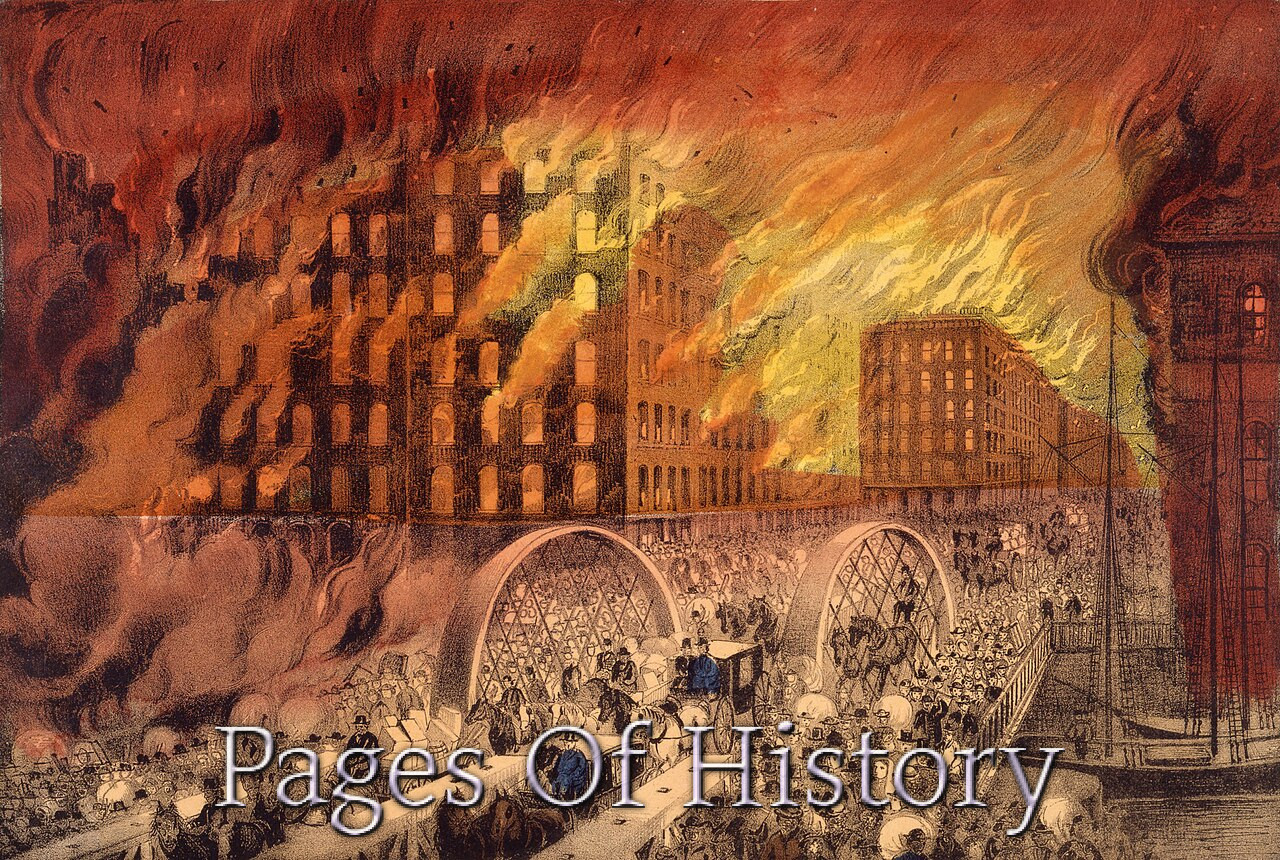
By midnight, the fire had consumed a large swath of the West Side and was approaching the South Branch of the Chicago River. The river was expected to be a natural firebreak. However, the wooden bridges and the massive lumberyards, coal yards, and grain elevators along the river’s banks provided a continuous fuel supply. A bridge over the river caught fire, and the flames leaped across to the South Side, where the city’s business district, hotels, and grand homes were located.
The Second Jump: The Main Branch
The fire then swept through the business district, destroying the courthouse, the opera house, the Palmer House hotel, and the Chicago Tribune building. It then reached the main branch of the Chicago River. Once again, the fire jumped the river, this time by igniting the wooden ships and barges moored in the river and the lumberyards on the North Side. By 2:00 AM on Monday, October 9, the entire city was effectively on fire.
The Great Escape
The speed and ferocity of the fire left residents with little time to flee. Thousands fled to the lakefront, standing in the cold water of Lake Michigan as the city burned behind them. Others sought refuge in the city’s parks and cemeteries. The death toll, while never precisely known, is estimated to be between 300 and 500 people. The property damage was staggering: over 17,500 buildings were destroyed, and an estimated 100,000 people were left homeless. The fire finally began to burn itself out on the evening of Monday, October 9, when a light rain began to fall. By then, the fire had consumed roughly 3.3 square miles of the city.
Key Figures and the Response to the Great Chicago Fire
The response to the fire was a story of both heroism and chaos. Several key figures emerged, leaving a lasting impact on how the city was rebuilt.
Robert A. Williams: The Fire Marshal
Fire Marshal Robert A. Williams was in charge of the city’s fire department. He had been up all night fighting the large fire on Saturday. On Sunday, he was exhausted. When the alarm came for the O’Leary fire, he was slow to respond. Once on the scene, he made the critical error of ordering his men to focus on saving individual buildings rather than creating firebreaks. His exhaustion and poor decision-making contributed to the fire’s unchecked spread. He was later heavily criticized, but he remained in his position, arguing that the fire was unstoppable from the start.
General Philip Sheridan: The Military Takeover
As the fire raged, Mayor Roswell B. Mason, overwhelmed, turned to the military for help. General Philip Sheridan, the famous Union cavalry commander, was stationed in Chicago. He immediately took command, declaring martial law. He ordered the use of gunpowder to blow up buildings in the path of the fire, creating firebreaks. While this tactic was controversial and sometimes backfired (the explosions could spread the flames), it was ultimately a key factor in stopping the fire’s advance on the North Side. Sheridan also organized the distribution of relief supplies and the prevention of looting.
Joseph Medill: The Rebuilder
In the aftermath, a new mayor was needed to lead the city’s recovery. Joseph Medill, the fiery editor of the Chicago Tribune, was elected on a platform of reform and rebuilding. Medill was a driving force behind the new building codes that required fireproof construction, including brick, stone, and iron. He also pushed for a modernized water system and a professional, well-equipped fire department. His leadership set the stage for the city’s miraculous rebirth.
The Aftermath and the Great Rebuilding
The destruction was almost total, but the response was a testament to the city’s resilience and ambition. The Great Chicago Fire did not destroy Chicago; it provided the blank slate for a new, more magnificent city to rise from the ashes.
Immediate Relief
The city was overwhelmed with refugees. Tents, shacks, and temporary shelters were erected in the parks and on the lakefront. The nation and the world responded with an outpouring of aid. Over $5 million in donations (a huge sum at the time) poured in from across the United States and from as far away as Europe. The city of Cincinnati sent a trainload of supplies. Queen Victoria of England sent a personal donation of books and money.
The New Building Codes
The most important legacy of the fire was the radical change in building regulations. The new Chicago building code was among the strictest in the world. It mandated that all new buildings in the central business district be constructed of fireproof materials: iron, stone, brick, and terra cotta. This led directly to the birth of the modern skyscraper, as architects like Louis Sullivan and William Le Baron Jenney experimented with steel frames and fireproof cladding. The fire, paradoxically, became the catalyst for architectural innovation.
The Chicago School of Architecture
The rebuilding effort, which took place over the next two decades, was an unparalleled architectural boom. The need for dense, fireproof, and efficient commercial space gave rise to the “Chicago School” of architecture. This movement pioneered the use of the steel skeleton, large plate-glass windows, and the elevator, all of which made the modern skyscraper possible. The Reliance Building, the Monadnock Building, and the Rookery Building are all direct products of this post-fire era. The city that had been a sprawling, wooden frontier town was reborn as a vertical, modern metropolis.
Analyzing the Myths and the Legacy of the Great Chicago Fire
The myth of Mrs. O’Leary’s cow persists not because it is true, but because it is a powerful narrative. It reduces a complex, systemic disaster to a simple, human story of negligence. It provides a convenient villain and a clear, moral lesson: be careful with fire. The reality is far more unsettling.
| Myth | Fact | Why the Myth Persists |
|---|---|---|
| A cow kicked over a lantern. | The cause is unknown; most likely a human error (smoking, chimney spark) or a natural ember from a distant forest fire. | Provides a simple, colorful scapegoat and deflects blame from urban planning failures. |
| Mrs. O’Leary was a villain. | Catherine O’Leary was a poor, Irish immigrant who was publicly hounded and ostracized. She was a victim of the fire and of a sensationalist press. | Fuels xenophobic and class-based prejudices against immigrant communities. |
| The fire was unstoppable. | Poor firefighting tactics, a misdirected alarm, and an exhausted fire marshal made the fire worse than it needed to be. | Absolves the city government and fire department of responsibility. |
| The fire destroyed everything. | The O’Leary home survived. The fire jumped around, leaving pockets of undamaged buildings. The waterworks and the city’s grain elevators were largely spared. | Simplifies a complex pattern of destruction into a total, apocalyptic event. |
| The fire was a pure tragedy. | While a tragedy, the fire also created an opportunity for a complete urban redesign and architectural innovation, leading to the modern city. | Ignores the complex, and sometimes positive, long-term consequences of disaster. |
The Enduring Lessons from the Great Chicago Fire
The story of the Great Chicago Fire is not just a historical event; it is a cautionary tale about the dangers of unchecked urban growth, the fragility of infrastructure, and the power of nature to overwhelm human ambition. The fire revealed the catastrophic consequences of building a city without adequate planning, fire safety, or building codes. It showed how a single mistake, amplified by a perfect storm of environmental and human factors, could lead to a national catastrophe.
The legacy of the fire is a double-edged sword. It destroyed a city, but it also gave birth to a new one. It forced a reckoning with the dangers of wooden construction and led to the development of modern fireproof building techniques. It spurred the creation of professional, well-funded fire departments across the country. The fire also cemented Chicago’s identity as a city of resilience, hustle, and reinvention. The motto “I Will” was not just a slogan; it was the lived experience of a generation of Chicagoans who refused to let their city die.
The real story of how the Great Chicago Fire started is a reminder that history is rarely as simple as a single cause or a single villain. It is a complex tapestry woven from drought, wind, wood, human error, and sheer bad luck. The cow may be a more satisfying story, but the truth—a story of a city that grew too fast, built too cheaply, and was caught by a fire it was not prepared to fight—is far more instructive and, in its own way, far more dramatic. The embers of that fire still glow in the building codes, the skyline, and the resilient spirit of the city that rose from its own ashes.