
📅 Last updated: 18.07.2026
- The Rise of a Knowledge Capital: Alexandria’s Founding Vision
- The First Blow: Julius Caesar’s Alexandrian War (48 BCE)
- The Slow Erosion: Roman Neglect and the Rise of Christianity
- Religious Violence and the Murder of Hypatia (415 CE)
- A Timeline of Destruction: Key Dates and Events
- The Aurelian Destruction (273 CE): The Likely End of the Main Building
- The Arab Conquest (642 CE): A Myth of Destruction
- The Real Culprits: A Perfect Storm of Factors
- The Lasting Impact: What Was Lost and What Survived
- Conclusion: The Myth and the Lesson
The Library of Alexandria fire is one of history’s most enduring and misunderstood tragedies, often simplified into a single dramatic blaze that erased the ancient world’s knowledge in one night. In reality, the destruction of the Great Library of Alexandria was not a single event, but a slow, multi-century process of decline, neglect, and violence. The most famous culprit—Julius Caesar—may have accidentally started a fire that damaged the library’s holdings in 48 BCE, but this was neither the first nor the last blow. The real reason the Library of Alexandria was burned is far more complex: it was a casualty of political instability, religious intolerance, economic decline, and the shifting priorities of successive Roman, Christian, and Muslim rulers, each of whom contributed to its gradual dissolution over nearly 600 years.
The Rise of a Knowledge Capital: Alexandria’s Founding Vision
To understand the Library’s demise, one must first grasp its extraordinary rise. Alexandria was founded by Alexander the Great in 331 BCE, but it was his successor, Ptolemy I Soter (r. 305–282 BCE), who transformed the city into the intellectual heart of the Hellenistic world. The Library of Alexandria, established around 295 BCE, was part of a larger complex called the Mouseion (Museum), a research institute dedicated to the Muses. Unlike a modern library, it was a state-funded academy where scholars lived, studied, and debated, supported by the Ptolemaic dynasty’s patronage.
The Library’s ambition was nothing short of universal: to collect every book in the known world. Agents were sent to every port and market, and any ship docking in Alexandria was searched for scrolls, which were confiscated, copied, and returned—sometimes only after the originals were kept. By the third century BCE, the Library housed an estimated 400,000 to 700,000 scrolls. This was not merely a collection; it was a tool of power. The Ptolemies used the Library to legitimize their rule, attract the best minds (like Eratosthenes, Euclid, and Archimedes), and project an image of cultural superiority over rival kingdoms like Pergamum and Antioch.
The First Blow: Julius Caesar’s Alexandrian War (48 BCE)
The most famous—and most misunderstood—episode in the Library’s decline is the Library of Alexandria fire associated with Julius Caesar. In 48 BCE, Caesar arrived in Alexandria during the Roman Civil War, pursuing his rival Pompey the Great. Pompey had been murdered by the Egyptian court, but Caesar found himself entangled in a dynastic struggle between Cleopatra VII and her brother-husband Ptolemy XIII.
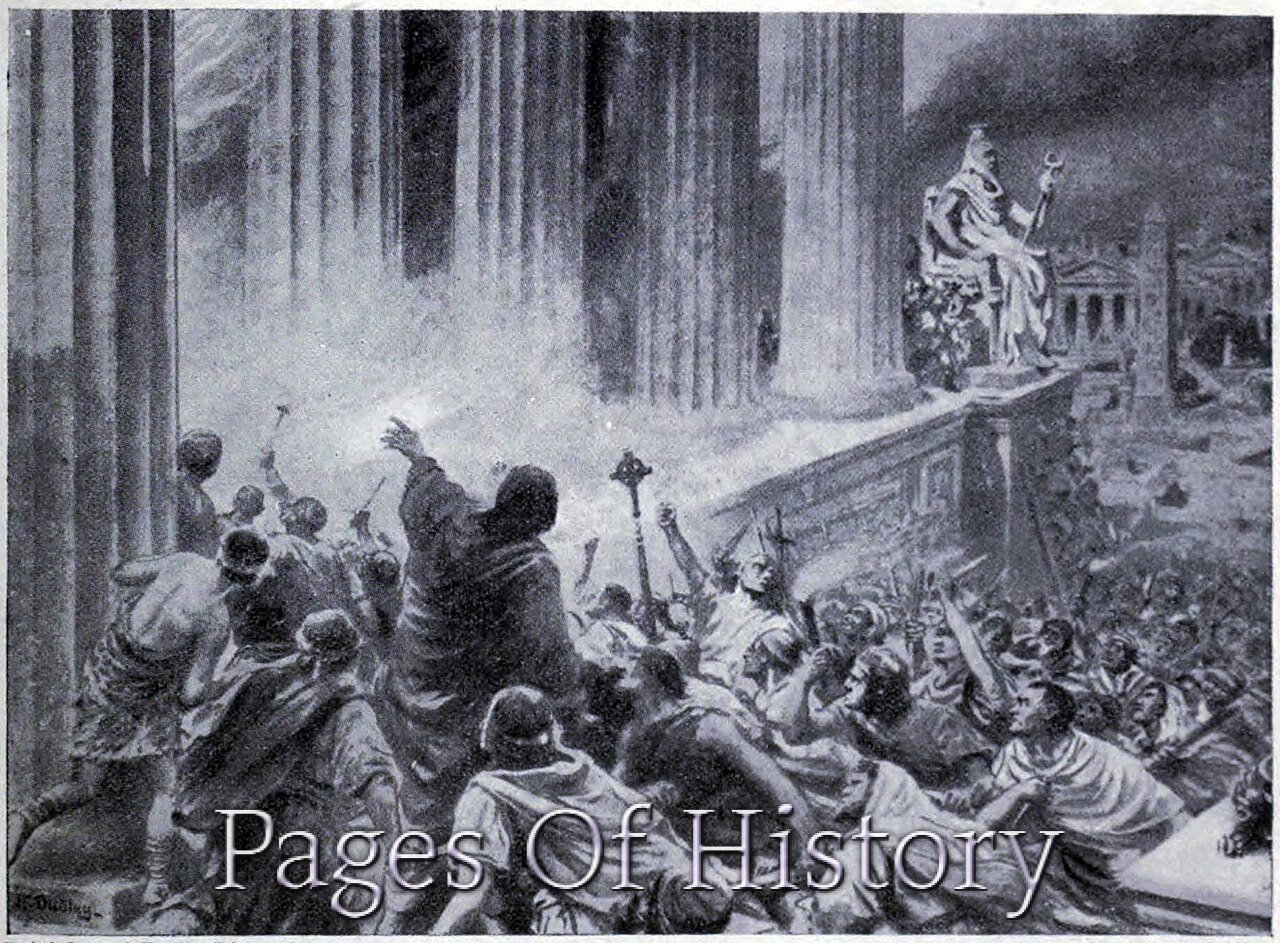
The situation escalated into the Siege of Alexandria (48–47 BCE). Caesar’s forces were vastly outnumbered, trapped in the royal quarter near the Great Harbor. To break the naval blockade, Caesar ordered his ships set on fire. The flames spread to the docks and then to the warehouses on the waterfront. According to the Roman historian Plutarch (writing over a century later), the fire “destroyed the great library.” However, modern historians are skeptical. The Library’s main building was located in the Bruchion district, some distance from the harbor. What likely burned was a storehouse of scrolls awaiting export or processing—perhaps 40,000 to 50,000 volumes—not the entire collection. The Library itself survived, albeit damaged, and continued to function for centuries.
“Caesar, in his own writings, mentions the fire but does not claim it destroyed the Library. The confusion arose from later Roman authors who conflated the harbor fire with the Library’s eventual fate.” — Dr. Diana Delia, historian of ancient Alexandria
The Aftermath: A Weakened but Living Institution
After Caesar’s departure, Cleopatra VII restored the Library, even requesting books from the rival library of Pergamum to replenish its holdings. The Library remained active through the early Roman period. Under the Emperor Augustus (r. 27 BCE–14 CE), Alexandria retained its prestige, but the Library’s glory days were fading. Roman emperors were less interested in funding Greek scholarship than in controlling Egypt’s grain supply. The Library shifted from a dynamic research center to a more conventional repository, its scholars producing commentaries rather than original discoveries.
The Slow Erosion: Roman Neglect and the Rise of Christianity
The Library of Alexandria fire attributed to Caesar was dramatic, but the real culprit was the slow erosion of state support. By the second century CE, the Roman Empire was in crisis. The Antonine Plague (165–180 CE) killed millions, and the Third-Century Crisis (235–284 CE) saw civil wars, invasions, and economic collapse. Alexandria suffered: the city was sacked by the Emperor Caracalla in 215 CE, who massacred thousands of citizens and closed many public buildings. The Library’s budget was slashed, its staff reduced.
Simultaneously, a new force was reshaping the intellectual landscape: Christianity. Early Christians in Alexandria were often hostile to pagan learning. The Library was a symbol of the old gods—the Mouseion was dedicated to the Muses, and its scrolls contained works of astrology, mythology, and philosophy that conflicted with Christian doctrine. However, the destruction was not immediate or uniform. Many Christian scholars, like Origen and Clement of Alexandria, actually used the Library’s resources to develop Christian theology. But as Christianity gained political power in the fourth century, tolerance waned.
The Role of the Serapeum
A key turning point came in 391 CE, when the Roman Emperor Theodosius I issued decrees banning pagan worship. In Alexandria, the Patriarch Theophilus led a mob to destroy the Serapeum, the temple of the god Serapis and a major repository of scrolls. The Serapeum was often called the “daughter library” of the Great Library. When the temple was razed, many scrolls were burned or looted. This was not a systematic destruction of all knowledge—Theophilus was targeting pagan idols, not books per se—but the loss was immense. The Serapeum’s destruction effectively ended the Library’s role as a public institution.
Religious Violence and the Murder of Hypatia (415 CE)
The final blow to the intellectual tradition of the Library—though not necessarily the building itself—came with the murder of Hypatia in 415 CE. Hypatia was a renowned philosopher, mathematician, and astronomer, the last great scholar of the Alexandrian tradition. She taught in the city’s schools, which were still using resources from the Library’s surviving collections.
In 415 CE, political and religious tensions exploded. The Patriarch Cyril of Alexandria was locked in a power struggle with the Roman governor Orestes. Hypatia, a friend of Orestes and a respected pagan intellectual, became a target. A mob of Christian monks, incited by Cyril’s followers, dragged Hypatia from her chariot, stripped her, and murdered her in a church, tearing her body apart with ostraca (broken pottery shards). Her death was not an attack on the Library itself, but it symbolized the end of the open, secular scholarship that the Library had embodied. After Hypatia, the remaining scholars fled or converted. The Library’s collections, now neglected and scattered, were vulnerable.
A Timeline of Destruction: Key Dates and Events
To clarify the long, fragmented decline, the following table summarizes the major episodes:
| Date | Event | Impact on the Library |
|---|---|---|
| c. 295 BCE | Foundation of the Library under Ptolemy I | Creation of the world’s largest scroll collection |
| 48–47 BCE | Julius Caesar’s fire in the Great Harbor | Destruction of a storehouse of scrolls; main Library damaged but survives |
| 215 CE | Caracalla’s massacre and sack of Alexandria | Decline of state funding; many scholars killed or fled |
| 273 CE | Emperor Aurelian destroys the Bruchion district | Likely destruction of the main Library building during civil war |
| 391 CE | Destruction of the Serapeum by Patriarch Theophilus | Loss of the “daughter library” and thousands of scrolls |
| 415 CE | Murder of Hypatia | Symbolic end of scholarly tradition; surviving collections scattered |
The Aurelian Destruction (273 CE): The Likely End of the Main Building
While Caesar’s fire is the most famous, the most devastating single event for the Library itself probably occurred under the Roman Emperor Aurelian. In 273 CE, Alexandria was caught in the conflict between the Roman Empire and the breakaway Palmyrene Empire of Queen Zenobia. After defeating Zenobia, Aurelian sacked Alexandria to crush a rebellion. His troops destroyed the Bruchion district, the royal quarter where the main Library building stood. The Roman historian Ammianus Marcellinus (writing around 380 CE) noted that the Bruchion was “now deserted.” No subsequent source mentions the main Library building. It is almost certain that Aurelian’s soldiers either burned the structure or so severely damaged it that it was abandoned.
The Arab Conquest (642 CE): A Myth of Destruction
No discussion of the Library of Alexandria fire is complete without addressing the persistent myth that the Arab general Amr ibn al-As burned the Library in 642 CE on the orders of Caliph Umar. The story, first recorded by the 13th-century Christian historian Gregory Bar Hebraeus, claims that when asked what to do with the Library’s books, Umar replied: “If they agree with the Quran, they are unnecessary; if they disagree, they are harmful. Burn them.” The scrolls were supposedly used as fuel for the city’s bathhouses for six months.
This account is almost certainly a fabrication. Contemporary Arab sources, such as the historian al-Maqrizi (15th century), do not mention the Library’s destruction. The Arab conquest of Alexandria in 642 CE was relatively peaceful—the city surrendered after a treaty. The Library had already ceased to exist as a functioning institution by that time. The myth likely arose centuries later as a polemical tool during the Crusades, used by both Christian and Muslim writers to discredit the other. There is no archaeological or contemporary textual evidence to support it.
The Real Culprits: A Perfect Storm of Factors
So, who or what really destroyed the Library of Alexandria? The answer is not a single fire, but a confluence of forces:
- Political Instability: The Ptolemaic dynasty’s decline, Roman civil wars (Caesar, Aurelian), and the Third-Century Crisis repeatedly damaged the city and disrupted funding.
- Economic Decline: The Library was expensive to maintain. As Rome’s economy faltered, the Library became a luxury the state could no longer afford.
- Religious Intolerance: The rise of Christianity shifted priorities. The Library’s pagan associations made it a target, and its resources were repurposed or destroyed by zealots.
- Natural Disasters: Alexandria was struck by earthquakes, tsunamis (especially the 365 CE Crete earthquake), and a gradual rise in sea level that eroded the coastline and damaged buildings.
- Technological Change: The transition from papyrus scrolls to the codex (the early book form) made many scrolls obsolete. Older works were not always copied, and they rotted or were discarded.
The Library’s fate was not a dramatic, single moment of arson, but a slow, centuries-long process of attrition. The Library of Alexandria fire that Julius Caesar started was a spark, not the inferno. The real fire was the cumulative effect of war, neglect, and changing ideologies.
The Lasting Impact: What Was Lost and What Survived
The loss of the Library of Alexandria is often described as the greatest intellectual disaster in history, but this requires nuance. First, not all knowledge was lost. Many works survived because they had been copied and distributed to other libraries across the Mediterranean—in Constantinople, Rome, Pergamum, and Antioch. The works of Homer, Plato, Aristotle, and the Greek playwrights all survived because they were widely disseminated. What was lost were the rare, the local, and the esoteric: the complete works of minor poets, the original manuscripts of the pre-Socratic philosophers, the medical texts of Herophilus and Erasistratus, and the geographical writings of Eratosthenes (including his calculation of the Earth’s circumference). We know these existed only through fragments and later citations.
Second, the Library’s destruction had a chilling effect on scientific and philosophical inquiry. The loss of institutional support and the departure of scholars meant that Alexandria never regained its intellectual primacy. The center of learning shifted to Constantinople, and later to the Islamic world (Baghdad’s House of Wisdom) and medieval Europe. The dark ages that followed in the West were not caused by the Library’s destruction, but the loss of Alexandria’s libraries accelerated the decline of classical scholarship in the Mediterranean.
Conclusion: The Myth and the Lesson
The story of the Library of Alexandria endures because it speaks to a universal fear: the fragility of knowledge. The myth of a single, catastrophic Library of Alexandria fire is more satisfying than the messy, drawn-out reality. It allows us to point fingers—at Caesar, at Theophilus, at the Arabs—and to imagine that if only that fire had been prevented, we would have the complete works of Aristotle or the lost plays of Sophocles. But the truth is more sobering: the Library was destroyed by the same forces that threaten libraries today—underfunding, political violence, religious intolerance, and neglect.
The real lesson of the Library of Alexandria is not that knowledge can be burned in a single night, but that it requires constant, deliberate effort to preserve. It is a warning against complacency. The Library was not killed by a fire; it was allowed to die by a thousand cuts. Its legacy is not just the books we lost, but the reminder that the survival of knowledge depends on the societies that value it. And that is a fire we must never let go out.