
📅 Last updated: 20.09.2026
The Popham Colony was England’s first serious attempt to plant a permanent settlement in New England — and one of its strangest failures. Founded in August 1607 at the mouth of the Kennebec River in present-day Maine, it lasted barely fourteen months before its surviving settlers sailed home, leaving behind a fort, a storehouse, and one of the most tantalizing mysteries in early American history. Unlike the “Lost Colony” of Roanoke, whose settlers vanished without a trace, Popham’s people did not disappear into the wilderness. They left deliberately, and then England largely forgot they had ever been there at all.
- The World That Produced the Popham Colony
- Why the Popham Colony Was Founded in 1607
- The Hard Winter at Fort St. George
- Popham Colony vs. Jamestown: A Tale of Two Settlements
- Why Did the Popham Colony Fail? The Real Causes
- What Happened to the Settlers?
- Rediscovering the Popham Colony
- Why Popham Matters Today
That forgetting is the real puzzle. Jamestown, founded in Virginia only weeks before Popham, nearly collapsed too — yet it endured and became the founding myth of English America. Popham had a better harbor, a healthier site, and a more diversified plan. So why did it vanish from memory and from the map? The answer lies in a collision of weather, leadership, economics, and the peculiar politics of early Stuart England.
The World That Produced the Popham Colony
To understand why a group of about 120 Englishmen spent the winter of 1607–1608 on a Maine peninsula, you have to start with the failure of Roanoke two decades earlier. Sir Walter Raleigh’s 1587 colony on the North Carolina coast had been abandoned and its fate never resolved. That wound stung English pride and, more practically, it left the question of North American colonization unresolved at exactly the moment England’s rivals were pulling ahead.
Spain had spent a century building an empire from Mexico to Peru, extracting silver that financed its armies in Europe. France had fur traders working the St. Lawrence and Acadia. England, by contrast, had fishing fleets off Newfoundland and a handful of failed ventures. The 1604 Treaty of London ended the long Anglo-Spanish War, freeing English capital and attention for overseas projects. Two years later, in April 1606, King James I issued a charter dividing the North American coast between two competing groups of investors: the Virginia Company of London, granted rights to the region from roughly the 34th to the 41st parallel, and the Virginia Company of Plymouth, granted the coast from about the 38th to the 45th parallel.
The Plymouth group was dominated by West Country gentry and merchants, and its most powerful figure was Sir John Popham, Lord Chief Justice of England. Popham was a formidable man — the judge who had presided over the trial of Sir Walter Raleigh in 1603 and who had helped prosecute the Gunpowder Plot conspirators in 1605. He was also deeply interested in colonization, partly for national prestige and partly, contemporaries suspected, for profit. His nephew and namesake, Captain George Popham, would lead the expedition.
Why the Popham Colony Was Founded in 1607
The Plymouth Company’s first attempt, in 1606, ended in disaster before it began: a Spanish warship captured the expedition’s leader, Captain Martin Pring, and the venture collapsed. The investors tried again the following year, assembling two ships — the Gift of God and the Mary and John — carrying roughly 100 to 120 settlers, including soldiers, sailors, carpenters, a minister, a surgeon, and a young man named Raleigh Gilbert, son of Sir Humphrey Gilbert, who would become the colony’s second president.
The fleet left Plymouth, England, on May 31, 1607, and sighted the Maine coast in early August. After exploring several rivers, the settlers chose a site on a peninsula at the mouth of the Sagadahoc River — the modern Kennebec — in what is now Phippsburg, Maine. The location was shrewd:
- Defensibility: The peninsula was nearly surrounded by water, easy to fortify against attack.
- Navigation: Deep water allowed large ships to anchor close to shore, unlike Jamestown’s shallow, swampy James River site.
- Trade: The Kennebec gave access to interior fur traders, and the coast offered abundant fish.
- Climate: It was far enough north to avoid the malaria and dysentery that would devastate Jamestown.
On August 19, 1607, the settlers held a formal ceremony, read their patent aloud, and named the settlement Fort St. George. The Popham Colony was officially born.
The Hard Winter at Fort St. George
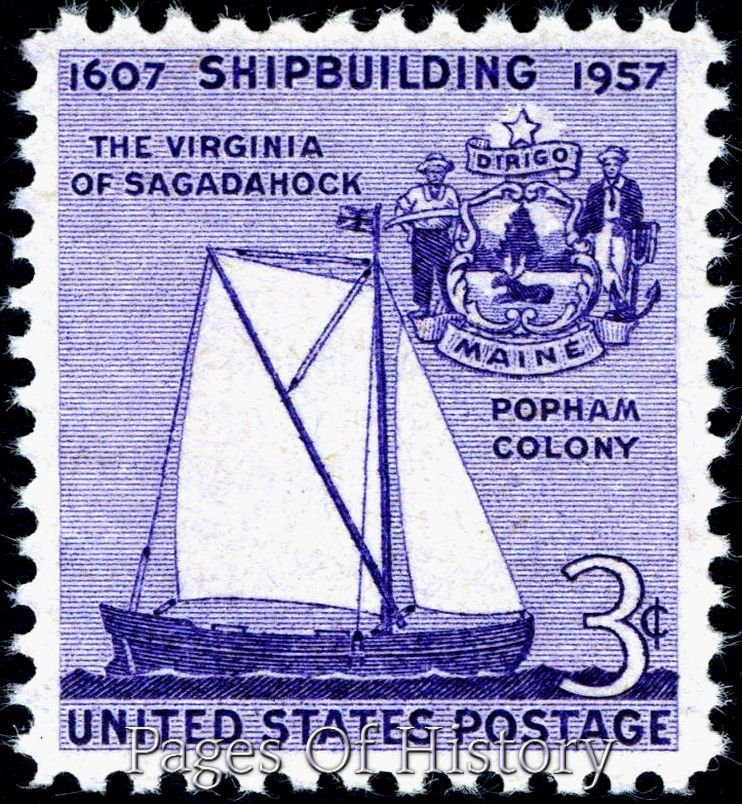
The first months were surprisingly productive. The settlers built a fort with a storehouse, a chapel, and a row of cabins. They constructed a small ship, the Virginia, a pinnace of about thirty tons — the first English ship built in North America. They made contact with the local Abenaki people, whose territory this was, and conducted some trade. A colonist named John Hunt drew a remarkable map of the coastline, still preserved today, which shows the fort in detail.
Then winter arrived. The Maine winter of 1607–1608 was brutal, and the colony’s food supplies ran short. Worse, the settlers had arrived too late in the season to plant crops. The president, George Popham, fell ill. He died in February 1608, and Raleigh Gilbert assumed leadership.
In the spring, the situation deteriorated further. A supply ship arrived — but it brought bad news. The colony’s chief patron, Sir John Popham, had died in June 1607, only days after the expedition sailed. Without his political weight in London, the venture lost its most important advocate. Then word came that Raleigh Gilbert’s elder brother, Sir John Gilbert, had died in England, leaving Raleigh the family estate. He now had a powerful reason to go home.
In the summer of 1608, the settlers made a collective decision. They dismantled what they could, loaded the Virginia and a returning supply ship, and sailed for England. They arrived in October 1608. The Popham Colony was over.
Popham Colony vs. Jamestown: A Tale of Two Settlements
The contrast with Jamestown is instructive, because the two colonies shared investors, timing, and a common English culture — yet one survived and one did not. The table below summarizes the key differences.
| Factor | Jamestown (1607) | Popham Colony (1607–1608) |
|---|---|---|
| Location | James River, Virginia; swampy, malarial | Kennebec River, Maine; defensible, healthy harbor |
| Leadership | Council of seven; contentious but deep bench | George Popham, then Raleigh Gilbert; both left or died |
| Primary goal | Gold, trade, and a permanent base | Trade, fishing, furs, and a base for privateering |
| Mortality, first winter | Roughly two-thirds died | Far lower; a handful died, including the president |
| Outcome | Survived; became permanent after 1610 | Abandoned in 1608 |
Jamestown’s survival was hardly inevitable — it nearly failed in 1609–1610 during the “Starving Time,” when the population fell from about 500 to roughly 60. What saved it was a combination of stubbornness, a steady stream of new investors, and the discovery of a cash crop, tobacco, in 1612. Popham had none of those advantages. Its investors were a smaller, less wealthy group; its cash crop was fur, which depended on Native trade networks that were already contested; and its leadership collapsed at the worst possible moment.
Why Did the Popham Colony Fail? The Real Causes
The colony’s collapse is often reduced to “the winter was hard,” but that explanation is too simple. Popham’s settlers survived the winter in better health than Jamestown’s. The real causes were structural and political.
1. The death of Sir John Popham
Sir John Popham was the engine of the enterprise. As Lord Chief Justice, he had the ear of the king, the respect of the merchant community, and the personal wealth to keep the venture afloat. His death in June 1607 — just days after the ships left England — removed the colony’s chief patron in London. Without him, the Plymouth Company’s investors had little appetite to keep funding a distant outpost with no obvious return. The supply ships that did arrive in 1608 brought discouragement rather than reinforcement.
2. Leadership vacuum
George Popham’s death in February 1608 and Raleigh Gilbert’s inheritance in England left the colony without a committed leader. Gilbert was a capable sailor and soldier, but he had no intention of staying. When the opportunity to return home came, he took it — and many settlers followed. A colony without a leader who wanted to stay was unlikely to survive.
3. Economic miscalculation
The Popham investors expected profits from furs, fish, and perhaps minerals. They found some fur trade and good fishing, but no gold or silver, and the fur trade required years of patient relationship-building with Native peoples. The English investors, like their Jamestown counterparts, were impatient. When the expected quick returns failed to materialize, enthusiasm waned.
4. The peculiar politics of the Plymouth Company
The Plymouth Company’s charter gave it a vast territory but weak financing. Its investors were West Country merchants and gentry with limited capital compared to the London group. After Popham’s death, the company’s attention drifted. It would not mount another serious colonization attempt in Maine until 1620, when it granted a patent to a group of religious separatists — the Pilgrims — who founded Plymouth Colony in Massachusetts. Ironically, the Pilgrims’ own settlement nearly failed too, and only survived with Native help and a fur trade that Popham had pioneered.
What Happened to the Settlers?
Unlike the Roanoke settlers, the Popham colonists did not vanish. Most returned to England in October 1608 aboard the Mary and John and the newly built Virginia. Some of them re-emerged in later colonial ventures. Raleigh Gilbert went on to serve in the Virginia Company and later in the Plymouth Colony’s affairs. Others simply faded back into English life.
The Virginia, the ship built at Fort St. George, had a notable afterlife. She was later sold and used in the Virginia trade, and in 1610 she carried settlers and supplies to Jamestown. For a time, the little pinnace built by the Popham colonists was one of the most useful vessels in English America — a quiet monument to the colony that England forgot.
The fort itself decayed. The site was visited occasionally by fishermen and traders, and by the 1620s it was in ruins. Local Abenaki people continued to use the area, and English settlers eventually returned to the region in the 1630s and 1640s, but they did not know they were building on the site of an earlier English colony. The Popham Colony had passed out of memory.
Rediscovering the Popham Colony
For nearly three centuries, the Popham Colony was a footnote — mentioned in a few early documents but largely ignored by historians who focused on Jamestown and Plymouth. That changed in the late nineteenth and twentieth centuries, as archaeologists and historians began to take the site seriously.
Key evidence came from several sources:
- John Hunt’s map (1607): A detailed plan of the fort and surrounding coast, drawn by a colonist, which survived in English archives.
- The Relacyon of George Percy and other Jamestown documents: Mentioned the Popham venture in passing.
- Archaeological excavations (1994–present): Led by Jeffrey Brain of the Peabody Essex Museum, digs at the Phippsburg site uncovered postholes, a storehouse, and artifacts including a copper token and fragments of the Virginia.
In 1994, archaeologists confirmed the location of Fort St. George on a peninsula in Phippsburg, Maine. Since then, excavations have revealed the fort’s layout, including a trench, a storehouse, and evidence of the shipbuilding that produced the Virginia. The site is now part of the Maine State Museum’s archaeological program and is recognized as a National Historic Landmark.
“The Popham Colony is not a story of disappearance. It is a story of abandonment — and of a historical memory that chose to forget.”
The rediscovery has forced historians to rethink the standard narrative of English colonization. Popham was not a marginal experiment; it was a serious, well-planned venture that failed for identifiable reasons. Its failure shaped the future: it left the Maine coast open to French and Dutch interest, delayed English settlement in the region by a generation, and cleared the way for the Pilgrims’ more successful — and more famous — colony at Plymouth in 1620.
Why Popham Matters Today
The Popham Colony’s story matters because it complicates the tidy story of American origins. Jamestown and Plymouth are remembered because they survived; Popham is forgotten because it did not. But survival was not inevitable for any of them. Jamestown nearly failed in 1610. Plymouth lost half its settlers in the first winter. Popham, by contrast, lost relatively few — and still gave up.
The difference was not the land or the climate. It was people, money, and timing. Sir John Popham’s death in 1607 removed the colony’s most powerful advocate at the moment it needed him most. George Popham’s death in 1608 removed its leader. Raleigh Gilbert’s inheritance gave its remaining leader a reason to leave. And the Plymouth Company’s shallow pockets meant no rescue fleet was coming.
In the end, the Popham Colony vanished not because its settlers disappeared, but because England chose to remember other ventures. The men who wintered at Fort St. George went home, and their story went with them. Only archaeology and a handful of documents have brought it back — a reminder that history is not just what happened, but what we choose to remember.