
📅 Last updated: 20.09.2026
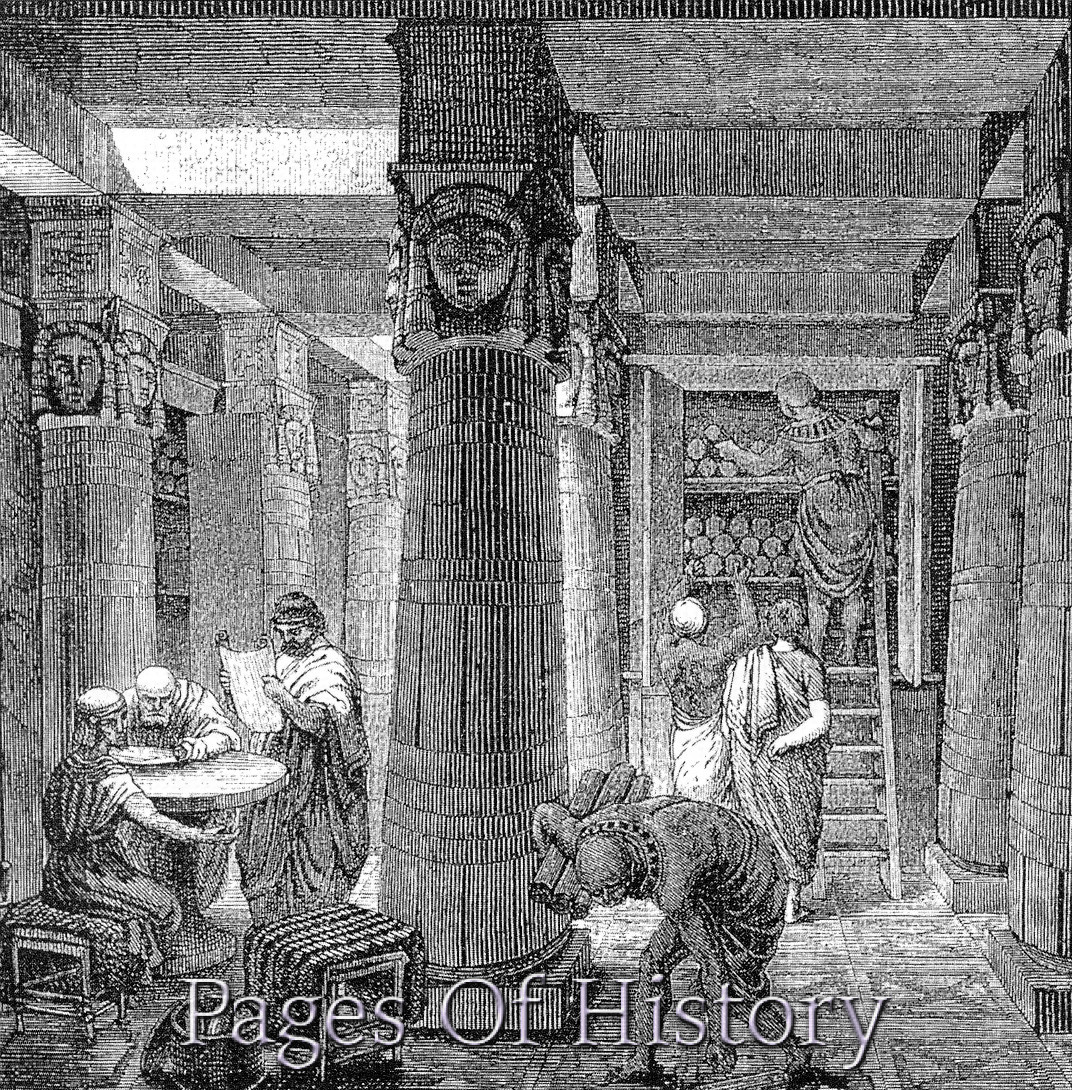
The Library of Alexandria is the most famous library that never was — or rather, the most famous library whose destruction we have imagined far more vividly than we have ever documented. For more than two thousand years, people have told and retold the story of a single, catastrophic fire that consumed the greatest archive of the ancient world. The truth is messier, slower, and in some ways more tragic: the Library of Alexandria was not destroyed in one night. It declined over centuries, casualty by casualty, through neglect, budget cuts, war, religious conflict, and the simple fragility of papyrus.
To understand what really happened, we have to separate three things that are constantly confused: the Library (the royal institution founded by the Ptolemies), the Museion (the research center attached to it), and the Serapeum (a temple of Serapis that later housed a “daughter library”). Different parts of this complex met different fates, at different times, at the hands of different people. Untangling them reveals a story far more interesting than the legend.
What the Library of Alexandria Actually Was
The Library of Alexandria was founded in the early third century BCE, probably under Ptolemy I Soter (ruled 305–282 BCE) and expanded by his son Ptolemy II Philadelphus (ruled 282–246 BCE). It was not a public lending library. It was a royal project — an instrument of prestige, a machine for collecting, copying, and standardizing Greek knowledge. It sat within the palace quarter of Alexandria, the city Alexander the Great had founded in 331 BCE on Egypt’s Mediterranean coast.
The institution had two parts. The main library was in the Brucheion, the royal palace district. A smaller “daughter library” was attached to the Serapeum, the temple of the syncretic god Serapis, in the Egyptian quarter. Both were connected to the Museion — the “shrine of the Muses” — a state-funded research institute where salaried scholars ate, studied, and argued at the king’s expense. This is the origin of our word museum.
Its collecting methods were aggressive. The Ptolemies reportedly seized books from ships docking in Alexandria and copied them, keeping the originals and returning the copies. They sent agents to buy manuscripts across the Greek world. The geographer Strabo, visiting around 20 BCE, described the Museion as a place where scholars “are maintained at public expense.”
The scale of the collection is disputed. Ancient sources give wildly inflated numbers — 200,000, 400,000, even 700,000 “volumes” (scrolls). These figures are almost certainly rhetorical. A realistic estimate for the main library at its height might be in the tens of thousands of scrolls, which was still an extraordinary concentration of knowledge for the ancient world.
The Scholars Who Made It Matter
The library’s real legacy was not its walls but its people. Its librarians and residents effectively invented the disciplines of textual criticism, geography, and systematic literary scholarship.
- Zenodotus of Ephesus (fl. c. 285 BCE): the first librarian, who began critical editing of Homer.
- Callimachus of Cyrene (c. 310–240 BCE): compiled the Pinakes, a 120-book catalog of the collection — arguably the world’s first library catalog and a foundational work of bibliography.
- Eratosthenes of Cyrene (c. 276–194 BCE): calculated the circumference of the Earth with startling accuracy using shadows and geometry.
- Aristarchus of Samothrace (c. 220–143 BCE): produced influential editions of Homer; the crater Aristarchus on the Moon is named for him.
- Apollonius of Rhodes (third century BCE): wrote the epic Argonautica while working there.
- Claudius Ptolemy (second century CE): the astronomer and geographer whose Almagest dominated astronomy for 1,400 years — though he worked later, in Roman Alexandria.
It is also where the Septuagint, the Greek translation of the Hebrew Bible, was traditionally said to have been produced — though the “72 translators” story is legend, not history.
Myth One: Julius Caesar Burned It in 48 BCE
The most persistent culprit in the popular imagination is Julius Caesar. In 48 BCE, Caesar was in Alexandria embroiled in a civil war between Cleopatra VII and her brother Ptolemy XIII. Trapped in the palace quarter and outnumbered, Caesar set fire to enemy ships in the harbor. The fire spread to the docks and some buildings near the waterfront.
Ancient writers — including Plutarch, Cassius Dio, and Seneca — mention that books were lost. Seneca, writing about a century later, says 40,000 scrolls burned. But here is the crucial detail: these losses are usually linked to books stored near the harbor, possibly in warehouses, not necessarily the main library in the palace. Strabo, who visited Alexandria about 25 years after Caesar’s fire, describes the Museion as still functioning. The geographer’s silence about any catastrophic destruction is telling.
“Forty thousand books were burned in Alexandria.” — attributed to Seneca, De Tranquillitate Animi, 9.5 (a figure almost certainly exaggerated and possibly referring to warehouse stock).
So Caesar’s fire was real, and it damaged part of the library complex. But it did not end the Library of Alexandria. Scholars continued to work there for centuries afterward. The institution survived; it was wounded, not killed.
Myth Two: The Christians Destroyed It in 391 CE
The second popular villain is Theophilus, Patriarch of Alexandria, backed by the emperor Theodosius I. In 391 CE, Theodosius issued decrees banning pagan sacrifice and closing pagan temples. In Alexandria, rioting between pagans and Christians escalated. The Serapeum — the great temple of Serapis — was destroyed by a Christian mob, reportedly with imperial approval.
This is a genuine historical catastrophe, and it is often described as the destruction of the Library of Alexandria. The problem is that the Serapeum’s “library” was a much smaller, later collection. By 391 CE, the main library in the Brucheion had likely already ceased to function as a royal institution, and there is no reliable evidence that a major library still operated inside the Serapeum at that point. The historian Socrates Scholasticus mentions that the Serapeum contained some books, but describes them as incidental, not the great library of legend.
What 391 CE really marks is the end of institutional pagan scholarship in Alexandria — the end of a cultural world in which a state-funded research library made sense. When the temple fell, so did the last plausible home for the old library’s mission.
Myth Three: The Muslims Burned It in 642 CE
The third and most durable legend attributes the destruction to the Arab conquest of Egypt. In 641–642 CE, the Muslim general ‘Amr ibn al-‘As captured Alexandria for the caliph Umar ibn al-Khattab. A story later circulated — first recorded by the Christian writer Bar Hebraeus in the thirteenth century, and by the Muslim historian al-Qifti around 1200 — that a scholar named John Philoponus asked ‘Amr to spare the library, and that ‘Amr wrote to Umar for instructions. Umar allegedly replied that if the books agreed with the Qur’an they were redundant, and if they disagreed they were heretical — so they should be burned to heat the city’s bathhouses for six months.
It is a dramatic story, and it is almost certainly a fabrication. It appears six centuries after the events it describes, in sources with clear polemical motives. More decisively, there is no library left to burn by 642 CE. The main collection had been dispersed, destroyed, or decayed long before. The story served later political purposes: Muslims used it to justify conquest, and Christians used it to criticize Muslim rule.
| Event | Date | What Actually Happened | Impact on the Library |
|---|---|---|---|
| Caesar’s Alexandrian War | 48 BCE | Fire spread from harbor ships to dockside buildings | Partial loss, likely warehouse scrolls; library continued |
| Roman conquest of Egypt | 30 BCE | Octavian annexed Egypt after Actium | Royal patronage ended; funding declined |
| Aurelian’s war in Alexandria | 272 CE | Emperor Aurelian retook the city from Zenobia’s forces | Brucheion quarter heavily damaged; main library likely ruined |
| Diocletian’s siege | 297–298 CE | Emperor Diocletian crushed a revolt, sacked Alexandria | Further destruction of the palace quarter |
| Destruction of the Serapeum | 391 CE | Christian mob demolished the temple under Theodosius I | End of the daughter library and pagan scholarship |
| Arab conquest of Alexandria | 642 CE | ‘Amr ibn al-‘As took the city | No significant library remained to destroy |
The Slow Death: Patronage, Politics, and Papyrus
The real answer to “why did the Library of Alexandria burn?” is that it did not burn — it faded. The library was a royal institution, and it depended entirely on royal money and royal interest. When the Ptolemies lost their independence, the library lost its patron.
The decline began with Rome. After Octavian defeated Mark Antony and Cleopatra at the Battle of Actium in 31 BCE and annexed Egypt in 30 BCE, Alexandria ceased to be a capital of a major independent power. It became a Roman province’s administrative center — wealthy, but no longer a royal court. The Ptolemies had competed for prestige by funding scholars; Roman emperors had other priorities.
What followed was a long series of blows:
- Political instability (1st–3rd centuries CE): Alexandria was repeatedly rocked by riots, pogroms, and imperial reprisals. In 215 CE, Emperor Caracalla massacred thousands of Alexandrians and dissolved their civic privileges.
- The crisis of the third century: In 269–272 CE, Queen Zenobia of Palmyra seized Egypt. Emperor Aurelian retook Alexandria by force, and the Brucheion — the palace quarter where the main library stood — was severely damaged.
- Diocletian’s sack (297–298 CE): After a usurper’s revolt, Diocletian besieged and sacked Alexandria, further devastating the royal quarter.
- Constantine and the Christian empire: After 313 CE, imperial patronage flowed to the Church, not to pagan research institutions. The Museion’s state funding dried up.
- Theodosius and 391 CE: The final legal and physical end of organized pagan scholarship in Alexandria.
And then there was the material problem: papyrus decays. Scrolls in a humid coastal city like Alexandria had to be constantly recopied to survive. A library is not a warehouse; it is a living organism that requires scribes, money, and demand. Once the copying stopped, the scrolls rotted. No fire was needed. Time did the work.
The Role of Book Losses Elsewhere
The loss of the Library of Alexandria also mattered because of what else was lost. Many works survived only in single copies held at Alexandria. When those copies vanished, so did the texts. We know the names of hundreds of ancient authors — historians, playwrights, scientists — whose works are entirely lost. The library’s disappearance is one reason our picture of antiquity is so fragmentary. We have seven plays by Sophocles out of more than 120. We have fragments of dozens of historians who once filled shelves in Alexandria.
Why the Myth Persists
The legend of the single catastrophic fire is more satisfying than the truth. It gives us a villain — Caesar, or Christians, or Muslims, depending on who is telling the story — and a moment of dramatic loss. The reality — centuries of neglect, budget cuts, warfare, and rot — offers no villain and no climax. It implicates everyone and no one.
The myth also serves modern agendas. In the nineteenth and twentieth centuries, European writers used the story to warn against religious fanaticism and to celebrate secular learning. Muslim and Christian polemicists used it against each other. The Library of Alexandria became a symbol, and symbols are more useful than facts.
Archaeologists have searched for the library’s remains for decades. Excavations near the site of the royal quarter — including work around the modern Bibliotheca Alexandrina, opened in 2002 — have found harbor structures, lecture halls, and possible library rooms, but nothing that definitively identifies the great library itself. The sea has claimed much of the ancient waterfront.
What We Can Learn From the Library of Alexandria
The Library of Alexandria’s fate is a lesson in fragility. Knowledge is not destroyed in a single dramatic moment; it erodes through indifference. The library died because the institution that funded it lost interest, because the political order that supported it collapsed, and because the physical medium that carried its contents was perishable.
The same pattern repeats throughout history. The great libraries of antiquity — Pergamon, Ephesus, Carthage — suffered similar fates. Medieval monastic libraries were dispersed during the Reformation. In the modern era, the burning of the library at Louvain in 1914 and the destruction of libraries in Sarajevo in 1992 and Baghdad in 2003 show that the impulse to destroy accumulated knowledge has not disappeared.
So why did the Library of Alexandria really burn? It didn’t — not in the way the legend claims. It was damaged by Caesar’s fire in 48 BCE, neglected by Roman emperors, shattered by Aurelian’s troops in the 270s CE, and finally extinguished as an institution when the Serapeum fell in 391 CE. By the time the Arabs arrived in 642 CE, there was nothing left to burn. The library’s true destroyer was not a single fire or a single enemy, but the slow withdrawal of the money, attention, and political will that had once made it the greatest center of learning in the ancient world.
That is a less cinematic ending — and a far more relevant one. The Library of Alexandria reminds us that the greatest threat to knowledge is rarely a torch. It is forgetting to pay for the scribes.