
📅 Last updated: 24.09.2026
The Ming treasure fleet was one of the most extraordinary maritime enterprises in human history — seven monumental voyages between 1405 and 1433 that carried Chinese power, silk, porcelain, and giraffes across the Indian Ocean as far as the coasts of East Africa. And then, almost as suddenly as it began, it stopped. No successor fleet sailed. The great shipyards at Nanjing fell silent, the ocean-going baochuan (“treasure ships”) rotted at their moorings, and the emperor’s court turned its back on the sea for good. Why? The answer is not a single dramatic decision but a slow convergence of politics, economics, ideology, and personal tragedy — one of history’s great “what ifs.”
- What the Ming Treasure Fleet Actually Was
- The Ideological Engine: Why the Ming Sailed at All
- Why the Ming Treasure Fleet Stopped: The Immediate Causes
- A Timeline of Decision Points
- The Deeper Causes: Why the Ming Treasure Fleet Was Structurally Vulnerable
- What Was Lost — and What It Meant
- The Great Divergence and the Ming Treasure Fleet
- Why Did the Ming Treasure Fleet Really Stop? The Verdict
What the Ming Treasure Fleet Actually Was
To understand why the voyages ended, you first have to grasp their scale. In 1405, the Yongle Emperor (Zhu Di, r. 1402–1424) dispatched a fleet under the command of his trusted eunuch admiral Zheng He. Zheng He was a Muslim from Yunnan, captured as a boy and castrated, who had risen through the imperial household to become one of the most powerful men in China. He was a soldier, a diplomat, and a devout Muslim who would later also fund Buddhist and Taoist temples — a fitting commander for a mission that was as much about diplomacy as trade.
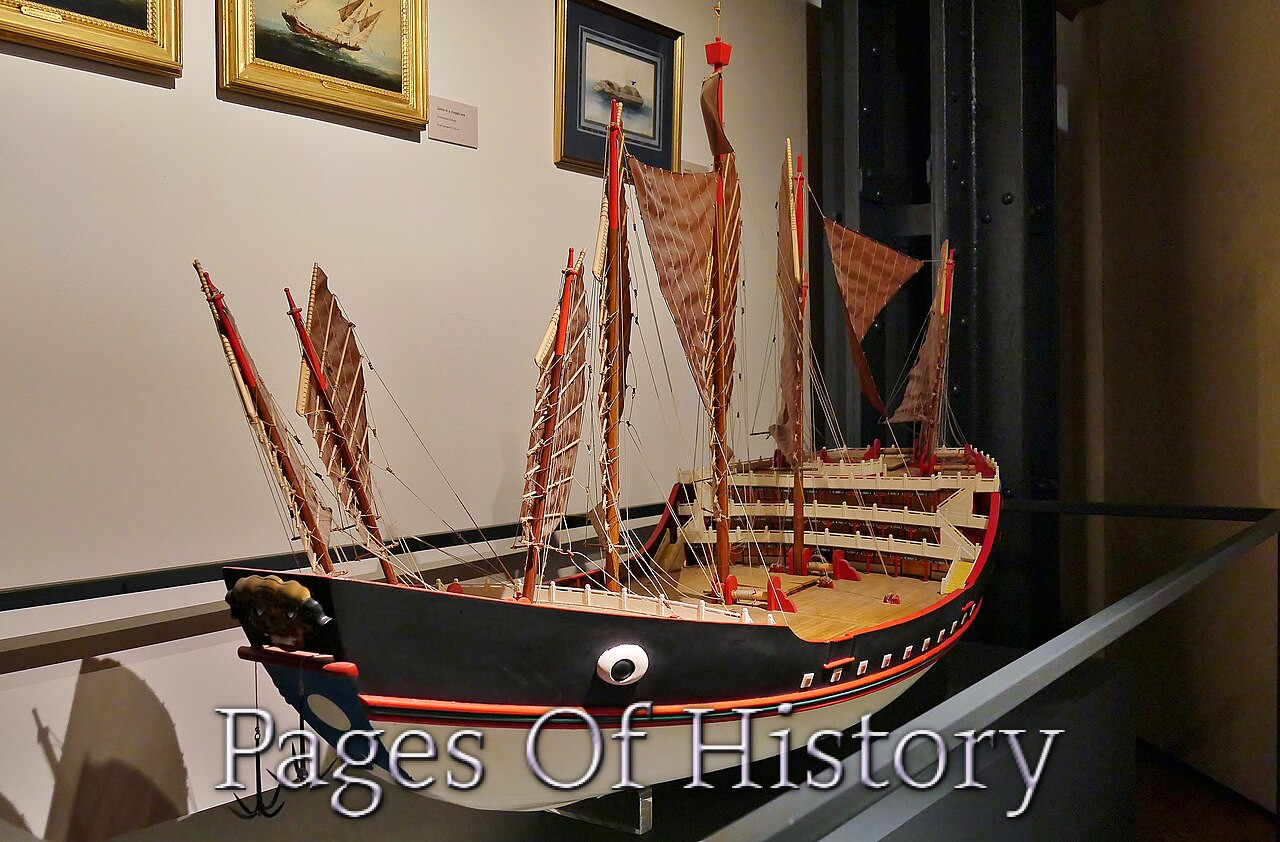
The numbers beggar belief. Contemporary and near-contemporary accounts describe the first voyage as comprising 317 ships and some 27,800 men — sailors, soldiers, interpreters, astrologers, doctors, carpenters, and clerks. The largest vessels, the treasure ships, were said to be over 100 meters long, though historians still debate the exact dimensions and whether such figures are exaggerated. Even the conservative estimates dwarf anything Europe could float at the time.
The fleet sailed in seven major expeditions:
- 1405–1407: To Java, Sumatra, and Calicut on India’s Malabar Coast.
- 1407–1409: Return to Calicut, plus Siam and the Strait of Malacca.
- 1409–1411: Ceylon (Sri Lanka), where Zheng He intervened in a local dynastic war.
- 1413–1415: To Hormuz in the Persian Gulf, and to Malindi on the East African coast.
- 1417–1419: The farthest-reaching voyage, reaching the Swahili coast and bringing back exotic animals including a giraffe.
- 1421–1422: A shorter voyage focused on restoring order in Southeast Asia.
- 1431–1433: The final voyage, under the Xuande Emperor, which returned Zheng He to Hormuz and the African coast.
These were not voyages of conquest in the European sense. The fleet rarely sought territory. Instead, it projected power, enforced the tributary system, suppressed piracy (notably defeating the pirate Chen Zuyi at Palembang in 1407), and brought foreign envoys back to Nanjing and later Beijing to kowtow before the emperor. It was statecraft by sea.
The Ideological Engine: Why the Ming Sailed at All
The voyages were not born of commercial hunger. Ming China under the Hongwu Emperor (r. 1368–1398), the dynasty’s founder, had actually banned private overseas trade — the haijin (“sea prohibition”) policy — to eliminate piracy and to prevent coastal merchants from growing rich and politically dangerous. So why did his son, the Yongle Emperor, launch the greatest fleets in history?
Several motives converged:
- Legitimacy: Yongle had seized the throne from his nephew in a bloody civil war. He needed to prove he was a true emperor, not a usurper. Grandiose projects — the Forbidden City, the Grand Canal, the voyages — were designed to display cosmic legitimacy.
- Tribute and prestige: The Confucian worldview held that the emperor ruled “all under heaven.” Foreign rulers who sent tribute acknowledged his supremacy. The voyages were a way to make that fiction real.
- Security: The Mongols remained the great strategic threat. Securing the Indian Ocean sea lanes and eliminating pirates protected trade and prevented hostile coalitions.
- Personal ambition: Yongle was a usurper who wanted to be remembered as a world-historical figure. He built the largest navy, the largest palace complex, and the largest encyclopedia (the Yongle Dadian) of his age.
Crucially, the voyages were not profitable in any meaningful commercial sense. They were funded entirely by the state treasury. The goods brought back — spices, gems, ivory, exotic animals — were consumed by the court or redistributed as gifts. The treasure fleet was a prestige project, and prestige projects are the first thing to go when money runs short.
Why the Ming Treasure Fleet Stopped: The Immediate Causes
The Yongle Emperor’s Death and the Rise of the Confucian Bureaucrats
Yongle died in 1424, on campaign against the Mongols. His son, the Hongxi Emperor, ruled for less than a year before dying in 1425. The next emperor, the Xuande Emperor, was more cautious. He faced a fiscal crisis: the treasury was drained by decades of war, the construction of Beijing, and the voyages themselves. In 1424, the voyages were suspended. They resumed once, in 1431, under Xuande — and then stopped for good after Zheng He’s death, probably in 1433, at Calicut on the return leg of the final voyage.
Zheng He’s death removed the single most important advocate for the voyages. He had no successor of comparable stature. The eunuch faction that supported the voyages lost its champion, while the Confucian scholar-officials of the civil bureaucracy — who had always despised the eunuchs and the voyages — gained the upper hand.
The Confucian Case Against the Sea
The scholar-officials had a coherent, if narrow, worldview. They argued that:
- The empire’s true wealth came from agriculture, not trade.
- Overseas commerce would enrich merchants and destabilize the social order.
- The voyages were a waste of money that could be spent on frontier defense and famine relief.
- Foreign exotica — giraffes and zebras — were frivolous curiosities, not real statecraft.
- The eunuchs who ran the voyages were corrupt and dangerous.
In 1436, the new Zhengtong Emperor (a child of eight) ascended the throne. The civil bureaucracy moved quickly. They destroyed the fleet’s records, burned the shipbuilding plans, and effectively forbade further construction of ocean-going vessels. The great shipyards at Nanjing were converted to other uses. By the 1470s, when a eunuch named Wang Zhi tried to recover the voyage archives to mount a new expedition, he found they had been deliberately hidden or destroyed by officials who opposed the whole enterprise.
The Fiscal Argument: Cost Versus Return
We do not have precise budget figures, but the scale of expenditure was enormous. Each voyage required thousands of men, hundreds of ships, and months of provisions. The state received tribute in return, but tribute is not profit. Meanwhile, the Ming faced mounting costs elsewhere: the reconstruction of the Grand Canal, the defense of the northern frontier against the Mongols, and the construction of Beijing as the new capital.
When the Yongle Emperor moved the capital from Nanjing to Beijing between 1403 and 1421, he shifted the empire’s strategic center of gravity northward. The voyages had been a Nanjing project — the shipyards were there, the eunuch admiralty was there. Once the court moved to Beijing, the voyages became geographically and politically peripheral.
A Timeline of Decision Points
| Year | Event | Significance |
|---|---|---|
| 1405 | First voyage departs under Zheng He | Beginning of the Ming treasure fleet era |
| 1421 | Capital moved to Beijing | Shifts focus northward; voyages become peripheral |
| 1424 | Yongle Emperor dies; voyages suspended | Loss of chief patron; fiscal crisis deepens |
| 1431–1433 | Final voyage under Xuande Emperor | Zheng He dies; no successor emerges |
| 1436 | Zhengtong Emperor ascends as a child | Bureaucrats consolidate power; voyages formally abandoned |
The Deeper Causes: Why the Ming Treasure Fleet Was Structurally Vulnerable
The immediate causes — Yongle’s death, Zheng He’s death, fiscal strain — are necessary but not sufficient. The voyages stopped because they were structurally fragile. They depended on a single patron, a single admiral, and a single ideological justification. Remove any one of those, and the whole enterprise collapsed.
No Commercial Constituency
Contrast the Ming voyages with the Portuguese and Spanish expeditions that followed a century later. Vasco da Gama’s 1498 voyage to India was funded by the Portuguese crown, but it was designed to capture the spice trade — to make money. Columbus sailed for gold and a western route to Asia. Magellan’s expedition, though disastrous, was a commercial venture with a clear profit motive.
The Ming treasure fleet had no such constituency. The haijin policy had suppressed private overseas trade, so there was no merchant class with a vested interest in the voyages. The court consumed the tribute; the merchants were excluded. When the state lost interest, no private sector stepped in to keep the ships sailing.
The Eunuch Versus Scholar-Official Conflict
Ming politics was a permanent struggle between the eunuchs of the imperial household and the Confucian scholar-officials of the bureaucracy. The voyages were a eunuch project — Zheng He was a eunuch, his subordinates were eunuchs, and the admiralty was staffed by eunuchs. To the scholar-officials, the voyages were not just wasteful; they were an institutional threat. Every successful voyage enhanced eunuch power at their expense.
When the eunuch faction lost its imperial patron, the scholar-officials moved to dismantle the entire apparatus. They did not merely stop the voyages; they erased the institutional memory of them. This was not an accident. It was a political purge.
The Mongol Threat and the Northern Turn
The Ming’s strategic priority was always the northern frontier. The Mongols had been expelled from China in 1368, but they remained a potent threat. Yongle himself led five campaigns against them and died on the fifth. The Great Wall was rebuilt and extended. The capital was moved to Beijing — literally “Northern Capital” — to be closer to the front.
Naval power in the Indian Ocean did nothing to address the Mongol threat. In fact, it diverted resources from it. When the empire had to choose between the sea and the steppe, it chose the steppe. This was a rational strategic calculation, but it had enormous long-term consequences.
What Was Lost — and What It Meant
The abandonment of the Ming treasure fleet was not just the end of a few voyages. It was the end of Chinese maritime power for centuries. Consider what followed:
- 1498: Vasco da Gama reaches Calicut — the same port Zheng He had visited decades earlier — and opens the sea route from Europe to Asia.
- 1511: The Portuguese conquer Malacca, the strategic strait Zheng He had secured for China.
- 1557: The Portuguese establish a permanent settlement at Macau, on China’s own coast.
- 1600s: European powers dominate the Indian Ocean trade that China had once controlled.
China did not simply withdraw from the world. It continued to trade, but on European terms and through European intermediaries. The haijin policy was relaxed and reimposed repeatedly, but the state never again built an ocean-going navy of comparable scale. By the 19th century, when British gunboats arrived during the Opium Wars, China had no blue-water fleet to oppose them.
Historians debate whether the voyages could have led to something like European-style colonialism. Most argue no — the Ming had no interest in territorial conquest overseas, and the ideological framework of the tribute system was fundamentally different from mercantile capitalism. But the voyages did demonstrate that China had the technology, the resources, and the organizational capacity to project power across the Indian Ocean. What it lacked was the will to sustain it.
The Great Divergence and the Ming Treasure Fleet
The question of why the Ming stopped sailing is often framed as part of the “Great Divergence” — the moment when Europe pulled ahead of Asia economically and technologically. The Ming treasure fleet’s abandonment is sometimes cited as a key turning point.
The argument goes like this: while China turned inward, Europe turned outward. Portugal and Spain, followed by the Dutch and English, built maritime empires that generated enormous wealth. China, by contrast, spent the next four centuries fighting off nomads, suppressing pirates, and trying to control its own coast. The wealth that could have funded industrialization was instead spent on frontier defense and internal repression.
This narrative is too simple. China remained the world’s largest economy until at least the 18th century. The voyages were not the only path to modernization, and it is not clear that continued voyages would have led to industrialization. But the contrast is striking: in 1433, the year Zheng He died, China had the most powerful navy in the world. By 1500, it had almost none. By 1840, it was being carved up by European powers.
“The Ming voyages were a dead end — not because they failed, but because they succeeded at something the empire ultimately did not value.”
That is the crux. The Ming treasure fleet succeeded on its own terms: it projected power, collected tribute, and brought back wonders. But those terms were defined by a single emperor and a single admiral. When they died, the terms died with them.
Why Did the Ming Treasure Fleet Really Stop? The Verdict
There is no single answer. The voyages stopped because of a confluence of factors that reinforced one another:
- Fiscal exhaustion: The state could not sustain the cost indefinitely, especially with other pressing demands.
- Political opposition: The Confucian scholar-officials opposed the voyages on ideological and institutional grounds, and they gained power after Yongle’s death.
- Loss of leadership: Yongle and Zheng He both died, leaving no comparable advocates.
- Strategic reorientation: The move to Beijing and the Mongol threat shifted priorities northward.
- Structural fragility: The voyages had no commercial constituency and no institutional home outside the eunuch faction.
Any one of these might have been survivable. Together, they were fatal.
It is tempting to imagine an alternate history in which the Ming treasure fleet continued — in which Chinese ships rounded the Cape of Good Hope, established colonies in Africa, and competed with Europe for global dominance. But that is fantasy. The Ming state was not designed for maritime empire. Its ideological foundations, its fiscal structures, and its political coalitions all pointed away from the sea.
What actually happened is more interesting: a civilization with the capacity for global reach chose, deliberately and repeatedly, not to use it. The reasons were not irrational. They were the product of a coherent worldview that valued stability over expansion, agriculture over commerce, and the steppe over the sea. That worldview had costs — enormous ones — but it was not a mistake. It was a choice.
The Ming treasure fleet remains a symbol of what might have been. But it is also a reminder that power is not just about capability. It is about will, and will is shaped by politics, culture, and the accidents of individual lives. When Zheng He died in 1433, he took the last great advocate of Chinese sea power with him. The ships rotted. The records burned. And the world moved on without China.