
📅 Last updated: 31.10.2026
The Boudica warrior queen stands as one of history’s most formidable figures of resistance—a British tribal leader who, in 60–61 CE, raised an army that burned three Roman cities to the ground and nearly drove the empire from Britain. Her revolt, triggered by brutal Roman treatment and the flogging of her own body, exposed the fragility of Roman rule in a province only recently conquered. This article examines who Boudica was, what drove her to war, how her rebellion unfolded, and why her legacy endures as a symbol of defiance against imperial power.
Boudica was a queen of the Iceni tribe in eastern Britain who led a major uprising against Roman rule in 60–61 CE. After Roman officials seized her lands, flogged her, and raped her daughters following her husband’s death, she assembled a coalition of tribes and destroyed the Roman settlements of Camulodunum, Londinium, and Verulamium, killing tens of thousands. Her army was ultimately defeated by the Roman governor Gaius Suetonius Paulinus at an unknown site, and Boudica reportedly died soon after, likely by poison.
- Who Was the Boudica Warrior Queen Before the Revolt?
- Why Did the Boudica Warrior Queen's Revolt Spread So Quickly?
- Where Was the Final Battle of the Boudica Warrior Queen?
- How Reliable Are the Ancient Sources on Boudica?
- What Was the Legacy of the Boudica Warrior Queen?
- Why Does Boudica Still Matter Today?
Who Was the Boudica Warrior Queen Before the Revolt?
Much of what we know about Boudica comes from two Roman sources: the Annals and Agricola of Tacitus, and the Roman History of Cassius Dio, writing more than a century later. Both were Romans writing for Roman audiences, and neither was an eyewitness. Yet their accounts, cross-referenced with archaeology and coin evidence, allow a reasonably detailed reconstruction of her life before 60 CE.
Boudica (also spelled Boadicea, a corruption introduced by later scribes) was the wife of Prasutagus, king of the Iceni, a tribe occupying what is now Norfolk and northern Suffolk. The Iceni had been a wealthy, horse-owning people—archaeological finds at sites like Snettisham reveal elaborate gold torcs and coin hoards testifying to their prosperity. During the Roman invasion of 43 CE under the emperor Claudius, the Iceni initially submitted and were granted client-kingdom status, meaning Prasutagus ruled nominally independently while Rome held ultimate authority.
This arrangement suited both parties for nearly two decades. Prasutagus grew wealthy, and Rome gained a buffer on the eastern frontier. The arrangement collapsed the moment Prasutagus died, around 59–60 CE.
The Trigger: Rome’s Betrayal of the Iceni
Prasutagus, hoping to protect his family, left a will dividing his kingdom between his two daughters and the emperor Nero. Roman law, however, did not recognize client kings’ wills as binding on imperial officials. According to Tacitus, “kingdom and household were ravaged by centurions, his property plundered by slaves” (Annals 14.31). Boudica was flogged publicly, and her daughters were raped. Icenian nobles were stripped of ancestral lands, and the tribe was treated as conquered property.
These were not random cruelties. They were the predictable result of Roman financial officials—particularly the procurator Catus Decianus—calling in debts and seizing assets. Rome had recently recalled loans made to British elites, and Seneca himself reportedly demanded repayment of a large sum he had lent to British tribes. The combination of humiliation, dispossession, and debt collection turned a loyal client kingdom into a powder keg.
Why Did the Boudica Warrior Queen’s Revolt Spread So Quickly?
The Iceni alone could not have challenged Rome. What made the revolt dangerous was its speed and breadth. Within weeks, Boudica’s forces were joined by the Trinovantes, a neighboring tribe whose capital at Camulodunum (modern Colchester) had been turned into a Roman colonia—a settlement for retired legionaries who had seized Trinovantian land and treated the locals with contempt.
Several factors explain the rapid escalation:
- Roman military overextension: Governor Gaius Suetonius Paulinus was campaigning in North Wales, assaulting the druid stronghold of Mona (Anglesey), with much of the province’s legionary strength.
- Economic grievance: Forced loans, land confiscation, and heavy taxation had alienated tribal elites across the southeast.
- Symbolic targets: Camulodunum hosted a temple to the deified Claudius, a visible monument to Roman domination and a natural focus for resentment.
- Weak local defenses: The colonia was largely undefended; its settlers had built no walls, trusting in Roman invincibility.
Boudica’s army—ancient sources give figures as high as 120,000, almost certainly exaggerated—moved first against Camulodunum. The town’s small garrison was annihilated, and the temple where veterans and civilians had barricaded themselves fell after a two-day siege. Archaeological excavation at Colchester has revealed a thick layer of burned debris from this period, confirming the destruction.
The Destruction of Londinium and Verulamium
News of the massacre reached Suetonius in Wales. He raced south along Watling Street with a force of perhaps 10,000 men, reaching Londinium (London) ahead of the rebels. Londinium was then a modest trading settlement, not yet a major city, but it was home to merchants and Roman officials. Suetonius judged it indefensible and abandoned it. Tacitus records that those who stayed—the old, the sick, women and children—were slaughtered indiscriminately. The rebels then burned Verulamium (St Albans).
Modern excavation has found a distinctive red layer of burned material beneath London’s modern streets, dated precisely to this period, corroborating the literary accounts. The revolt had now destroyed three settlements and killed an estimated 70,000–80,000 people, according to Tacitus—a figure that, while uncertain, conveys the scale of the catastrophe.
Where Was the Final Battle of the Boudica Warrior Queen?
The decisive engagement took place at an unidentified site, probably somewhere in the English Midlands along Watling Street. Suetonius chose ground deliberately: a narrow defile with woods behind him and an open plain in front, forcing the numerically superior Britons to attack on a narrow front where Roman discipline and formation could prevail.
Before the battle, both commanders spoke. Tacitus gives Boudica a speech that is almost certainly his own composition but reflects the themes of the revolt: “We British are used to women commanders in war… I am fighting as an ordinary person for my lost freedom, my bruised body, and my outraged daughters” (Annals 14.35). Suetonius, by contrast, urged his men to “ignore the clamour of these savages” and remember their training.
The Tactics That Doomed the Rebellion
The Britons attacked in a massed charge, but the narrow ground neutralized their numbers. Roman legionaries held their formation, hurled javelins, then advanced in wedge formation. The Britons broke and fled—straight into the wagons they had parked behind their lines to watch the battle, which blocked their retreat. The slaughter was immense. Tacitus claims nearly 80,000 Britons died for the loss of about 400 Romans.
Boudica herself escaped the battlefield but died shortly afterward. Tacitus says she poisoned herself; Cassius Dio says she fell ill and died. Neither is certain. What is certain is that her revolt collapsed, and Roman vengeance was brutal. Suetonius ravaged the territories of the Iceni and Trinovantes, and the province took years to recover. Nero reportedly considered abandoning Britain entirely before deciding to retain it.
| Date | Event | Significance |
|---|---|---|
| 43 CE | Claudian invasion of Britain | Iceni become client kingdom under Prasutagus |
| c. 59–60 CE | Death of Prasutagus | Will ignored; Boudica flogged, daughters raped |
| 60–61 CE | Revolt begins | Camulodunum destroyed; temple of Claudius burned |
| 60–61 CE | Londinium and Verulamium burned | Three cities destroyed; tens of thousands killed |
| 61 CE | Battle of Watling Street | Rebel army annihilated; Boudica dies |
| 61–62 CE | Roman reprisals | Province pacified; Nero considers withdrawal |
How Reliable Are the Ancient Sources on Boudica?
The two main sources present Boudica in sharply different ways, and understanding those differences is essential to assessing her historical reality.
Tacitus, writing about 40–50 years after the events, presents Boudica as a wronged queen demanding justice—a figure whose grievances are concrete and whose courage is admirable even by Roman standards. His account is shaped by his own senatorial perspective: he uses the revolt to criticize imperial officials and to praise Suetonius’s military skill. Cassius Dio, writing in the early third century, draws on earlier sources but embellishes heavily, giving Boudica a lengthy speech and describing her as exceptionally tall with a harsh voice and a mass of red hair. These physical details are almost certainly literary invention, echoing classical tropes about “barbarian” warriors.
Neither author was present in Britain. Neither likely read a primary account from an eyewitness. Yet both preserve a core of historical truth corroborated by archaeology: the burned layers at Colchester, London, and St Albans; the destruction of the temple of Claudius; and the sudden, violent disruption of early Roman Britain. Boudica almost certainly existed, and her revolt almost certainly happened on the scale described.
What Was the Legacy of the Boudica Warrior Queen?
Boudica’s immediate legacy was Roman retrenchment. Suetonius’s harsh reprisals were criticized in Rome, and the new procurator, Gaius Julius Classicianus, worked to reconcile the province. He was helped by the recall of Suetonius, whose scorched-earth policy was judged counterproductive. The province survived, but the revolt demonstrated that Rome’s grip on Britain was contingent on local cooperation—a lesson later governors, notably Agricola, took seriously.
For the Iceni, the aftermath was catastrophic. Their tribal identity faded, and their lands were absorbed into the Roman province. Yet the revolt may have won modest concessions: some scholars argue that the Iceni were later granted a degree of self-government as a civitas, though the evidence is thin.
From Obscurity to Icon
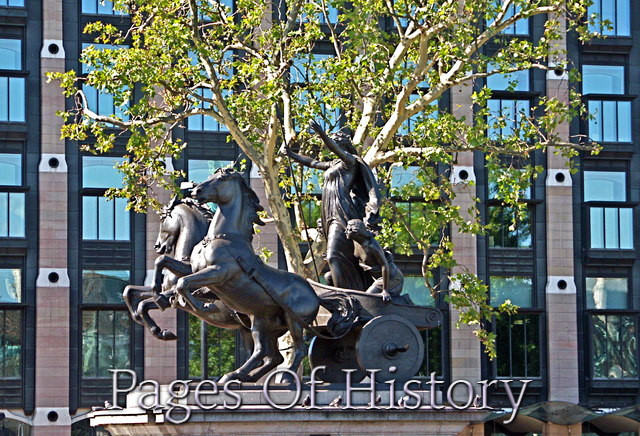
Boudica was largely forgotten in the Middle Ages. Interest revived in the Tudor period, when her story was linked to Elizabeth I—another queen leading a nation against foreign threat. In the Victorian era, she became a symbol of British imperial vigor, commemorated in a bronze statue by Thomas Thornycroft on Westminster Bridge (unveiled in 1902) showing her in a chariot with her daughters. Suffragettes later adopted her as a feminist icon, and she has since appeared in novels, films, and television series.
Modern historians treat her more cautiously. She was not a proto-nationalist—Britain did not exist as a concept—and her revolt was as much about aristocratic grievance and revenge as about liberation. Yet the image of a queen who took up arms after being flogged and whose daughters were violated retains a powerful hold on the imagination.
Why Does Boudica Still Matter Today?
The Boudica warrior queen matters because her story illuminates the mechanics of empire: how conquest, debt, humiliation, and cultural arrogance can ignite resistance; how quickly a province can slip from control; and how the memory of defeat can become more powerful than the defeat itself. Her revolt forced Rome to reconsider how it governed Britain, and it left a permanent mark on the island’s historical consciousness.
She also matters as a case study in how history is written. The gap between the Boudica of Tacitus, the Boudica of Cassius Dio, and the Boudica of modern imagination is a reminder that every historical figure is mediated by sources, agendas, and audiences. What survives of her is fragmentary and contested—and yet, in the burned layers beneath Colchester and London, something real remains.
For anyone seeking the historical Boudica, the evidence points to a wealthy, wronged queen who seized a moment of Roman weakness and came remarkably close to changing the course of British history. She failed on the battlefield, but she succeeded in ensuring that Rome would never again take Britain for granted. That is a legacy worth remembering.