
📅 Last updated: 25.11.2026
The Antikythera mechanism is the earliest known geared device built to model the heavens, recovered in 1901 from a Roman-era shipwreck off the Greek island of Antikythera. For more than a century it has forced historians to revise their assumptions about what Hellenistic Greek craftsmen could actually build. Its bronze gears, astronomical dials, and eclipse predictions reveal a level of mechanical sophistication that would not be matched in the West for well over a thousand years.
The Antikythera mechanism is a hand-powered bronze analog computer built in the 2nd century BCE, probably by Greek craftsmen linked to Rhodes or Syracuse. It used at least 30 interlocking gears to track the Sun, Moon, planets, and lunisolar calendar, and to predict solar and lunar eclipses decades in advance. It was lost in a shipwreck around 60 BCE and rediscovered by sponge divers in 1901.
- What Was the Antikythera Mechanism, and Why Does It Matter?
- Discovery: Sponge Divers, a Bronze Hand, and a Century of Study
- How Did the Antikythera Mechanism Actually Work?
- Who Built It, and Where? The Antikythera Mechanism's Origins
- Timeline: From Hellenistic Workshop to Modern Laboratory
- Why Did This Technology Disappear?
- What the Antikythera Mechanism Reveals About Greek Science
- Legacy: The Antikythera Mechanism in History and Memory
- Conclusion: A Machine That Rewrote the History of Technology
What Was the Antikythera Mechanism, and Why Does It Matter?
The device is a wooden case roughly the size of a shoebox, fronted by a circular zodiac dial and a calendar ring, with a large bronze gear assembly sandwiched inside. Turning a side handle advanced the entire system. On the front, pointers showed the position of the Sun and Moon against the zodiac; a rotating sphere may have displayed lunar phase. On the back, two spiral dials served as a lunar calendar and eclipse predictor, with a third smaller dial tracking the 76-year Callippic cycle.
What matters is not just the object but the implication. Before 1901, the standard account of mechanical history ran from Hellenistic “toys” to medieval Arab and European clockwork. The Antikythera mechanism collapsed that timeline. Here was a portable, geared, predictive instrument built centuries before the Roman Empire reached its height and more than a millennium before European cathedral clocks. It is, in the strict sense, a computer: an analog calculating machine whose gears embody astronomical theory and whose outputs are read from dials.
The wreck site lies off Antikythera, a small island between the Peloponnese and Crete, on a shipping lane between the Aegean and the western Mediterranean. The cargo—luxury goods, sculpture, glassware, and the mechanism—suggests a vessel carrying loot or trade goods westward, probably toward Rome, when it struck the rocks around 60 BCE. That date is inferred from coins and pottery in the wreck.
Discovery: Sponge Divers, a Bronze Hand, and a Century of Study
In the autumn of 1900, Greek sponge divers sheltering from a storm near Antikythera found a wreck at roughly 45–60 meters. The following year, working with the Greek navy, they raised statues, coins, furniture fragments, and a corroded lump of bronze and wood that nobody initially recognized. The lump was set aside at the National Archaeological Museum in Athens.
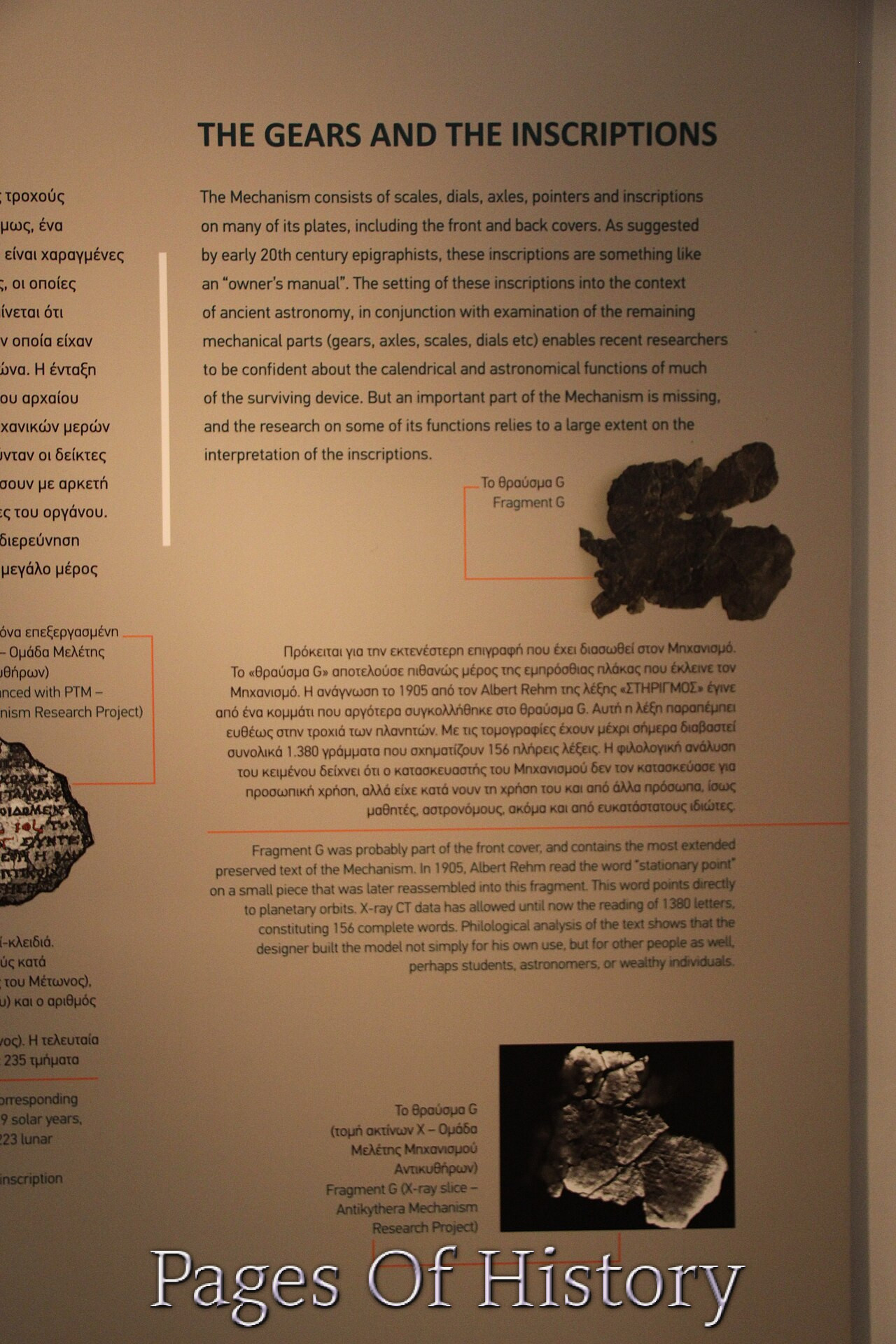
In 1902, the archaeologist Valerios Stais noticed a gear wheel embedded in the corroded mass. Debate followed for decades. Some scholars thought the object an astrolabe; others dismissed it as a curiosity. Serious progress came only with new technology. In 1974, Derek de Solla Price published Gears from the Greeks, arguing that the device was a calendrical and astronomical computer. In 2005, a CT-scanning project led by Tony Freeth and colleagues at Cardiff University, with support from the National Geographic Society, revealed hidden inscriptions and gear teeth in unprecedented detail. A 2006 paper in Nature (“Decoding the ancient Greek astronomical calculator known as the Antikythera Mechanism”) presented a reconstructed gear train and confirmed the device’s predictive functions.
Later work, including the 2016 “Cosmos” inscription study and 2021 UCL-led research on the front dial, refined the picture: the mechanism displayed not only the Sun and Moon but also the five planets known to antiquity, and its eclipse predictions were color-coded for solar versus lunar events and for time of day.
How Did the Antikythera Mechanism Actually Work?
The gear train and the Metonic cycle
The core of the machine is a set of bronze gears with triangular teeth, cut by hand. The largest surviving gear has 223 teeth; another has 127. These numbers are not arbitrary. The 223-tooth gear encodes the Saros cycle, the 223-lunar-month period after which eclipses repeat in a similar pattern. The 127-tooth gear relates to the 254-lunar-month period of the Moon’s motion relative to its nodes. The 19-year Metonic cycle, which reconciles lunar months with solar years, is built into the calendar ring.
At least 30 gears are known, and scholars estimate the original total may have been closer to 37. The gearing ratios are exact fractions—1/19, 1/76, 223/127—so the machine’s outputs are not approximations but the arithmetic consequences of Greek astronomical theory. That is the essential point: the mechanism is a physical embodiment of the mathematics in texts like Geminus’s Introduction to the Phenomena and the astronomical tables behind them.
The front dial: Sun, Moon, and zodiac
The front face carried a zodiac ring and a calendar ring. A pointer showed the Sun’s position through the year; a second, more complex pointer showed the Moon’s position, with a small rotating sphere for lunar phase. Because the Moon’s speed varies (it moves faster near perigee), the mechanism used a pin-and-slot device to introduce the variation—an ingenious mechanical solution to the problem of the Moon’s elliptical orbit, centuries before Ptolemy formalized epicyclic models.
The back dials: eclipse prediction and the games calendar
The upper back dial was a spiral with 235 divisions, marking the Metonic calendar of lunar months. The lower back dial was a four-turn spiral with 223 divisions for the Saros eclipse cycle, with glyphs indicating predicted eclipses and their characteristics. A smaller dial tracked the Callippic cycle (76 years, four Metonic cycles). Inscriptions around the dials named months and noted which athletic festivals—including the Olympic Games—fell in which months, making the device a practical calendar as well as an astronomical instrument.
Who Built It, and Where? The Antikythera Mechanism’s Origins
The mechanism was not a one-off miracle. Its design reflects a specific intellectual tradition: the mathematical astronomy of the Hellenistic world, especially the school associated with Rhodes and the legacy of Archimedes at Syracuse. Cicero, writing in the 1st century BCE, describes bronze spheres built by Archimedes that reproduced the motions of the Sun, Moon, and planets—devices now lost but plausibly ancestral to the Antikythera mechanism. Cicero also mentions similar devices made by Posidonius of Rhodes.
Most scholars now place the mechanism’s construction around 150–100 BCE, with some favoring a Rhodian origin and others a Syracusean one. The inscriptions are in Greek, and the month names align with a Corinthian-Epirote calendar, pointing toward northwestern Greece or a colonial context. The device may have been built by a workshop with access to Babylonian eclipse records and Greek geometric astronomy—two traditions that had already been fused by the 2nd century BCE.
What is certain is that the knowledge required was not secret. The gears encode standard cycles: Metonic, Saros, Callippic, and the 76-year period. The genius lay in engineering—cutting precise teeth, minimizing friction, and packaging the whole system into a portable case.
Timeline: From Hellenistic Workshop to Modern Laboratory
| Date | Event | Significance |
|---|---|---|
| c. 150–100 BCE | Mechanism built, probably in Rhodes or Syracuse | Peak of Hellenistic geared astronomy; reflects Archimedean tradition |
| c. 60 BCE | Shipwreck off Antikythera | Device lost with cargo bound for Rome |
| 1900–1901 | Sponge divers recover wreck material | Mechanism raised and deposited in Athens |
| 1902 | Valerios Stais identifies a gear | First recognition of mechanical content |
| 1974 | Derek de Solla Price publishes Gears from the Greeks | Establishes the device as an astronomical computer |
| 2005–2006 | CT scanning and Nature paper | Reveals gear train, inscriptions, and eclipse predictor |
| 2016–2021 | Inscription and front-dial studies | Confirms planetary display and refined reconstruction |
Why Did This Technology Disappear?
The mechanism’s disappearance is as instructive as its existence. No comparable geared astronomical device survives from the Roman world, and the tradition of precision gear-cutting seems to have lapsed in the West after antiquity. Several factors explain this:
- Elite, expensive craft: The device required skilled bronze-workers and mathematicians; it was a luxury object, not a mass-produced tool.
- Fragile materials: Bronze corrodes and wood decays; few such instruments could survive centuries of use, let alone shipwreck.
- Shift in intellectual priorities: Roman practical astronomy favored calendars and astrological texts over geared models; the market for such devices shrank.
- Loss of institutional continuity: The workshops and schools that trained such craftsmen did not survive the political disruptions of the late Republic and Empire.
The knowledge itself did not vanish entirely. Astronomical cycles and gear technology resurfaced in the Islamic world—al-Biruni describes geared calendar devices—and later in medieval European clockwork. But the specific integration of gears, dials, and predictive astronomy seen in the Antikythera mechanism was not equaled in the West until the 14th century.
What the Antikythera Mechanism Reveals About Greek Science
The device complicates the familiar story of Greek science as purely theoretical. Plato and Aristotle prized contemplation over craft; yet here is a machine that required both. The mechanism’s existence shows that Hellenistic astronomers and instrument-makers worked together, translating geometric models into metal. It also shows that Babylonian observational data—eclipse records spanning centuries—circulated widely enough to be encoded in a portable instrument.
There is a further point about accuracy. The mechanism’s predictions were not perfect; its gear ratios approximate the real periods, and its eclipse predictions were schematic rather than precise. But for its time, the level of agreement was remarkable. The device could forecast the possibility of an eclipse years ahead, which had practical value for calendar-keeping and, presumably, for prestige.
Legacy: The Antikythera Mechanism in History and Memory
The mechanism’s modern reception has been shaped by technology as much as by history. The 2005 CT scans transformed it from a corroded curiosity into a readable text. Reconstructions—including working models built by Michael Wright and the 2012 Lego model by Andrew Carol—demonstrate that the design is mechanically sound. The device has become a touchstone in discussions of ancient technology, cited in debates about whether technical progress is linear and whether “lost” knowledge is truly lost or simply unsupported by institutions.
Its cultural reach is wide: it appears in museum displays, documentaries, and even fiction. But the historical lesson is sober. The Antikythera mechanism was not an anomaly dropped into a primitive world; it was the product of a specific intellectual and craft tradition that flourished briefly and then faded. Its survival is an accident of shipwreck and corrosion, and its decipherment is an accident of modern imaging.
Conclusion: A Machine That Rewrote the History of Technology
The Antikythera mechanism endures as the most eloquent surviving artifact of Hellenistic ingenuity. It is a computer in bronze, a calendar, an eclipse predictor, and a statement about what ancient Greeks could imagine and build. Its gears encode the same cycles that astronomers still use to describe the Moon and eclipses, and its recovery reminds us that the history of technology is not a straight line but a series of peaks, gaps, and rediscoveries.
For historians, the device settles a long argument: the ancient world was capable of precision engineering. For general readers, it offers something rarer—a direct encounter with ancient minds at work, preserved in corroded metal and legible only through modern science. The Antikythera mechanism is not merely a relic of Greece’s first computer; it is a challenge to every assumption about how knowledge travels through time.