
📅 Last updated: 23.07.2026
For centuries, the monolithic figures of Rapa Nui have stood as silent sentinels, their enigmatic presence sparking endless debate about the civilization that created them. The mystery of how the Easter Island statues, known as moai, were transported from the volcanic quarry of Rano Raraku to their final platforms (ahu) across the island has been one of archaeology’s most persistent puzzles. While traditional narratives once favored tree-log rollers or dragging, a revolution in experimental archaeology and indigenous oral history has given rise to a compelling consensus: the moai were “walked.” This article explores the new theories, the evidence supporting them, and the profound implications they have for our understanding of Rapa Nui society.
- The Traditional View: A People Who Destroyed Themselves
- The "Walking" Hypothesis: A New Paradigm Emerges
- How the Easter Island Statues Were "Walked": The Evidence
- Redating the Collapse: A Story of Resilience, Not Ruin
- Why Did the Easter Island Statues Walk? The Social and Spiritual Logic
- Experimental Archaeology: Proving the Theory in Practice
- Implications for Understanding Rapa Nui Society
- Legacy and the Living Statues
The Traditional View: A People Who Destroyed Themselves
For much of the 20th century, the dominant explanation for moving the Easter Island statues involved massive amounts of timber. The prevailing hypothesis, popularized by scholars like Jared Diamond in his 2005 book Collapse, painted a grim picture. According to this “ecocide” narrative, the island’s Polynesian settlers, arriving around 1200 CE, used vast quantities of trees to create log rollers and sledges. The statues, weighing up to 80 tons and standing over 30 feet tall, were supposedly dragged from the quarry to the coast, a process that required immense human labor and, critically, an enormous amount of rope made from tree fibers.
The consequence, the theory argued, was ecological catastrophe. The Rapa Nui people deforested their island to move their gods, leading to soil erosion, crop failure, societal collapse, and internecine warfare—epitomized by the rise of the “Birdman” cult (Tangata manu) and the toppling of many moai during the 17th and 18th centuries. This story became a powerful cautionary tale for the modern world. However, it rested on shaky ground. No one had ever successfully replicated the transport of a full-sized moai using logs, and the island’s extinct palm trees (Paschalococos disperta) were found to have wood that was too brittle for such heavy, repetitive strain.
The “Walking” Hypothesis: A New Paradigm Emerges
The seeds of the new theory were planted by the Rapa Nui people themselves. Their oral traditions consistently speak of the moai walking to their platforms. Elders described the statues moving with a “waddling” or “shuffling” motion, guided by the collective will and spiritual power (mana) of the community. For decades, Western archaeologists dismissed this as myth, but a small group of researchers began to take it literally.
The key breakthrough came from a collaboration between archaeologist Terry Hunt of the University of Hawaii and Carl Lipo of Binghamton University. In a series of experiments starting in 2011, they demonstrated that a carefully shaped moai replica, when properly harnessed with ropes, could be “walked” upright by a relatively small team of people. The technique, they argued, was not about brute force but about physics and leverage.
The Physics of a Waddling God
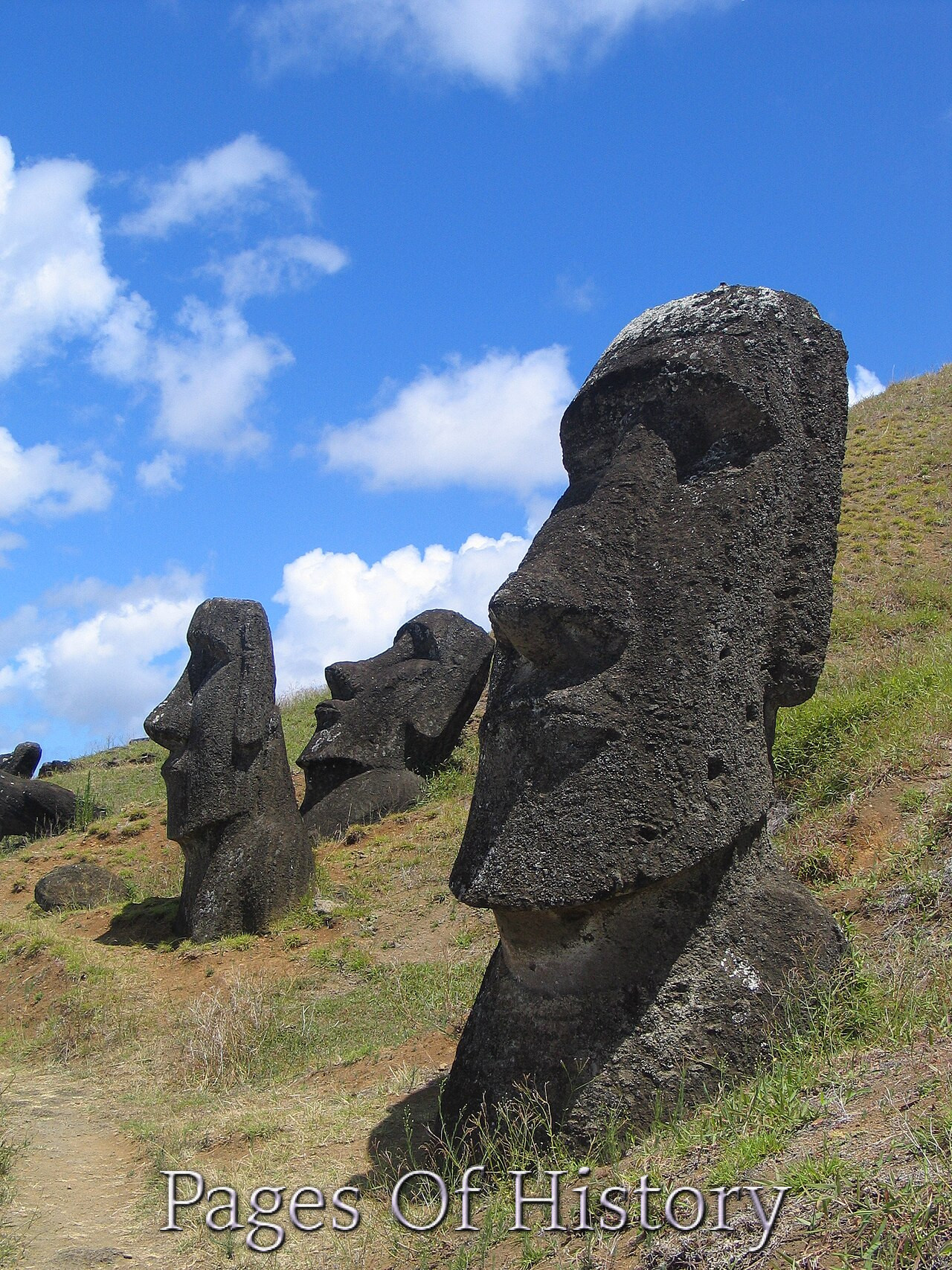
The genius of the walking method lies in the moai’s design. Hunt and Lipo noticed that the statues are not perfectly vertical. They have a slight forward lean and a pronounced, D-shaped cross-section. Their center of gravity is carefully engineered. By tying ropes around the statue’s head and neck, a team of pullers on each side could rock the moai side-to-side, creating a controlled, pivoting motion. A third team at the back would prevent it from toppling forward. With each rock, the statue effectively took a “step,” rotating on its curved base.
This method, known as “statue walking” or “rocking,” required no logs, no sledges, and no paved roads. It needed only ropes—made from the fibers of the hau hau tree (Triumfetta semitriloba) or the makaloa sedge—and human coordination. In their 2012 experiment, a team of just 18 people successfully walked a 4.5-ton concrete replica nearly 100 meters in a few hours. The implications were staggering: the same workforce that could drag a statue with logs might have walked a dozen statues in the same time.
How the Easter Island Statues Were “Walked”: The Evidence
The walking hypothesis is not just a clever idea; it is supported by a growing body of archaeological and physical evidence that recontextualizes how the Easter Island statues were moved.
- Roadway Design: The ancient roads leading from Rano Raraku to the ahu are not straight paths. They are gently curved and, crucially, are made of a compacted, slightly soft surface—often a mixture of volcanic tuff and clay. This surface would have been ideal for absorbing the shock of a rocking statue and would have been impractical for dragging a heavy object on a sledge, which requires a hard, flat surface.
- Statue Morphology: The moai are not uniform. Statues found along the roads or abandoned in the quarry often have a more rounded, bulbous base than those standing on ahu. This rounded base is perfectly suited for the rocking motion of walking. Statues that reached their destination were often re-carved to have a flat base, allowing them to be securely mounted on their platforms.
- Abandoned Statues: The famous “fallen” moai along the roads are not randomly scattered. Many are found lying face-down, and their posture—with the head tilted to one side—is exactly what would be expected if a walking team lost control and the statue tipped forward while rocking.
- Postholes and Rope Marks: Excavations along the transport roads have revealed a pattern of shallow postholes at regular intervals. These are not the deep holes needed for a massive wooden sledge or a tree-trunk roller. Instead, they are consistent with the placement of small wooden stakes used to anchor guide ropes and provide leverage for the walking teams.
This evidence paints a picture of a sophisticated engineering culture that understood leverage, weight distribution, and material science. The Rapa Nui did not need to destroy their forests to move their statues; they needed to manage their labor efficiently.
Redating the Collapse: A Story of Resilience, Not Ruin
The walking theory has forced a fundamental re-evaluation of Rapa Nui history. If the moai were not dragged using logs, then the central pillar of the “ecocide” narrative—that deforestation was caused by statue transport—collapses. This has led to a new wave of research that has redated key events on the island, changing the story from one of self-destruction to one of resilience.
The New Timeline
| Event | Old Date | New Date (Based on Recent Research) | Key Implication |
|---|---|---|---|
| First Polynesian Settlement | ~800-1200 CE | ~1200 CE (Hunt & Lipo, based on radiocarbon dating of rat bones and seeds) | Shorter timeframe for monument building; less time for ecological damage before European contact. |
| Major Moai Construction & Transport | ~1000-1600 CE | ~1200-1500 CE | Era of monumental construction was intense but relatively brief, coinciding with the island’s peak population and resource abundance. |
| Deforestation Event | Caused by statue transport, ~1000-1600 CE | Caused by Polynesian rat (Rattus exulans) and slash-and-burn agriculture, completed by ~1450 CE | Deforestation was a gradual process, not a sudden crash. The rats ate the palm seeds, preventing forest regeneration. |
| Moai Toppling (Huri Mo’ai) | ~1680-1770 CE (civil war) | ~1770-1830 CE (post-European contact) | The toppling of the statues was likely a result of introduced diseases, slave raids, and cultural disruption, not an internal civil war over resources. |
This revised timeline shows that the Rapa Nui people lived with a deforested landscape for centuries. They adapted. They switched from fishing (which required trees for canoes) to intensive chicken farming (building stone chicken houses called hare moa). They developed sophisticated rock gardening techniques (lithic mulching) to grow sweet potatoes and taro in the thin, wind-swept soil. The moai toppling, once seen as the climax of a civil war, is now understood to be a post-contact phenomenon, likely triggered by the devastating arrival of Europeans in 1722, which brought disease, slave trading (most notably the Peruvian slave raid of 1862), and cultural collapse.
Why Did the Easter Island Statues Walk? The Social and Spiritual Logic
Understanding how the Easter Island statues were walked is only half the story. The more profound question is why. Why did a small, isolated population invest so much energy into creating and moving these colossal figures? The new theories offer a compelling answer that combines social organization, spiritual belief, and political competition.
The moai were not just statues; they were living embodiments of deified ancestors (aringa ora). Each statue was believed to contain the mana (spiritual power) of a specific high-ranking chief or lineage. Placing a moai on an ahu was an act of immense spiritual significance. The statue would stand with its back to the sea, watching over its clan’s territory, protecting the people, and ensuring the fertility of the land.
The walking of the moai was, therefore, a public performance of power. It was a competitive display of a clan’s ability to mobilize labor, coordinate logistics, and channel spiritual energy.
- Competition and Prestige: The act of quarrying, carving, and walking a moai was a massive undertaking that required the cooperation of dozens, perhaps hundreds, of people. A clan that could successfully walk a 10-ton statue from the quarry to its ahu was demonstrating its organizational superiority and divine favor.
- Ritual Procession: The journey itself was a sacred pilgrimage. The “walking” was a ceremonial procession, not a mundane transport job. The roads were processional ways. The ropes were ritually prepared. The teams of pullers chanted and sang, guided by a leader who communicated with the statue’s spirit. This explains why the roads are not the most efficient straight lines; they follow the topography in a way that would have been dramatic and visually impressive for the community watching.
- Resource Management Without Waste: The walking method was incredibly efficient in terms of materials. It required no timber, a scarce resource even in the island’s early days. Ropes could be reused. The main cost was human labor and food. This efficiency suggests that the Rapa Nui were not reckless; they were calculating. They understood their resource constraints and designed their technology accordingly.
“The moai were not moved. They walked. They were animated by the mana of the ancestors and the belief of the people. The engineering was an expression of faith.” — Dr. Carl Lipo, paraphrasing the core principle of the walking theory.
Experimental Archaeology: Proving the Theory in Practice
The most compelling evidence for the walking theory comes from the field. Experimental archaeology, where researchers attempt to recreate ancient technologies, has been crucial in moving the debate from hypothesis to consensus.
The landmark 2012 experiment by Hunt and Lipo, funded by the National Geographic Society, was the first to successfully walk a full-sized statue replica. The team used three ropes: two on the sides for rocking and one in the back as a safety line. They found that the statue could be walked with a rhythmic, coordinated motion. The key was that the statue’s curved base acted like a pivot point. As it rocked to one side, the opposite edge lifted off the ground, allowing the team to pull it forward a few inches. By repeating this motion, they achieved a steady, if slow, pace.
Later experiments refined the technique. In 2013, a team including Sergio Rapu, a former governor of Rapa Nui and an archaeologist, successfully walked a smaller moai replica using the same method, demonstrating that the technique was not dependent on the size of the replica. Most recently, in 2020, a team from the University of Oregon used photogrammetry and 3D modeling to analyze the exact shape of the statues’ bases. Their computer simulations confirmed that the D-shaped cross-section and the forward lean were not accidental. They were deliberate design features that made the statues stable when upright but dynamically unstable when rocked, allowing them to “walk” with minimal effort.
These experiments have shown that a team of 15-20 people could walk a medium-sized moai (around 10-15 tons) at a rate of about one kilometer per day. For the largest moai, like “Paro” (82 tons), the team would have been larger, perhaps 50-100 people, but the principle remained the same. This is a far cry from the hundreds or thousands of people needed for the log-rolling theory.
Implications for Understanding Rapa Nui Society
The walking theory has transformed our understanding of Rapa Nui from a cautionary tale of ecological stupidity to a story of human ingenuity and adaptation. It has forced scholars to reconsider several key aspects of the society.
Population and Cooperation: The walking method suggests that Rapa Nui society was not a despotic, slave-driven state, as some earlier theorists had imagined. Instead, it was a highly cooperative, decentralized society. The ability to coordinate dozens of people to walk a statue required trust, communication, and a shared spiritual purpose. This aligns with the island’s lack of a centralized political structure. The ahu and moai were built by individual clans, competing for prestige but cooperating on a shared cultural project.
The Role of Deforestation: If statue transport didn’t cause deforestation, what did? The new evidence points to the Polynesian rat. The rats, which arrived with the first settlers, thrived on the island and ate the seeds of the giant palms, preventing them from regenerating. Combined with slash-and-burn agriculture for farming, the rats effectively doomed the island’s forests. This was a slow, gradual process, not a sudden crash. By the time the last moai was carved in the early 1500s, the island was already largely deforested, but the people continued to thrive for another 200 years before European contact.
The End of the Moai Era: The walking theory also explains why the moai carving stopped. Around 1500 CE, the quarry at Rano Raraku shows signs of a sudden halt. Incomplete statues are left in the rock, and finished statues are abandoned on the roads. The traditional view was that this was due to societal collapse from war. The new theory suggests a more mundane reason: the quarry’s rock quality deteriorated. The tuff (volcanic ash) from Rano Raraku is layered. The early statues were carved from high-quality, hard stone. As the quarry was dug deeper, the stone became more fractured and brittle. The last statues carved, including the giant unfinished one at 69 feet tall, are made of inferior stone. It became too risky to walk a statue that might break mid-journey. The moai era ended not because of war, but because the resource—the good stone—simply ran out.
Legacy and the Living Statues
Today, the walking theory has been largely accepted by the archaeological community. It has also been embraced by the Rapa Nui people, who see it as a validation of their oral traditions. For them, the moai are not dead stone; they are living ancestors who still possess mana. The act of walking was not just a physical feat; it was a spiritual one. The statues were not moved; they were guided.
The legacy of this new understanding is profound. It replaces a narrative of self-inflicted doom with one of resilience and innovation. The Rapa Nui people were not ecologically blind; they were master engineers who created a sustainable (if fragile) system on one of the most isolated places on Earth. Their greatest monuments were not a burden on their environment but a testament to their ability to organize, cooperate, and express their deepest beliefs. The Easter Island statues, once a symbol of a failed civilization, are now a monument to human achievement.
The mystery of the moai is not fully solved. We still do not know exactly how the massive topknots (pukao), weighing up to 12 tons, were placed on the statues’ heads. But the walking theory has given us a new lens through which to view Rapa Nui. It shows us a people who walked their gods across the landscape, not out of desperation, but out of devotion. And in doing so, they left a legacy that continues to walk through the corridors of history, challenging our assumptions and inspiring our imagination.