
📅 Last updated: 23.09.2026
The Byzantine Empire fall in 1453 is often remembered as a single, dramatic moment: the walls of Constantinople breached, the last emperor dying in the breach, the crescent raised over Hagia Sophia. That image is true, but it is only the final frame of a story that took centuries to unfold. To understand why the empire that once ruled from the Danube to the Euphrates collapsed, we have to look far beyond the siege guns of Sultan Mehmed II — to a thousand years of war, plague, economic decline, religious division, and geopolitical misfortune. This article examines the real causes, the key figures, and the lasting consequences of one of history’s most consequential endings.
- The Empire That Would Not Die: Byzantium Before the Fall
- The Fourth Crusade: The Wound That Never Healed
- Why Did the Byzantine Empire Fall? The Structural Causes
- Key Dates Leading to the Byzantine Empire Fall
- The Ottomans: The Empire That Replaced Byzantium
- The Siege of 1453: How the Walls Finally Fell
- Myths and Truths About the Byzantine Empire Fall
- Why 1453 Mattered: Consequences and Legacy
- Conclusion: The Truth About 1453
The Empire That Would Not Die: Byzantium Before the Fall
At its height under Justinian I (r. 527–565), the Eastern Roman Empire reconquered Italy, North Africa, and parts of Spain, and its capital Constantinople was the largest and wealthiest city in the Christian world. Even after the Arab conquests of the seventh century stripped away Egypt, Syria, and North Africa, Byzantium survived as a resilient, adaptable state. Its secret was a combination of geography — the Theodosian Walls of Constantinople were virtually impregnable for a millennium — and institutions: a sophisticated bureaucracy, a gold coinage (the nomisma) trusted from Scandinavia to India, and the theme system of provincial armies.
But the eleventh century brought a catastrophe from which the empire never fully recovered. On 26 August 1071, at the Battle of Manzikert in eastern Anatolia, the Byzantine army under Emperor Romanos IV Diogenes was crushed by the Seljuk Turks under Sultan Alp Arslan. Romanos was captured. The defeat itself was not fatal — the Seljuks were lenient — but the civil war that followed was. Byzantine generals turned on each other, and the empire lost control of Anatolia, its principal source of soldiers, horses, grain, and tax revenue. That loss, more than any single later event, began the long slide toward 1453.
The Fourth Crusade: The Wound That Never Healed
If Manzikert opened the wound, the Fourth Crusade drove the knife in. In 1204, a crusading army that had set out for the Holy Land was diverted — through a toxic mix of Venetian commercial interests, Byzantine dynastic intrigue, and debt — to Constantinople itself. On 13 April 1204, the crusaders stormed the greatest Christian city in the world and subjected it to three days of looting, rape, and sacrilege. Hagia Sophia was desecrated; the imperial treasury was emptied; the famous bronze horses of the Hippodrome were carted off to Venice, where they still stand above St. Mark’s Basilica.
“The city was filled with every kind of crime… even the sacred vessels of the churches were seized and turned into common use.” — Niketas Choniates, Byzantine historian and eyewitness
The political consequences were just as devastating. The empire fragmented into three successor states — the Empire of Nicaea, the Despotate of Epirus, and the Empire of Trebizond — while Latin crusader states occupied Greece and the Aegean. Michael VIII Palaiologos recaptured Constantinople in 1261, but the restored empire was a hollow shell. Its navy was gone, its finances ruined, its territory reduced to a patchwork of coastal fragments. The Byzantine Empire fall was not a sudden event but a slow hemorrhage that began in 1204.
Why Did the Byzantine Empire Fall? The Structural Causes
Historians generally agree that no single factor explains the collapse. Instead, several long-term structural weaknesses interacted and compounded one another over centuries. Understanding these is essential to separating myth from reality about 1453.
1. Permanent Military and Territorial Contraction
After 1071, Byzantium was locked in a defensive posture it never escaped. The Komnenian emperors (1081–1185) partially restored power through alliances with Venice and the West, but this came at a price: the Venetians received sweeping commercial privileges that drained Byzantine revenues and strangled local merchants. By the fourteenth century, the empire was a collection of scattered territories — Constantinople, Thessalonica, the Morea (Peloponnese), and a few Aegean islands — surrounded by hostile or indifferent powers.
2. Economic Collapse
The Byzantine economy was crippled by multiple blows. The loss of Anatolia removed the agricultural heartland. Italian merchants — Venetians and Genoese — controlled the empire’s trade, extracting profits that once flowed to Constantinople. The Black Death of 1347–1351 killed perhaps a third of the remaining population. By the 1400s, the empire’s annual revenue was a fraction of what it had been in the twelfth century; the state could barely pay its own officials, let alone maintain an army.
3. Civil War and Political Instability
The Palaiologan dynasty (1261–1453) was plagued by internal conflict. The most catastrophic was the civil war of 1341–1347 between John VI Kantakouzenos and the regency for John V Palaiologos. Both sides hired foreign mercenaries — including Ottoman Turks, who fought as allies of Kantakouzenos and gained their first footholds in Europe as a result. The war exhausted the treasury and left the empire dependent on foreign powers for its very survival.
4. Religious Division and the Failure of Union
The schism between the Eastern Orthodox and Roman Catholic churches, formalized in 1054, had profound political consequences. Western Europe was unwilling to send substantial military aid to “schismatic” Greeks without conditions. When Emperor John VIII Palaiologos agreed to a union of the churches at the Council of Florence in 1439, hoping to trigger a new crusade, the deal was rejected by the Byzantine people and clergy. The promised Western help never materialized in meaningful force. The empire died isolated, its own population preferring Ottoman rule to Catholic submission.
Key Dates Leading to the Byzantine Empire Fall
The following table traces the critical milestones that set the stage for 1453. Each date represents a turning point that narrowed the empire’s options and brought the Ottomans closer to the walls of Constantinople.
| Date | Event | Significance |
|---|---|---|
| 1071 | Battle of Manzikert | Byzantine defeat by Seljuk Turks; loss of Anatolia begins |
| 1204 | Fourth Crusade sacks Constantinople | Empire fragments; permanent economic and political damage |
| 1354 | Ottomans seize Gallipoli | First permanent Ottoman foothold in Europe |
| 1389 | Battle of Kosovo | Ottoman dominance in the Balkans consolidated |
| 1402 | Battle of Ankara | Timur defeats Bayezid I; brief Ottoman interregnum delays Constantinople’s fall |
| 1453 | Fall of Constantinople | End of the Byzantine Empire |
The Ottomans: The Empire That Replaced Byzantium
By the early fifteenth century, the Ottoman Turks had transformed from a minor Anatolian principality into the dominant power in the eastern Mediterranean. Their rise was not accidental. The Ottomans combined effective military organization — including the janissary corps of elite slave-soldiers — with a pragmatic policy of religious tolerance that made them attractive to populations weary of Byzantine taxation and factionalism. By the 1440s, the Ottomans controlled virtually all of the Balkans, and Constantinople was an isolated enclave surrounded by Ottoman territory.
The decisive moment came in 1451, when Mehmed II ascended the Ottoman throne for the second time. He was 19 years old, ambitious, and obsessed with taking Constantinople. He immediately began preparations: building the fortress of Rumeli Hisarı on the Bosphorus to cut off Byzantine supply lines from the Black Sea, commissioning a massive foundry to cast enormous bronze cannons, and assembling an army of perhaps 80,000 men. The Byzantines, by contrast, could muster only about 7,000 defenders, including a small contingent of Genoese and Venetian volunteers led by the charismatic Giovanni Giustiniani.
The Siege of 1453: How the Walls Finally Fell
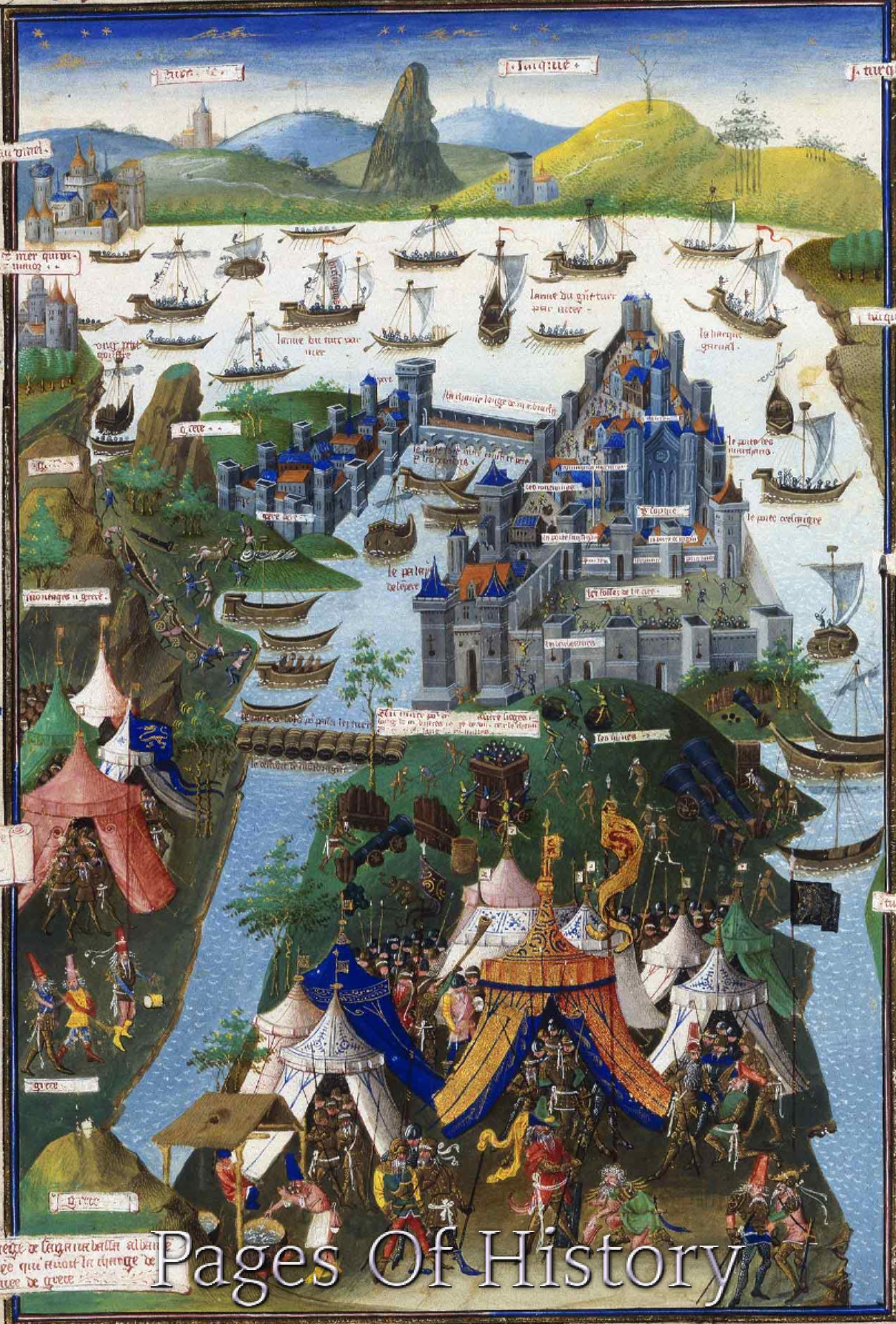
The siege began on 6 April 1453. For 53 days, Mehmed’s forces bombarded the Theodosian Walls with cannon fire — a revolutionary use of gunpowder artillery that changed military history. The walls, designed to resist siege engines and catapults, crumbled under the impact of stone balls weighing up to 600 kilograms. The Byzantines repaired the breaches at night with rubble and earth, but the damage was relentless.
Mehmed also used psychological warfare. He offered the defenders surrender terms; they refused. He launched assaults from both land and sea, including a daring overland transport of ships across the Galata hill to bypass the chain blocking the Golden Horn. On 29 May 1453, the final assault came in waves: irregulars first, then Anatolian troops, then the janissaries. The defenders held for hours, but Giustiniani was wounded and withdrew, and the line collapsed. Emperor Constantine XI Palaiologos, refusing to flee, was last seen fighting in the breach. His body was never found.
By midday, the Ottomans controlled the city. Mehmed entered Constantinople and rode directly to Hagia Sophia, where he ordered it converted into a mosque. The last remnant of the Roman Empire — which had endured for nearly 1,500 years — was gone.
Myths and Truths About the Byzantine Empire Fall
Popular accounts often simplify or distort the story. Here are some common misconceptions, corrected:
- Myth: The fall was sudden and unexpected. Truth: The empire had been in terminal decline for centuries; 1453 was the final act, not the first.
- Myth: The Byzantines were weak and decadent. Truth: They fought with remarkable courage and ingenuity against overwhelming odds; the defenders’ stand is one of history’s great last stands.
- Myth: The West abandoned Byzantium entirely. Truth: Some Western volunteers and ships fought alongside the Byzantines, but political and religious divisions prevented meaningful relief.
- Myth: Gunpowder alone destroyed the walls. Truth: Artillery was decisive, but Ottoman numerical superiority, naval control, and Byzantine exhaustion were equally important.
- Myth: The fall ended Greek culture. Truth: Greek scholars fled to Italy, fueling the Renaissance; Byzantine artistic and religious traditions survived in Russia and the Orthodox world.
Why 1453 Mattered: Consequences and Legacy
The fall of Constantinople sent shockwaves through Europe. For the Ottomans, it confirmed their status as a world power and gave them a magnificent capital — renamed Istanbul — that would serve as the seat of their empire for nearly five centuries. For Christendom, it was a traumatic blow that intensified fears of Islamic expansion and spurred calls for a new crusade (which never came).
But the consequences were not only military and political. The exodus of Byzantine scholars to Italy — men like Gemistos Plethon and Manuel Chrysoloras — brought classical Greek texts to Western Europe, contributing directly to the Renaissance. The fall also changed trade routes: with the Ottomans controlling the eastern Mediterranean, Europeans sought new sea routes to Asia, indirectly encouraging the Age of Exploration.
For the Orthodox world, the fall of Constantinople was a spiritual catastrophe. The Patriarchate survived under Ottoman rule, but the emperor — the protector of Orthodoxy — was gone. Moscow, which had already begun to assert its independence, gradually claimed the mantle of the “Third Rome,” a claim that shaped Russian identity for centuries.
Conclusion: The Truth About 1453
The Byzantine Empire fall was not a single event but the culmination of centuries of decline. Manzikert in 1071, the Fourth Crusade in 1204, the civil wars of the fourteenth century, the loss of Anatolia, the stranglehold of Italian merchants, the failure of religious union — all of these factors eroded the empire’s strength long before Mehmed II’s cannons opened the breaches. The siege of 1453 was the final, dramatic chapter of a story that had been unfolding for nearly four hundred years.
What makes 1453 so compelling is not just the tragedy of a dying empire, but the courage of those who defended it and the profound consequences of its fall. It marked the end of the Roman Empire — a political entity that had lasted from Augustus to Constantine XI — and the beginning of a new era in which the Ottomans dominated the eastern Mediterranean and Western Europe looked increasingly to the Atlantic. Understanding why Byzantium fell requires us to look beyond the walls of Constantinople, to the deeper forces of economics, geography, religion, and human ambition that shaped the fate of empires. The truth is more complex — and more fascinating — than any single date or battle.