
📅 Last updated: 04.11.2026
The story of the Roanoke Colony is one of the most enduring mysteries in American history: 115 English settlers, including a newborn named Virginia Dare, vanished from a small island off the coast of present-day North Carolina sometime between 1587 and 1590, leaving behind only a carved word—”CROATOAN”—and a handful of buried clues. It was England’s first serious attempt to plant a permanent settlement in the New World, and its failure shaped the course of English colonization for a generation.
The Roanoke Colony was a late-16th-century English settlement established on Roanoke Island (modern North Carolina) by Sir Walter Raleigh’s enterprise. Its 1587 group of about 115 colonists disappeared by 1590, when governor John White returned from England to find the site dismantled and the word “CROATOAN” carved on a post. No definitive proof of their fate has ever been found, but the leading theories involve assimilation with local Algonquian peoples, especially the Croatoan of Hatteras Island, or a desperate overland migration.
- Why Did England Attempt a Colony at Roanoke?
- The 1587 Expedition: A Different Kind of Colony
- What Did John White Find on Roanoke Island?
- What Are the Leading Theories About the Lost Roanoke Colony?
- Key Facts About the Roanoke Colony at a Glance
- Why Did the Roanoke Colony Fail?
- What Did the Roanoke Colony Mean for English Colonization?
- What Does Modern Archaeology Say About the Roanoke Colony?
- What Really Happened to the Lost Roanoke Colony?
- The Lasting Legacy of the Roanoke Colony
Why Did England Attempt a Colony at Roanoke?
The Roanoke venture grew out of a specific geopolitical moment. In the 1580s, Spain dominated the Atlantic. Its treasure fleets carried silver from Potosí and Mexico across the ocean, and its navy was the most feared in Europe. England, under Queen Elizabeth I, was a Protestant power locked in a cold—and increasingly hot—war with Catholic Spain. Sir Francis Drake’s raids on Spanish ports and ships had already inflamed tensions. A permanent English base in North America offered strategic advantages: a haven for privateers raiding Spanish shipping, a launch point for attacks on the Spanish Caribbean, and a claim to the continent before Spain or France could consolidate theirs.
Sir Walter Raleigh, a courtier and favorite of the Queen, received a royal patent in 1584 granting him the right to explore and settle lands in North America. He never set foot in the colony himself, but he financed and organized the expeditions. His first reconnaissance voyage that same year, led by captains Philip Amadas and Arthur Barlowe, reached the Outer Banks and returned with glowing reports of fertile land, friendly natives, and abundant resources. The region was named “Virginia” in honor of the Virgin Queen.
The first actual settlement attempt came in 1585, when Raleigh dispatched roughly 100 men under Ralph Lane to Roanoke Island. That colony was essentially a military garrison. Lane’s men explored the region, searched for gold and a passage to the Pacific, and alienated their native neighbors—particularly the Secotan and their leader Wingina—through violence and food requisitioning. When Drake arrived in June 1586, the colonists, starving and demoralized, accepted his offer of passage home. The Lane colony had lasted less than a year.
The 1587 Expedition: A Different Kind of Colony
The second attempt, the one that became the famous Roanoke Colony, was conceived on different terms. Raleigh intended a civilian settlement with families, not a garrison. John White, an artist who had accompanied the 1585 expedition and produced invaluable watercolors of Algonquian life, was appointed governor. The fleet of three ships sailed in April 1587 with about 150 people, including 17 women and 9 children. Among them were White’s daughter Eleanor and her husband Ananias Dare.
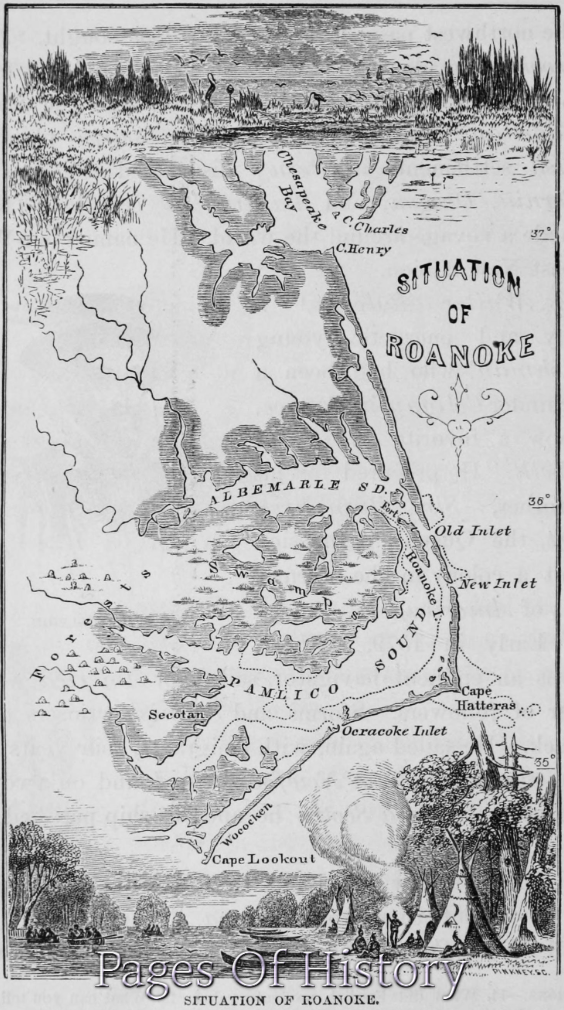
The plan called for the colonists to settle in the Chesapeake Bay area, north of Roanoke, where the land and harbors were considered superior. But the fleet’s commander, Simon Fernandes, refused to carry them further. Historians have debated his motives—perhaps he wanted to finish the voyage quickly to pursue privateering, perhaps he was acting on orders. Whatever the reason, the colonists were deposited on Roanoke Island in July 1587, on the site of the abandoned Lane settlement.
They arrived to find a landscape transformed by hostility. The Englishmen of 1585 had killed Wingina, and the surrounding peoples had not forgotten. The colonists made contact with the Croatoan, a smaller group living on the island now called Hatteras, who had been friendly to the English. But the mainland tribes were openly hostile. On August 18, 1587, Eleanor Dare gave birth to Virginia Dare, the first English child born in North America. A few days later, on August 22, the colonists baptized the newborn and Manteo, a Croatoan who had traveled to England with the 1584 expedition and returned as an ally.
The Governor’s Reluctant Departure
With winter approaching and supplies dwindling, the colonists pressed John White to sail back to England for provisions. White resisted—he understood the danger of leaving—but the colonists’ need was urgent. He departed in late August 1587, leaving behind 115 people, including his daughter and granddaughter. He intended to return within months.
He could not. England was on the brink of the Spanish Armada crisis. Every available ship was requisitioned for national defense, and White’s small vessel was pressed into service. The Armada was defeated in the summer of 1588, but the war continued, and White struggled for nearly three years to secure passage. He finally sailed in 1590, arriving at Roanoke in August—three years after his departure.
What Did John White Find on Roanoke Island?
White’s return is documented in his own account and in the narrative published by Richard Hakluyt. On August 18, 1590—his granddaughter’s third birthday—White and his landing party reached the island. They found the settlement site abandoned. The houses had been dismantled, not destroyed. The colonists had taken the time to disassemble their buildings and carry away the materials, a sign of orderly departure rather than sudden attack.
On a large tree or post, the letters “CRO” had been carved. On a nearby post, the full word “CROATOAN” appeared. White had agreed with the colonists before he left that if they moved, they would carve the name of their destination, and if they were in distress, they would carve a cross above it. There was no cross.
The landing party also found a few buried items—chests and other objects that had been hidden, later described as “things belonging to the colony.” White’s men searched nearby islands but found no trace of the settlers. A storm forced them to abandon the search and sail for England. White would never learn what became of his family.
What Are the Leading Theories About the Lost Roanoke Colony?
The disappearance of the Roanoke Colony has generated speculation for four centuries, from the plausible to the fantastical. Historians and archaeologists generally focus on a few evidence-based possibilities.
Assimilation with the Croatoan
The most widely accepted theory is that the colonists moved south to Croatoan Island (modern Hatteras) and integrated with the Croatoan people. The carved word points directly there, and White’s agreement with the colonists suggests they would have followed through. The Croatoan had been English allies, and Manteo, who had lived in England, was among them. Assimilation would explain the absence of bodies, the dismantled houses, and the lack of a distress signal. It would also explain later reports from English explorers who heard of Europeans living among native peoples in the region.
The “Lost Colony” as Migrants to the Mainland
Some scholars argue the colonists may have divided, with a group moving north toward the Chesapeake Bay, their original destination, or west to the mainland. The archaeologist Ivor Noël Hume and others have pointed to evidence of European artifacts in native sites along the Albemarle Sound. The “Site X” excavations led by archaeologist David Phelps in the 1990s uncovered a small number of European objects—copper, a ring, a sword hilt—at a native settlement on Hatteras that could date to the late 16th century, though the evidence remains inconclusive.
Attacks and Enslavement
Hostile mainland tribes, particularly those aggrieved by the Lane colony’s violence, could have attacked the settlers. But the dismantled houses argue against a sudden massacre. Some historians have suggested the colonists were captured and enslaved by Spanish or native forces, or that they were absorbed into other tribes after conflict. Spanish records from the period mention no captured English colonists, though Spain was actively searching for the English settlement.
Later Claims and the “Croatoan” Survivors
In 1701, the explorer John Lawson visited the region and reported meeting Hatteras Indians who claimed their ancestors had been white people. In 1709, he wrote that the Hatteras people “tell us that several of their ancestors were white people and could talk in a book, as we do; the truth of which is confirmed by gray eyes being found frequently amongst these Indians, and no others.” These accounts are late and unverifiable, but they are consistent with assimilation. A 2018 study of the Hatteras community’s oral traditions and genealogy, though not conclusive, kept the possibility alive.
Key Facts About the Roanoke Colony at a Glance
| Event | Date | Significance |
|---|---|---|
| Raleigh’s patent and first reconnaissance | 1584 | Amadas and Barlowe explore the Outer Banks; region named “Virginia” |
| Lane colony established | 1585 | Military garrison of about 100 men; abandoned June 1586 |
| Second expedition sails | April 1587 | About 150 colonists, including families; John White appointed governor |
| Colonists land at Roanoke | July 1587 | Fernandes refuses to carry them to Chesapeake; settle on Roanoke |
| Virginia Dare born | August 18, 1587 | First English child born in North America |
| White departs for England | Late August 1587 | Leaves 115 colonists; delayed by Spanish Armada |
| White returns to Roanoke | August 1590 | Finds settlement dismantled; “CROATOAN” carved; no survivors found |
Why Did the Roanoke Colony Fail?
The failure of the Roanoke Colony was not a single event but a cascade of decisions, delays, and circumstances. Several factors stand out:
- Strategic and logistical overreach: Raleigh’s enterprise was underfunded relative to its ambitions. Supply chains across the Atlantic were fragile, and the Spanish war consumed ships and resources England needed for colonization.
- Deteriorating native relations: The Lane colony’s violence, especially the killing of Wingina, poisoned relations with mainland tribes and left the 1587 settlers in a hostile environment.
- The Chesapeake diversion: Fernandes’s refusal to carry the colonists to their intended destination placed them in a less favorable location with fewer resources.
- The Spanish Armada: The 1588 crisis delayed White’s return by nearly three years, a gap the colony could not survive without resupply.
- Leadership vacuum: White’s departure left the colonists without their appointed governor at a critical moment, though they may have elected a replacement.
What Did the Roanoke Colony Mean for English Colonization?
The Roanoke failure did not end English ambitions in North America; it redirected them. Raleigh, financially exhausted, eventually assigned his rights to the Virginia Company, and in 1607 a new settlement was founded at Jamestown, about 100 miles north. The Jamestown colonists had learned from Roanoke’s mistakes—or at least tried to. They chose a site with better access to shipping, maintained (for a time) more disciplined relations with native peoples, and received more consistent resupply. John Smith’s famous 1608 map of Virginia even marked the location of the lost colony, and the Jamestown settlers were instructed to search for survivors. They found none.
The Roanoke story also shaped English perceptions of North America. It became a cautionary tale about the dangers of the wilderness, the fragility of supply lines, and the consequences of alienating native peoples. It fed a growing literature of colonial adventure and disaster, and it gave England its first martyrs of settlement—most famously Virginia Dare, whose name became a symbol of English presence in the New World.
The mystery itself became a cultural inheritance. Generations of writers, from 19th-century historians to 21st-century novelists, have returned to the carved word “CROATOAN” as a symbol of the unknown. The Roanoke Colony remains a case study in how historical evidence—a few documents, a handful of artifacts, a single word—can sustain centuries of interpretation.
What Does Modern Archaeology Say About the Roanoke Colony?
Modern research has moved beyond speculation toward systematic investigation. The First Colony Foundation, founded in 2004, has conducted excavations on Roanoke Island and in the surrounding region. Work at the site of the 1585 Lane colony and the 1587 settlement has uncovered evidence of English occupation—pottery, tools, and structural remains—but nothing that resolves the fate of the colonists.
More promising is the “Site X” location on Hatteras Island, where Phelps’s excavations found European artifacts in a native context. The First Colony Foundation has also explored sites along the Albemarle Sound, including a location called “Site Y,” where a small number of European objects have been recovered. The foundation’s archaeologists have argued that the colonists may have split into groups, with some moving to Hatteras and others to the mainland. The evidence is suggestive but not conclusive; no single discovery has yet provided definitive proof.
In 2012, the foundation announced the discovery of a patch on a map of the region, drawn by John White, that appeared to conceal a fort symbol. The “Virginea Pars” map, held by the British Museum, was examined with modern imaging techniques, and the patch was found to cover a drawing of a fort. Some scholars interpreted this as evidence that White knew of a planned settlement location, possibly inland. The finding remains debated.
What Really Happened to the Lost Roanoke Colony?
The honest answer is that no one knows with certainty. But the balance of evidence points toward a scenario of dispersal and assimilation rather than massacre or mysterious disappearance. The colonists, left without resupply for three years in a hostile region, likely made a pragmatic decision: they dismantled their settlement, moved to a safer location, and sought shelter with the Croatoan, their only reliable allies. Some may have later moved to the mainland or been absorbed into other groups. The carved word “CROATOAN” was not a cry for help but a signpost—an attempt to tell White where they had gone.
Why, then, did White not find them? He arrived in 1590 with a small party, was hampered by storms, and had limited time and resources. The Croatoan may have moved, or the colonists may have dispersed further. The English never mounted a sustained search. By the time Jamestown was founded in 1607, the trail was cold.
The Roanoke Colony’s fate remains one of history’s great unresolved questions, but it is not a story of supernatural vanishing. It is a story of human beings making difficult choices under extreme pressure, and of the limits of historical evidence. The carved word on the post is not a mystery in itself—it is a message. The mystery is what happened after the message was left.
The Lasting Legacy of the Roanoke Colony
The Roanoke Colony occupies a unique place in American memory. It was England’s first attempt at a permanent settlement in North America, and its failure taught hard lessons that shaped the success of Jamestown and, later, Plymouth. It produced the first English child born in the New World, Virginia Dare, whose name became a touchstone for later generations of Americans. And it left behind a word—”CROATOAN”—that has fascinated historians, archaeologists, and the public for more than four centuries.
The story also serves as a reminder of the human cost of colonization. The 115 colonists who disappeared were not abstractions; they were families, including children, who trusted their governor to return and were left to fend for themselves in an unfamiliar land. Their fate, whatever it was, was shaped by the geopolitical rivalries of Europe, the failures of supply, and the complex relations between English settlers and the native peoples whose land they had entered.
Modern archaeology continues to probe the evidence, and new discoveries may yet resolve the mystery. Until then, the Roanoke Colony remains a powerful example of how history is constructed—from documents, artifacts, and the stories people tell about the past. The carved word endures, and with it the question: what really happened to the lost colonists of Roanoke?