
📅 Last updated: 22.07.2026
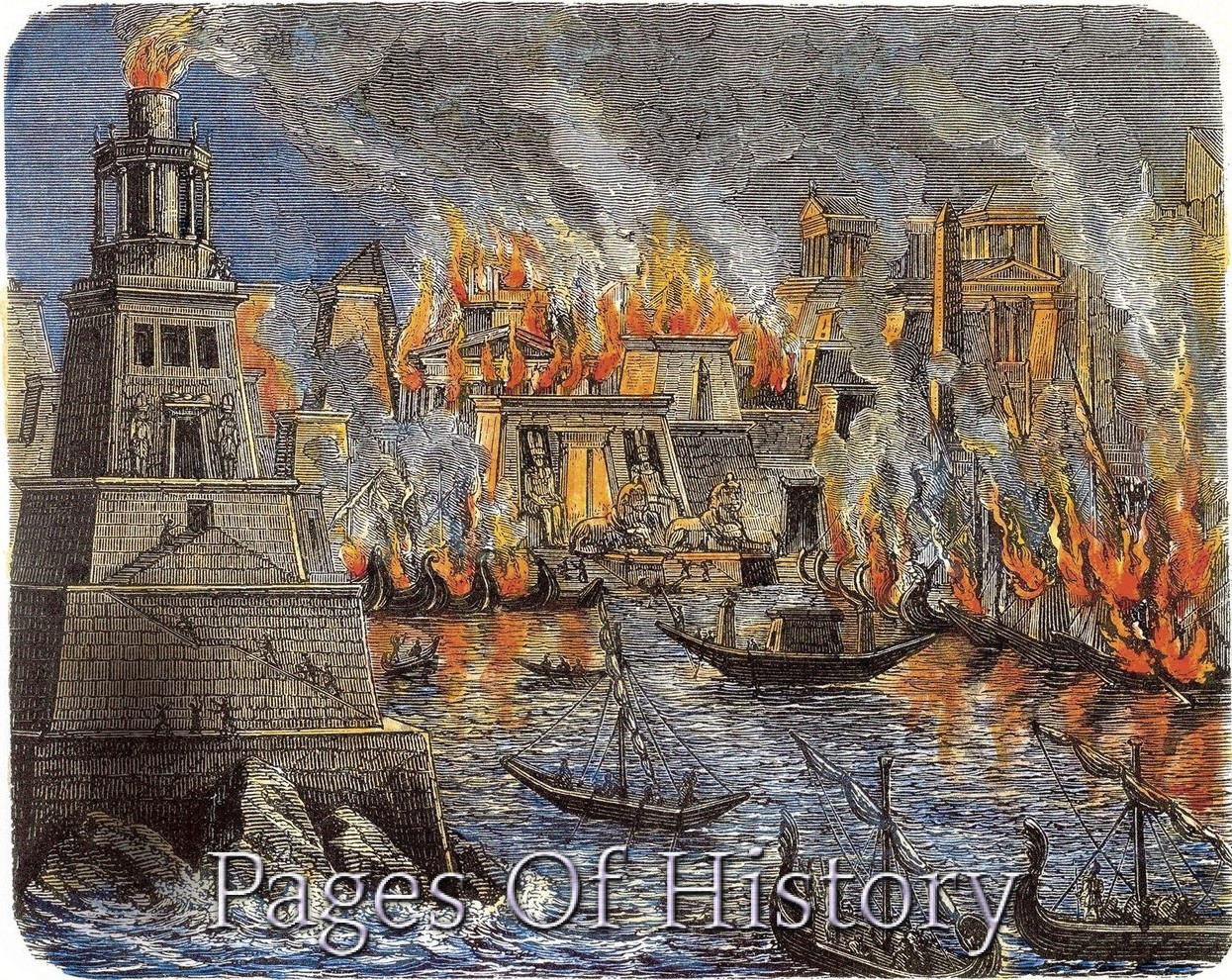
The popular image of the Library of Alexandria destroyed by a single, dramatic fire—often blamed on Julius Caesar or a marauding Arab general—is one of history’s most enduring and oversimplified myths. The real reason the Library of Alexandria was destroyed is not a single event but a slow, multi-century process of institutional decay, political neglect, religious strife, and civil conflict, rather than a singular act of barbarism. To understand its true fate, one must look beyond the flames of 48 BCE and examine the complex interplay of Ptolemaic ambition, Roman exploitation, and the gradual disappearance of the patronage that made the Library a beacon of ancient knowledge.
The Birth of a Knowledge Empire: The Ptolemaic Vision
The Library of Alexandria was not born from a vacuum. It was the deliberate creation of the Ptolemaic dynasty, the Greek rulers of Egypt who succeeded Alexander the Great. After Alexander’s death in 323 BCE, his general Ptolemy I Soter seized Egypt and established a capital at Alexandria, a city designed as a cultural and commercial crossroads. The Ptolemies, particularly Ptolemy II Philadelphus (reigned 283–246 BCE), understood that intellectual prestige was a form of political power. They aimed to make Alexandria the undisputed center of the Hellenistic world, rivaling Athens itself.
- The Birth of a Knowledge Empire: The Ptolemaic Vision
- The First Major Blow: Julius Caesar and the Fire of 48 BCE
- The Roman Era: Neglect and Depletion
- The Crisis of the 3rd Century: Civil War and the Palmyrene Sack
- The Christian Era: Religious Conflict and the Serapeum
- The Arab Conquest Myth: A Misattributed Culprit
- Key Events in the Library’s Decline: A Timeline
- What Was Actually Lost?
- The Legacy: A Symbol of Lost Potential
- Conclusion: The Lesson of the Library
To achieve this, they built the Mouseion (the “shrine of the Muses”), a research institute that functioned as a combination of a university, a think tank, and a royal court for scholars. Attached to the Mouseion was the Great Library, a facility designed to house a comprehensive collection of all known Greek literature and scientific works. The Ptolemies employed aggressive—even ruthless—acquisition policies. They confiscated books from ships docking in Alexandria’s harbor, returning only copies to their owners. They demanded scrolls from other kingdoms, often offering enormous sums or refusing to return originals. A famous anecdote tells of Ptolemy III Euergetes borrowing the official Athenian copies of the plays of Aeschylus, Sophocles, and Euripides, depositing a fortune in silver as security—only to forfeit the silver and keep the originals.
“The Ptolemies were not just collectors; they were curators of a universal library. Their goal was to possess, catalog, and critique every text in the known world.” — Dr. Amanda H. Podany, historian of the ancient Near East.
By the mid-2nd century BCE, the Library held an estimated 400,000 to 700,000 scrolls—the largest single repository of human knowledge in antiquity. It attracted the greatest minds of the age: the mathematician Euclid, the astronomer Aristarchus of Samos (who proposed a heliocentric solar system), the poet Callimachus, and the geographer Eratosthenes, who calculated the Earth’s circumference with astonishing accuracy. The Library was not merely a storage facility; it was a living engine of scholarship.
The Structure of the Library
The Library was actually two facilities: the larger “Great Library” within the Mouseion complex in the royal district of Brucheion, and a smaller “daughter library” attached to the Serapeum, a temple dedicated to the god Serapis in the Egyptian quarter of Rhakotis. This dual structure would become significant during the later periods of destruction. The scrolls were organized by subject, with a dedicated staff of librarians, copyists, and editors. The most famous of these librarians was Eratosthenes, who served as head of the Library around 240 BCE.
The First Major Blow: Julius Caesar and the Fire of 48 BCE
The most famous—and most misunderstood—chapter in the story of the Library of Alexandria destroyed begins with a Roman civil war. In 48 BCE, the Roman general Julius Caesar arrived in Alexandria pursuing his rival Pompey the Great. Pompey had already been murdered by the Egyptians, but Caesar decided to intervene in a separate dynastic struggle between Cleopatra VII and her brother Ptolemy XIII. Caesar, with a small force, found himself besieged in the royal palace complex near the harbor.
To escape the trap, Caesar ordered his ships set on fire, hoping to scatter the Egyptian fleet. The flames, however, spread from the ships to the docks and then to the warehouses and buildings along the waterfront. A portion of the Great Library’s scrolls, stored in dockside warehouses awaiting cataloging, was consumed in the blaze. The ancient historian Plutarch, writing in the 1st century CE, describes this incident but notes that the fire was accidental and limited in scope.
“Caesar was forced to set fire to the ships, and the flames, spreading from the docks, destroyed the great library.” — Plutarch, Life of Caesar (c. 110 CE).
This was not the end. The main collection within the Mouseion itself appears to have survived largely intact. However, the fire of 48 BCE marked a turning point. It demonstrated the vulnerability of the Library to political violence and, more importantly, signaled the decline of Ptolemaic power. The Romans, not the Ptolemies, were now the arbiters of Egypt’s fate. After Caesar’s assassination in 44 BCE, Cleopatra VII attempted to revive the Library, famously receiving 200,000 scrolls from the library of Pergamon as a gift from Mark Antony. But this was a last gasp.
The Roman Era: Neglect and Depletion
After Cleopatra’s death in 30 BCE, Egypt became a Roman province. The Roman emperors, while often patrons of culture, did not prioritize the Library of Alexandria in the same way the Ptolemies had. The Library’s funding, which had come from the royal treasury, was gradually reduced. The Mouseion continued to operate, but its scholars were increasingly marginalized, their work less valued by a Roman administration focused on grain shipments and tax collection.
The Library suffered not from a single catastrophic fire, but from a slow death by a thousand cuts. Scrolls were lost to humidity, insects, and simple neglect. The Roman preference for Latin over Greek further diminished the Library’s relevance, as the vast majority of its holdings were in Greek. By the 2nd century CE, the Library had lost its preeminent status. The Roman emperor Hadrian (r. 117–138 CE) built his own library in Athens, and the Library of Alexandria was no longer the intellectual center of the Mediterranean.
Evidence of Decline
- Lack of major acquisitions: No new significant collections were added after the 1st century CE.
- Scholarly diaspora: Prominent scholars like Claudius Ptolemy (the astronomer) and Galen (the physician) worked in Alexandria in the 2nd century CE, but they often sent their works to Rome for publication.
- Physical decay: By the 3rd century CE, contemporary references to the Library become rare, suggesting it was no longer a functioning institution.
The Crisis of the 3rd Century: Civil War and the Palmyrene Sack
The Roman Empire’s Crisis of the Third Century (235–284 CE) was devastating for Alexandria. The city was repeatedly caught in the crossfire of imperial rivalries. In 269–270 CE, Queen Zenobia of Palmyra invaded Egypt and seized Alexandria. Her forces, though ultimately defeated by the Roman emperor Aurelian, caused widespread destruction. The historian Ammianus Marcellinus records that the Brucheion quarter—the very district that housed the Great Library—was heavily damaged or destroyed during Aurelian’s reconquest of the city in 272 CE.
This was a critical moment. The Great Library, already diminished, very likely ceased to exist as a physical institution at this time. The surviving daughter library at the Serapeum, located in the more stable Egyptian quarter, became the primary repository of what remained of the collection. But the scale of loss was immense. By the end of the 3rd century, Alexandria’s intellectual glory was a memory.
The Christian Era: Religious Conflict and the Serapeum
The rise of Christianity in the 4th century CE brought a new and deadly threat to the remaining scrolls. The Roman Empire, under Emperor Theodosius I, officially adopted Nicene Christianity in 380 CE. Pagan temples and institutions were targeted for closure or destruction. Alexandria, a city with a long history of violent religious conflict between pagans, Christians, and Jews, became a flashpoint.
In 391 CE, the Roman emperor issued a decree banning pagan worship. The Patriarch of Alexandria, Theophilus, saw this as an opportunity to destroy the Serapeum, the last major pagan temple in the city and the home of the daughter library. A Christian mob, encouraged by Theophilus, stormed the temple, demolished its statues, and looted or burned its contents. It is almost certain that the scrolls stored in the Serapeum were destroyed in this attack. The historian Socrates Scholasticus, writing in the 5th century, describes the destruction but does not specifically mention the library—suggesting that the loss of books was a secondary concern to the destruction of the pagan shrine itself.
“Theodosius… ordered the destruction of the temples of the pagans in Alexandria. The Serapeum was razed to the ground, and the books that were found there were either burned or dispersed.” — Socrates Scholasticus, Ecclesiastical History (c. 439 CE).
This event, while devastating, was the destruction of the surviving remnant of the Library, not the original Great Library. The Great Library had been gone for over a century by this point. The Serapeum’s collection was likely a fraction of the original—perhaps tens of thousands of scrolls, not the hundreds of thousands of the Ptolemaic era.
The Arab Conquest Myth: A Misattributed Culprit
The most persistent myth concerning the Library of Alexandria destroyed is the story of the Arab conquest in 642 CE. According to this tale, the Arab general Amr ibn al-As, upon conquering Alexandria, asked Caliph Umar what to do with the Library’s books. The Caliph supposedly replied: “If these books agree with the Quran, they are superfluous; if they disagree, they are harmful. Therefore, burn them.” The story claims that the books were used as fuel for the city’s bathhouses for six months.
This story is almost certainly a fabrication. It first appears in the writings of the 13th-century Christian historian Bar Hebraeus, over 600 years after the supposed event. No contemporary Arab, Greek, or Coptic source from the 7th century mentions the destruction of the Library. Arab historians like al-Mas‘udi (10th century) and Ibn al-Nadim (10th century) describe Alexandria as a city of learning but make no reference to a great library being burned. Furthermore, by 642 CE, there was effectively no Library left to destroy. The Great Library had been gone since the 3rd century, and the Serapeum’s collection had been destroyed in 391 CE.
Why the Myth Persists
- Propaganda: The story was used by later Christian polemicists to portray Muslims as barbaric destroyers of knowledge.
- Romanticism: The idea of a single, dramatic event fits a compelling narrative of loss.
- Simplification: It is easier to blame a specific act than to understand centuries of gradual decline.
The truth is less sensational but more historically accurate: the Library was already dead by the time the Arabs arrived. The Arab conquest, while transformative for Alexandria, did not destroy the Library.
Key Events in the Library’s Decline: A Timeline
| Date | Event | Impact on the Library |
|---|---|---|
| c. 283 BCE | Ptolemy II Philadelphus establishes the Great Library. | Foundation of the institution. |
| 48 BCE | Julius Caesar’s fire in Alexandria. | Partial loss of scrolls in warehouses; political destabilization. |
| 30 BCE | Roman conquest of Egypt. | End of Ptolemaic patronage; gradual neglect begins. |
| 272 CE | Aurelian’s destruction of the Brucheion quarter. | Likely destruction of the Great Library. |
| 391 CE | Destruction of the Serapeum by Christian mob. | Destruction of the daughter library. |
| 642 CE | Arab conquest of Alexandria. | No evidence of Library destruction. |
What Was Actually Lost?
The true tragedy of the Library of Alexandria destroyed is not just the loss of the physical scrolls, but the loss of the knowledge they contained. We know of many works that were likely held in the Library and are now lost. These include:
- The complete works of the Greek tragedians: Only 7 of Sophocles’ 120 plays survive; only 7 of Aeschylus’ 70; only 18 of Euripides’ 92.
- Lost histories: The works of Manetho, an Egyptian priest who wrote a history of Egypt in Greek; the lost books of Livy’s History of Rome; the writings of the historian Theopompus.
- Scientific treatises: The lost works of Aristarchus on heliocentrism; the anatomical writings of Herophilus and Erasistratus; the engineering manuals of Philo of Byzantium.
- Philosophical texts: The lost dialogues of Aristotle; the works of the Stoic philosopher Chrysippus, who wrote over 700 scrolls.
It is important to note that many of these works were not only in the Library. They were copied and circulated throughout the Mediterranean. The Library’s destruction did not cause a complete loss of ancient knowledge; rather, it removed the central repository, making the transmission of texts more fragile and dependent on scattered copies. The loss was cumulative: as other libraries in Rome, Constantinople, and elsewhere were later destroyed, the chain of transmission broke entirely for many works.
The Legacy: A Symbol of Lost Potential
The Library of Alexandria has become a powerful symbol—perhaps the most powerful symbol—of the fragility of human knowledge. Its destruction, whether real or imagined, serves as a cautionary tale about the vulnerability of culture to political upheaval, religious intolerance, and simple neglect. The real reason the Library of Alexandria was destroyed is a complex story of systemic failure, not a single villainous act. It was destroyed by the decline of the Ptolemaic state that created it, by the indifference of Roman rulers who had no stake in Greek scholarship, by the violence of civil war, by the zeal of Christian iconoclasts, and by the slow erosion of time itself.
Modern attempts to revive the Library, such as the Bibliotheca Alexandrina, which opened in 2002 near the original site, are a testament to the enduring ideal of a universal library. But they also underscore what was lost: not just books, but a system of knowledge—a place where scholars could live, debate, and collaborate, funded by a state that saw intellectual achievement as a measure of its own greatness. That system has never been fully replicated.
Conclusion: The Lesson of the Library
The story of the Library of Alexandria destroyed is not a simple morality tale. It is a complex historical process that unfolded over centuries, driven by political change, religious conflict, and institutional decay. The Library’s destruction was not a single act of barbarism but a slow, tragic erosion of the conditions that allowed knowledge to flourish. Its true legacy is not the fire that consumed it, but the lesson that knowledge requires constant protection, funding, and political will to survive. The Library did not fall to a single enemy; it was starved, neglected, and eventually dismantled by the very forces that had once made it great. In this, its fate is a mirror for all institutions that depend on the patronage of power—and a warning that even the brightest flame can be extinguished by indifference.